Electric Articles
As I followed Steve Wartman and his crew through the process of building a deck, many of you sharp-eyed readers noticed that the overhead power lines were very close to the new deck. When I asked Steve about it, he said the power lines were to be buried at a later date. Well that time arrived last week, and here’s how they did it. Burying power lines is not a very complicated task. However, it can be quite laborious without the right machinery, and a big part of today’s Pro-Follow involves the Ditch Witch. A Ditch Witch is...
We’re back with another Pro-Follow update. Steve Wartman and his crew are working through a basement remodel, and today’s article focuses on the electrical rough-in. If you’re just joining us, here’s what you missed: Day 1: Framing the walls Day 2: Vapor Barrier and Ductwork In contrast to the electric rough-in for the other Pro-Follow basement, this job was relatively small and uncomplicated. The electrician only needed three additional circuits, and the breaker panel had several unused slots. There was no need...
Welcome back to our Basement Remodel Pro-Follow. I’ve been shadowing expert general contractor Joe Bianco and his crew as they finish an unfinished basement. This is the third installment in our series. Day 1 covered framing out the basement into four distinct rooms. Day 2 covered the plumbing rough-in, which included re-positioning an underground drain for the bathroom shower. Today I’m covering the electric rough-in, following a subcontracted master electrician through a two-day process. We’ll be reviewing installation...
The National Electric Code (NEC) is published by the National Fire Protection Association (NFPA). The NFPA recovers part of its code development costs by selling code books. However, they do make available a limited-use online copy of the 2011 NEC. Unfortunately, the NFPA intentionally makes this free online version difficult to find and use. (If the free online version were easy to use, no one would buy the books!) I tell you how to access the free version below. New! If you are a Google Plus User and find this how-to helpful, we would...
Editor’s note: This article originally ran in 2008. We’ve come a long way in terms of quality pictures since then, but the information is still useful for tackling this project. —– Ever since we moved to this house, Kim and I have been longing for a master bedroom ceiling fan. In our first home, we had a Hampton Bay fan hanging over the foot of our bed. We grew accustomed to having the white noise & gentle air circulation usher us to sleep each night. Since our new home didn’t come with this feature,...
A friend caught me the other day and asked if I knew anything about smoke detectors. He was curious why his smoke alarm was going off for no apparent reason and what he should do about it. I didn’t have an answer for him, and it actually reminded me that one of my smoke detectors may be on the fritz too. A while back, one of our smoke detectors started beeping every so often. No big deal right? Just change the battery backup, and you’re good to go. Wrong. I still don’t know what the problem was but I’ve been doing...
Every now and then one of our electric-related articles will surface an old debate: what’s really dangerous: voltage or amperage? The most recent post that raised the issue was last week’s Frigidaire wall oven heating issue where I warned readers to turn off the breaker because “220 volts can be lethal.” One of our commenters, Katharine, chimed in saying, “Voltage isn’t lethal, amperage (current) is.” So what really is the dangerous component, voltage or amperage? The answer is both. It’s...
While traditional oven/stove combinations plug in to either a 3- or 4-prong 240-volt socket, wall ovens and cooktops must be direct wired using appropriate junction boxes, usually installed in the cabinet above or below the wall oven, and/or in the cabinet beneath the cooktop. One common question is whether a separate cooktop and wall oven can be installed on the same circuit. The answer, according to the 2008 National Electric Code, is YES, provided certain conditions are met in the installation. In general, the rule in section 220.55...
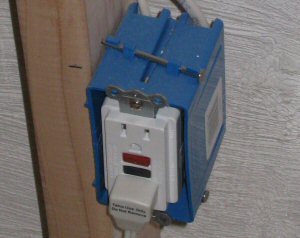
Over the last two weeks we’ve told you how polarized outlets and grounded electrical circuits increase the safety of the electrical systems in our homes. This week we’re going to focus on a third electrical safety enhancement we enjoy: the ground fault circuit interrupt, or GFCI. You’ll recall from both of the previous articles in our series that in the normal operation of electric devices, electricity flows from the hot side of the outlet, through the appliance, and back out the neutral (common) side. In this scenario,...
Last week we discussed why outlets and plugs are polarized (it’s a safety feature… if you missed that article, it’s worth a quick read). This week I want to take a minute to describe why modern day electric circuits and appliances are grounded. Most of the electric circuits in your house have three wires going to them, a black wire (normally hot, or energized), a white wire (normally neutral), and a bare copper wire (always ground). The larger left slot in an outlet is connected to the neutral wire; the smaller right...