

Cut Door Trim and Stops for Hardwood Flooring Installation in Doors
July 1, 2010 | by Fred (email) |
In almost every hardwood flooring job, you’ll be required to lay hardwoods under at least one side of a door. In many cases, the flooring that is being replaced is not as tall as the hardwoods that are being installed, and the door trim and stops will need to be cut to accommodate the width of the hardwood floors.
This article is part of our series on Hardwood Flooring Installation. We’re installing 1100 square feet of Brazilian Walnut flooring across the first floor of our house. If you’d like to follow along, subscribe via RSS or e-mail using the buttons at the right.
Determining Where to Stop the Hardwoods
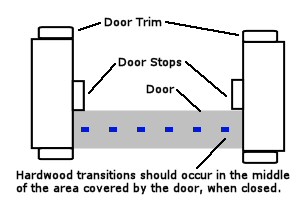 If hardwoods are going to be laid in a room that transitions to another surface in an adjacent room separated by a door, the hardwood should stop half way under the door when the door is closed . This prevents a room from appearing to have another surface “creeping” under the door.
The picture at the right shows the proper hardwood transition location. Â You should consider any transition molding or other component that may be required to the new surface. For example, if you’re transitioning to ceramic tile, you may have to leave space for a rubber joint, a tile edge, or a T-molding made out of hardwood (the latter is a less optimal choice because it creates a tripping hazard).
Whether you’re going through the door completely or only part way through, you will need to address the door stops and trim, and potentially the jambs that make up the sides of the door frame. The goal is to make the wood fall underneath all of these components so the trim looks like it rests on top of the floor. Â This may require very precise cuts of the hardwood, and will likely require you to trim up the molding, stops, and jambs to fit the wood in.
How to Cut Door Trim for Hardwoods
Tools  & materials required:
- Spare piece of hardwood
- Pencil
- Hand saw, jamb saw, or multi-tool such as the Rockwell Sonicrafter
- Elastomeric sealer (optional)
Step 1: Determine the height to cut the stop, molding, and jambs. Â This can be accomplished by setting a piece of hardwood on the subfloor next to each component and marking across the component with a pencil.
Step 2: Use a saw or multitool to cut the jambs, trim, and molding at the pencil marks. Â For this job we think the Sonicrafter is one of the best suited tools. It provides a very limited-vibration, accurate cut of the trim at the precise location required.
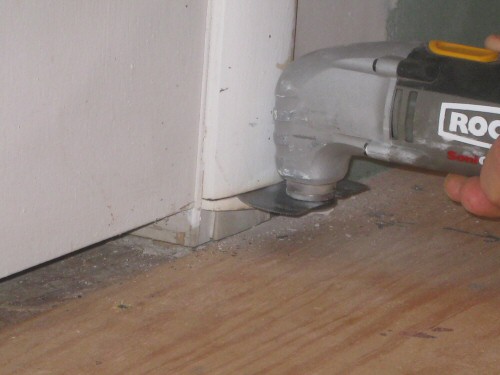
Extra Tip: Be careful not to cut the trim too high. Trim that floats above the floor just slightly will be imperceptible to you and visitors. Trim that is more than 1/16″ off the floor will have an obvious gap. While visitors may not notice it, you might! Â The goal is to have no gap between the wood and the trim.
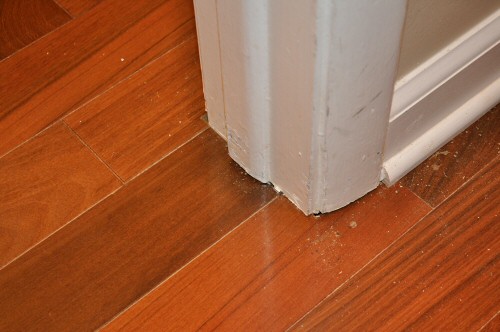
Step 3: Measure and cut the hardwoods so that they fall underneath the stop and molding, and either butt up next to the jamb or go underneath it. Â We prefer to cut the jambs completely so that the wood can fall underneath them. Â Again, it is important to ensure you don’t cut too high to avoid a non-professional finish. Â This will likely require both rip and mitre cuts to get correct, and depending on board length may be more easily addressed with a jig saw than the combination of a mitre and table saw. Â We’ll cover using a jig saw, mitre saw, and table saw in a separate article.
The door jambs and trim in this house are very old, beat up, and haven’t been painted for years… So this picture doesn’t look great. Â That said, you can see how the wood goes under the trim (and you can also see a slightly imperfect cut towards the back of the door that is visible and will need to be filled with a matching wood putty or caulk — a less desirable solution). Â We intend to replace all of the doors on this floor in the next 12 months.
Step 4: Carefully caulk or fill gaps, if desired. Â If you’ve cut the door jambs or stop slightly too high, you may be able to run a bead of elastomeric sealer between the wood and the jamb/stop/molding and obtain a very clean finish that hides the gaps without revealing the less-than-optimal carpentry. Â We’ll cover using caulk to hide other flaws in a future article.
Cutting Doors to Fit over Hardwoods
If you’ve raised the flooring level with you new hardwoods, you will likely need to cut the actual door. Â For wooden solid and hollow-core doors, this can be accomplished by either of the following methods:
- Use a table saw to rip-cut the bottom of the board. This will require two people and careful teamwork to slide the door through the table saw
- Use a circular saw to cut the door, clamping a piece of wood as a guide near the bottom of the door to keep the circular saw from swaying as you cut. (Clamping a guide board is better than simply marking and cutting, since circular saws are difficult to keep straight for finish work.
No matter which method you use, you’ll want a high-tooth-count furniture blade to make the cut. We used a new 10″ DeWALT 80-tooth blade on our table saw to make the cut, which produced a very clean, tight finish.
Also, instead of trying to measure the entire door, make sure to measure from the bottom hinge to the floor. You can then use the same reference point on the door. This is more accurate, as it removes any deviation that might be present between the top of the door and the top of the doorframe.
What do you think? What tips would you add for working around and through doorways?
P.S. Stop back this afternoon for the first “sneak peak” at a partially finished floor!
Properly laying the first three boards in a hardwood flooring installation is essential to a quality install. Â The first three boards set the tone and direction for the floor. They must be absolutely straight and laid without gaps or bends. Â Since wood is a dimensionally-imperfect material, this can be a challenge to get right, but the extra effort is worth the time investment. After all, no one wants to spend thousands of dollars on hardwood floors and have the installation lead to a sub-par surface.
We’re laying 1100 square feet of Brazilian Walnut hardwood floors across the first floor of our colonial home. This is the third in a series of more than a dozen articles that describe how to install wood flooring. Subscribe by using the buttons at the right (RSS or by e-mail) Â to keep up with the project.
Determining the Best Starting Point for Hardwoods
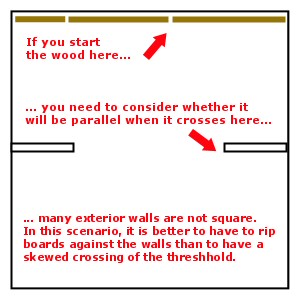 Every hardwood installation has to start somewhere. In a simple rectangular room, the starting point will be against one of the walls. In more complex rooms, you will want to pick a starting point that eases the installation.
As a first step, identify starting points that allow for the least number of complicated rejoining efforts. Â Rejoining efforts occur when the field of hardwoods is broken for some reason (such as to go around a stair case in the center of the room through two doors on both sides of it). Rejoins require you to work carefully in separate sections, ensuring the hardwoods remain tight and even, so that the rejoin on the other side of the object doesn’t require special cutting or routing steps.
It is also ideal to choose a location that requires the fewest groove-to-groove joins, as these will require a extra double-tongue splines. Â While not at all complicated to install, it is an extra step.
No matter where you decide to start the floors, you want to consider visual elements throughout the space that will be affected by the very first board you lay. Â For example, look at the picture in the upper right. Let’s say that in the middle of two rooms there is a doorway. You want the wood to cross the doorway accurately parallel to the horizontal walls. If you start at the end of one room on a wall that is not perfectly square, the wood may cross the doorway unevenly. Â It is better to have the uneven boards hug an exterior wall than to have the boards cross the doorway out-of-line.
In the installation we’re sharing with you, we’re dealing with six different rooms on the first floor (the floor layout is below). Â We decided to start the wood at the front of the house in the dining room and study because it provides a contiguous, full-length perspective on the house.
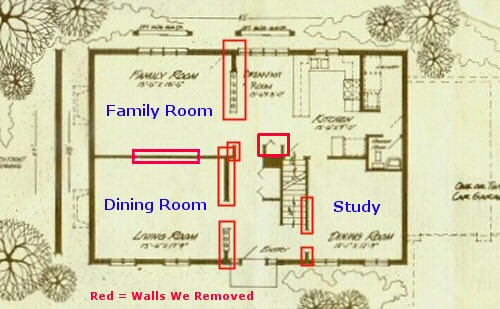
In this layout, we have three doorways to get through. It is more important in our installation that the wood cross each threshold parallel to the doorways. We decided to start at the front of the house, but measure our starting line based on the doorways. Â Indeed, the front exterior of our home is about 1/2″ out of square from side-to-side. Â It isn’t noticeable to the naked eye, but it would be noticeable if the hardwoods crossed the thresholds out-of-square.
Step 1: Before measuring a starting point, lay red rosin paper over the subfloor. Red rosin paper reduces squeaks between the subfloor and hardwoods and serves as a partial moisture barrier to prevent moisture wicking from the subfloor below to the hardwoods. Â (Note: some people prefer 15 lb. roofing felt for this step. Roofing felt isn’t necessary, and it is much messier than rosin paper).
You only need to lay one sheet at a time as you can lay more as you work through the floor, overlapping the paper by 3 inches each time. Â A simple manual staple gun is sufficient to hold the paper down. There’s no need to go nuts with the stapler either – a few staples here and there are sufficient.
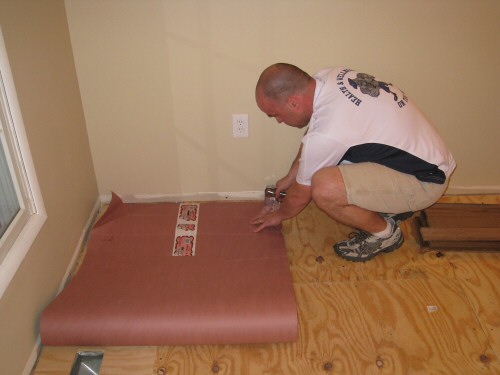
Step 2: Measure and mark the starting point for the first board. Â We took several measurements from the middle of the room (where the doors are into the neighboring room), back to the starting point. Â We found that our exterior wall was out of square with the interior wall, and so used the interior wall as a guide, even though our preferred starting location was against the exterior wall. Â The goal is to make the boards start about 1/2″ from the exterior wall on both the back side and edge. Â Since the wall was out of square, this varied as much as 1/2″ along the perimeter.
In every hardwood installation, you should leave 1/2″ expansion joints between the flooring surface and the exterior wall. These will be covered by molding and allow the floor to expand and contract with changes in humidity and moisture.
It is possible that a wall varies so much you may have to rip parts of boards to ensure full coverage on the floor while still leaving a 1/2″ gap. Â This is not difficult to do and is covered in another article in this series.
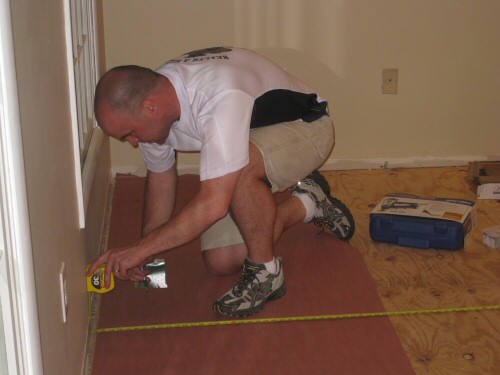
Step 3: Once you have several reference points for your starting line, snap a chalk line down your red rosin paper connecting the lines.
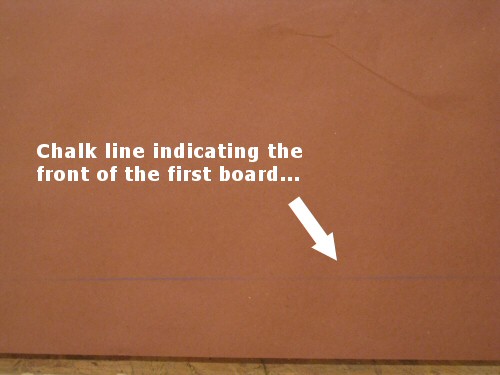
Step 4: Place the first board on the chalk line, ensuring perfect alignment with the line. I generally lay out the first 2-3 boards horizontally on the floor end to end and visually “check” to make sure everything appears to line up.
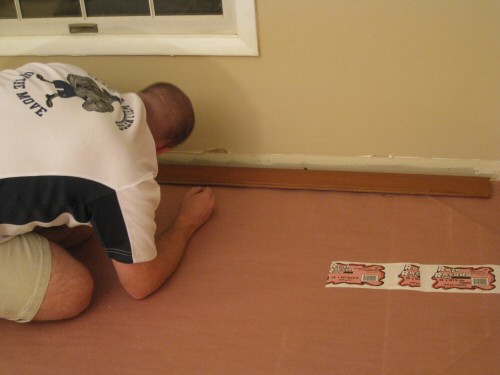
Step 5: Blind nail the first board into place, using shims or an assistant to ensure the board doesn’t move during blind nailing. Â Blind nailing means using a finish nailer to insert a nail above the tongue of the board down through the board into the subfloor at a 45 degree angle. This way the nail remains hidden by the next board installed. Â We used a Duo-Fast Floormaster 250BN for this task (review to come later in the series).
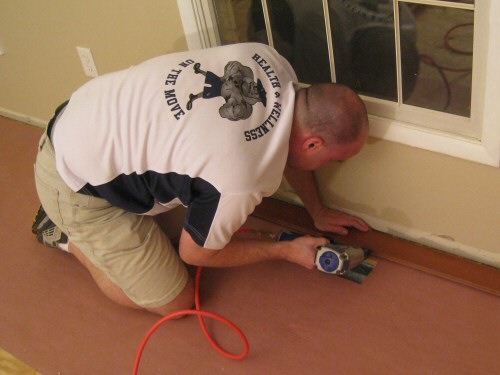
Some installers will top-nail the back edge of the first board since it will likely be covered by baseboard and shoe molding. Â This can prevent the board from slipping out of place as you add second and third boards. We don’t like to do this because it can split the board. Instead, for the first board, we blind nail about every 4 inches to ensure sufficient fasteners in the subfloor. Â We sometimes shim the first board away from the wall temporarily to avoid it moving when nailing subsequent boards.
Step 6: Work your way down the floor, ensuring boards stay square edge-to-edge and in line with the chalk line. Â If you’ve done it correctly, you should be able to drag a 4 foot or 8 foot level down the edge of the boards with no deviation in straightness.
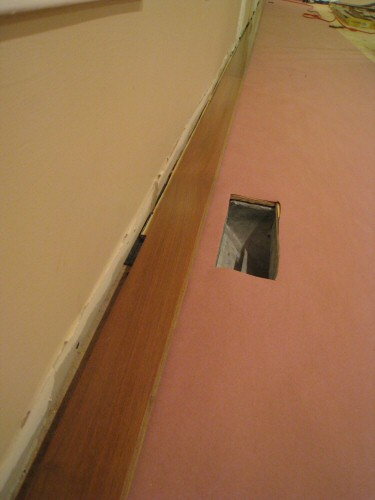
Step 7: Install the second hardwood flooring row across the house. Â It is imperative that during this step you ensure the first row does not move. We recommend temporarily shimming between the wall and the first board, ensuring sufficient fasteners in the first board, and regularly rechecking the measurements to ensure no movement.
Step 8: Install the third row of hardwood flooring. Â If you’re using 2.25″ traditional boards, you’ll likely still have to blind nail as a hardwood flooring nailer will not fit yet. Â If you are installing 3.25″ boards or larger, the third row can be installed with a flooring nailer/stapler. Â We used and recommend the DuoFast 15-gauge Hardwood Flooring Stapler for this job.
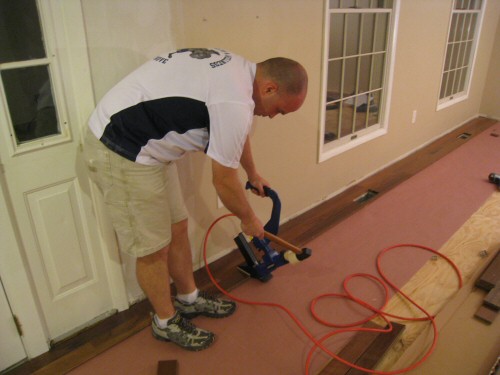
Once the third board is installed, you can remove the shims between the wall and the first board. It is unlikely that the floor will move at this point, even under the shock of a flooring stapler.
Summary of Tips for Installing the First Few Boards
- Consider room obstacles and layout to determine starting position.
- Lay red rosin paper before beginning installation.
- Snap a chalk line and follow it religiously for the first board.
- Make sure the first board doesn’t move when installing the second and third boards–consider shimming against the wall, installing more blind nails in the tongue, or top nailing the back of the board under where the baseboard and shoe molding will be.
- Use the hardwood flooring nailer/stapler as soon as you get far enough away from the wall for the tool to fit.
- Don’t rush! The first few boards are the most important to get right. Everything else practically lays itself 🙂
What do you think? Feel free to add your own tips below!
Acclimating hardwoods is the process of matching the wood’s humidity and temperature to the ambient humidity and temperature of your home. Because wood expands and contracts with changes in temperature and moisture, it is important to “synchronize” the wood with the normal living conditions in your house to the greatest extent possible.
If you fail to properly acclimate hardwoods, they will likely be mismatched to the house, which could lead to two unfortunate consequences. Â If the wood is at a higher relative humidity than the house, it will likely contract shortly after installation. Even though you install the boards tightly against one another, gaps will develop in the floor–as much as 3/32 of an inch per 3.25″ board. With prefinished floors this is particularly troubling because you don’t have a puttying and sanding step to allow you to fill the gaps.
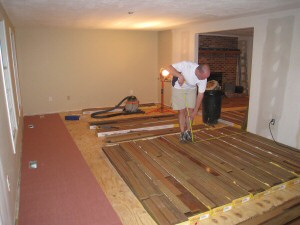
Perhaps even worse than the development of gaps happens when the house is at a much higher humidity than the floors. In this case, as the hardwoods take on moisture, they expand, potentially forcing the boards out against perimeter walls, or worse, buckling at the joints, cupping, and pulling fasteners out of the floor.
This article is part of our hardwood flooring installation instructions. Click that link for an index of all the articles in the series.
How Long to Acclimate Wood Floors
Unfortunately, there is no 100% correct answer for how long to acclimate floors. A good “rule of thumb” is 7-10 days for installation over wood subfloors. Â If you have a moisture-meter on hand, you can test the wood; it should be at 11% moisture content or less (the goal would be the average of normal moisture content year round) Â The subfloor should be equally dry. Â Do not install wood over a wet or damp subfloor.
Note: If you plan to install over concrete, we suggest using an engineered wood rather than a solid. The slab should be dry and additional subfloor prep is required. This scenario is beyond the scope of this series of articles, because issues such as moisture wicking through the slab must be considered. Â Many engineered woods do not require acclimation.
How to Acclimate Hardwood Flooring
Acclimation Location: Hardwoods should be acclimated in the same room/level where they will be installed.  Don’t make the mistake of acclimating the hardwoods in a basement when they are to be installed on the first floor.  Basements are moisture-prone since higher humidity air is heavier and sinks. Even though it may present a sizable inconvenience, you should acclimate the wood in the same area as the installation.
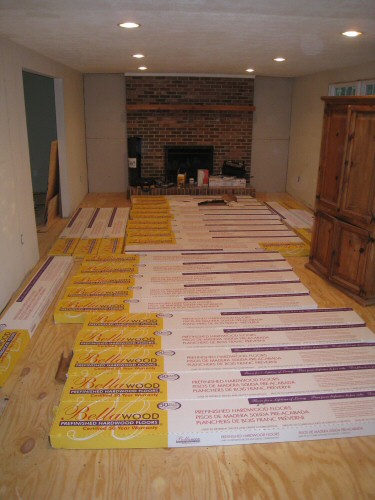
Don’t Stack Boxes: Some hardwoods (especially exotics like Brazilian Walnut) are very heavy. You need to spread the boxes out around the floor. Â Do not stack 1000 square feet of flooring in the center of a single room, or you run the risk of floor damage/collapse. Â Further, stacking boxes doesn’t support good acclimation. Instead, place all the boxes flat on the sub-floor.
Open Boxes for Best Results: If possible, opening the boxes exposes the hardwoods to more direct airflow, which supports the acclimation process.
Run the Air Conditioner / Heat Normally: Run the air conditioner or heat just like you usually do. Don’t attempt to dramatically modify the house or the woods. Â Your air conditioner should have been running for at least 5 days prior to bringing in the woods (in other words, if you just got back from a month long vacation where the A/C was off, wait a week before bringing the woods into the house, and then another 7-10 days for acclimation).
Don’t Allow Hardwoods to Get Wet: You should always keep the hardwoods stored in a well ventilated area and away from any condensate. For most homes, this isn’t a problem. Never let hardwoods sit outside through a rainstorm.
Don’t Acclimate Too Soon after Construction: Some compounds, like drywall compound for instance, will put moisture into the air as they dry.  Wait until all compound has dried and the house has stabilized around normal occupancy conditions.
Best Season to Install Hardwood Flooring
In the heat and high humidity of mid-Summer, even a well-cooled house may be at a much higher humidity than normal. While Summer is a very convenient time for hardwood installation, it may be better to wait until milder months, like those in Spring and Fall, so that the normal living condition of the house is best matched to the floor and an “average” moisture content level is reached.
Conversely, Winter installations can be problematic if the humidity is extremely low in the house, leading the floors to significantly expand and create forces across the floor when the humidity peaks in the Summer.
Consequences of Not Properly Acclimating
Talk to folks at the flooring store and you’ll likely hear some real installation horror stories. Don’t skip proper acclimation. Â Read manufacturer’s instructions. You cannot rush the process, and if you do, you may end up with a sub-par installation.
Should You Lay Hardwood Floors Parallel or Perpendicular to Floor Joists?
February 25, 2010 | by Fred (email) |
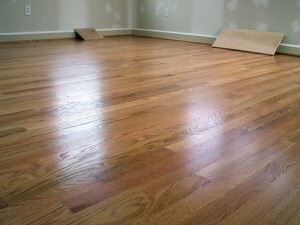 Reader question: I’m about to lay hardwoods in my house and I’ve heard that you should lay them perpendicular to the windows so the light doesn’t reflect off the gaps in the boards. A friend told me that I should lay the wood across the joists and that would mean running the wood parallel to the windows. What’s the right answer? — Lisa
Lisa, good question. In our opinion, it depends on what subfloor is already sitting on top of the joists, and specifically whether its plywood or OSB.
Plywood vs. OSB Subfloor
If your subfloor is 1/2″ plywood or less, we’d run the surface wood perpendicular to the joists. If it’s 5/8″ plywood or better, we’d be less concerned which direction the wood was running but would still be inclined to run the wood across the joists. With 5/8″ plywood or thicker, the plywood itself will grip the fasteners well enough to avoid the floor from pulling up, so hitting joists periodically throughout the installation is less of an issue.
If your subfloor is oriented strand board (OSB), we’d run the wood across the joists; however, that is mostly personal preference. You probably wouldn’t have a problem running the boards either way if the OSB is 5/8″ thick or better. Originally, OSB didn’t hold hardwood fasteners quite as well as plywood did; however, newer OSB has a holding capacity similar to that of same-width plywood. With 1/2″ OSB or less, just like with plywood we’d definitely run the wood perpendicular to the joists and we’d mark the joists with lines on the surface of the OSB and ensure we were driving fasteners down into the joists as often as possible to increase the strength of the floor.
Glue and Screw Additional Plywood
If you really want to run the hardwoods perpendicular to the windows, and your floor doesn’t meet our recommend specs, you could glue and screw a half inch of plywood to the existing sub-floor. Glue using liquid nails and screw the floor down every 10-12 inches square. This costs you 1/2″ of room height and extra materials, but it is a viable alternative. If you’re dealing with an unlevel subfloor, we recommend you check out our instructions for leveling a subfloor.
Prefinished vs. Unfinished Woods
I think a major question about whether the windows issue is a problem is how smooth your floor will be and whether you’ll lay prefinished or finish-in-place floors. Prefinished floors are more likely to show gaps between the boards than finish-in-place floors, because the latter is sanded flat prior to finishing.
No matter what you do, you should eliminate squeaks on the subfloor first by screwing the floor down through the sub-floor to the joists anywhere you can hear squeaking. You should also lay red rosin paper on the subfloor before you apply the wood to eliminate squeaks caused by the subfloor and hardwood rubbing together.
If you haven’t already purchased hardwood flooring tools, follow that link for the complete list of what you’ll need. Â You can also read our complete instructions for installing hardwood floors.
(photo: pdz_house)

 If you’ve just finished installing hardwood floors, or are in the market, you should know that hardwood floor may change color. Sunlight affects each wood species differently, but most will darken over time until it’s fully seasoned. This post will focus on how sunlight will affect your floor so you can make in informed choice.
Discoloration Caused by Sun Light
Sunlight contains Ultraviolet type A and type B rays (UVA & UVB). These rays can bounce off water, sand, and even penetrate glass. Many people know that UV light can cause skin cancer, but it can also change the color of furniture, carpets, hardwood flooring and artwork. In short, UV light can cause your furnishings to take on a prematurely aged look.
UV Effects on Hardwood Flooring
UV light causes wood to change color, especially exotic species. Depending on your type of wood, UV exposure may lighten or darken your flooring, but most tend to darken. The effects are very evident where area rugs or furniture cause an uneven change in color. Typically, color changes occur more rapidly at first and are indistinguishable after 3 – 6 months (depends somewhat on exposure).
It’s tough to find the effects of UV light on specific wood species. I’d encourage readers to comment with their own experience.
- Cedar – sunlight bleaches out unfinished cedar floors and causes them to darken after a finish is applied.
- Brazilian Cherry – darken relatively quickly.
- American Cherry – darkens to a deep red.
- Teak – turns darker brown.
- Yellow / Red Oak – slightly lighter over time.
- Maple – lighten over time.
- Brazilian Walnut – darkens causing a more uniform look.
- American Walnut – lightens over time (nathalie comment).
- Brazilian Ash – little change over time.
- Purpleheart – turns more of a brown.
- Tigerwood – darkens quickly! (nathalie comment)
UV Window Films Protect Hardwood Flooring
One way to counteract UV rays is to block them. If you prevent them from entering your home, they can’t damage your hardwood floors. New windows have lots of innovative features like double and triple pane glass, inert gas insulation, and non-conductive window frames. UV blocking films are an important feature you should consider when replacing your windows.
These films can also be installed on pre-existing windows. You can opt to have a professional install them, or tackle the project yourself. Either way, UV films not only protect you and your family, but they also protect your home and furnishings by blocking up to 99% of these rays.
What do you think? Has your floor changed color? Do you have a UV coating on your windows?
Image courtesy of back_garage
Before & After: Rustic Wood Floors Renovation by Melanie in Richmond
July 20, 2008 | by Fred (email) |
 This week’s Before and After is brought to you by Melanie in Richmond. Melanie didn’t leave a blog address with her submission, so we’re not sure whether she has a blog or not. But, when you see her Before and After story below, I’m sure you’ll agree she should have one if she doesn’t already. (Apparently there are actually folks who work on their homes and don’t blog about it–shocking!)
Melanie’s Before and After is a superb restoration of rustic wood floors in her Richmond, VA Rowhome. The result is a beautiful floor with a lot of character. It’s a bold design move, and one that paid off.
As a result of her submission, Melanie is automatically entered into our contest for a $50 home improvement gift card. And, as always, OPC will make a $25 donation to Habitat for Humanity in her honor.
Continue reading below Melanie’s post for this week’s Habitat Quick Fact, and a link where you can financially contribute to Habitat or locate a local affiliate where you can volunteer.
Rustic Wood Floor Restoration by Melanie
So about three months ago Kris and I decided to test what was under our black and white checkered vinyl kitchen floor. I didn’t mind the look of our kitchen, other than it being kind of mini and not having any drawers. I like my original wood cabinets and the Formica countertop….. But I really didn’t like the floors. So, we did some investigating and this is what we uncovered.
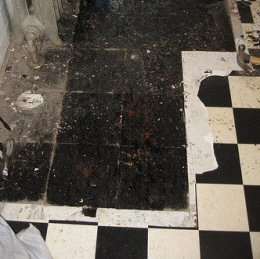
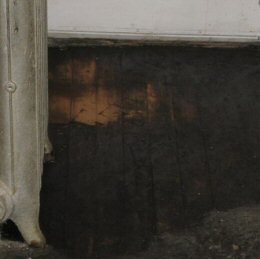
Underneath the black and white vinyl was red and white checkered linoleum tiles. These things took us (Kris) a few days to chip away at, which exposed this black tar…..also known as cutback adhesive. We tried tons of adhesive removers, all unfortunately pretty harsh since the safer methods we heard about just weren’t cutting it. After about a month of working on small sections each night after work and living with plastic on our floors we got as much of it up as we could. We were also simultaneously demo-ing our existing basement stairs and pantry, having new ones built by our green builder friends at New Earth and creating a 5 ft. opening between our kitchen and pantry.
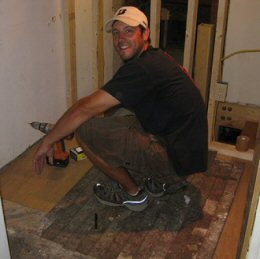
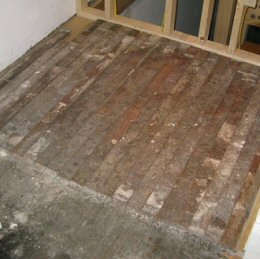
After as much of the cutback was off as we could handle and the “new†floor was in place, it was time to rent the floor sander. I believe we needed a drum sander for this amount of adhesive, but the man at Home Depot suggested an orbit sander, called U-Sand-It. It took driving back, buying lots more sand paper and extending our contract from 4 hours to 24 hours…..but eventually we got it to a point we were happy with.
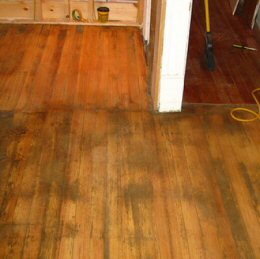
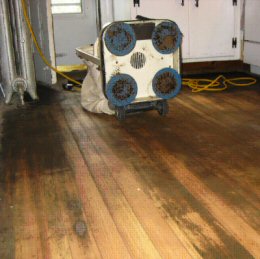
Some of the black marks from the adhesive….or possibly water damage (who knows, the floor is 90 years old) didn’t come off, but hey, if we wanted a new looking floor we could have bought one! Next was time to finish it off!
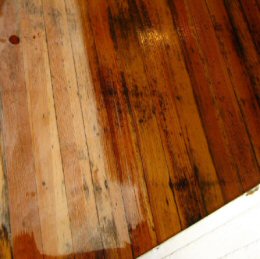
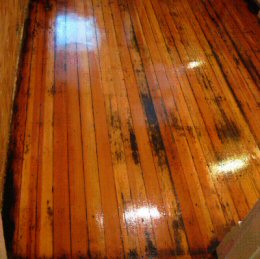
We used an oil based semi gloss polyurethane because that is what is on the rest of the floors and we have liked it so far. The first coat, by recommendation of my dad, we cut with half paint thinner. It made it easy to get used to applying the finish with the wool mop head that Home Depot suggested, and then we progressively used less paint thinner in each coat until the fourth and final coat was all polyurethane. This is how is looked before drying….it is not this shiny at all anymore and we love it!
Thanks from OPC!
Melanie, thanks so much for submitting your article to our Before and After event…Â Your rustic floors are great… quite a restoration!
Habitat Quick Fact
One of Habitat’s most lauded strengths is that they do not merely provide hand-outs in communities. They engage the community; each Habitat house is built by and for partners within their program. From Habitat’s web site:
How does [Habitat] work?
Through volunteer labor and donations of money and materials, Habitat builds and rehabilitates simple, decent houses with the help of the homeowner (partner) families. Habitat houses are sold to partner families at no profit and financed with affordable loans. The homeowners’ monthly mortgage payments are used to build still more Habitat houses.Habitat is not a giveaway program. In addition to a down payment and the monthly mortgage payments, homeowners invest hundreds of hours of their own labor — sweat equity — into building their Habitat house and the houses of others.
To read more general facts about Habitat, visit their Frequently Asked Questions page.
If you’re inspired by Habitat’s mission as much as we are, please consider giving financially. You could match our $25 donation today.  Just follow this link to Habitat’s online donation page.
If you did give to Habitat this Summer, either because of this program or for any reason, please let us know so we can honor you in an upcoming article.
How Can I Submit an Article?
There’s plenty of weeks left this Summer and more room for articles. If you have a Before and After project that you’ve finished, consider submitting it! Odds are, you’ll get picked, make a difference for a Habitat homeowner, and have a chance to win the $50 gift card.
Submit articles to oneprojectcloser@gmail.com.
What do you think? Have you ever restored original hardwoods? Leave Melanie a note and let her know what you think!
This weeks Before and After is brought to you from my first floor hallway. I’m preparing to lay hardwood floors in about 2 weeks time. And there is a lot to get ready.
To prepare, I’m removing all the quarter-round, baseboards, carpet, carpet pad, and existing hardwood. It’s slow going but I hired Bryan to help (and it was well worth it).
The carpet was the easiest. I just took a box-cutter knife and cut it into strips. Then rolled them up and secured with tape. You wouldn’t imagine how much dust came up out of the carpet. It reminds me of Freds post about not installing carpet. The pad came up easily and I bound that into rolls too. But the installers sure used a lot of staples. We went over the entire area with pliers removing them one by one.
Before yesterday, I had a hardwood floor in my hallway. I debated keeping it and trying to integrate the new floor with the existing. In the end I decided to scrap it. Here’s my rationale. I wanted a seamless look and that would require removing a few boards and replacing them with new boards. Not the easiest task. The next obstacle would be to match a stain or refinish the boards. Either way I be applying the finish myself. And that is another job I’d much rather avoid.
I don’t feel like the pictures really do it justice but check em out.


Now it’s your turn! Link in your Before and After project here. Make sure and leave a comment.