

There Are Six New Tools in Our Rewards Center! Have You Signed Up for an Account Yet?
February 21, 2012 | by Ethan (email) |
If you’re new to OPC or haven’t looked around much, you might have missed our Rewards Center. In a nutshell, it’s the page on our site where you can score 100% free tools, and I’m not talking about some namby-pamby flashlight you’ll never use. Right now, the Rewards Center is stocked with a Johnson level, Channellock pliers, a Stanley utility bar, a Ridgid orbital sander, and more!
To get in on the action, all you need to do is sign up for a Project Rewards account on our site. What’s the program all about, you ask? Basically, we reward you for visiting and interacting here on One Project Closer. It’s 100% free. There’s no cost to join, and there’s no shipping charges for the rewards we send you.
How to Join Project Rewards
Take a minute and sign up for an account. After you do, you’ll earn two (2) Project Points (pp) for logging in each day and five (5) Project Points for every comment you leave. When you’ve got enough points, you can bid on items like the Channellock pliers that are starting at just 50 pp. (Yep, you could get those pliers with just 10 comments on our site if no one else bids!)
What’s the Catch?
There is no catch. Our Project Rewards program encourages readers (that’s you!) to participate on OPC. That’s all we ask. We love it when readers visit, and we especially love it when you leave a comment. In fact, you can sign up for an account, then leave a comment on this article and earn 5 pp right now!
Not convinced yet? Read here for more information.
[Well, maybe there’s just one catch. We ship only to destinations in the U.S. and Canada… Sorry to our Aussie & UK readers…]
Up for Grabs Right Now
We just refreshed our Rewards Center this morning. You’ll find all of these tools up for bid starting immediately.


The top offerings include a Ridgid 6″ random orbital sander, a Stanley utility bar (like Steve Wartman’s crew used for the Shed Build Project), a Johnson 9″ Torpedo level (with magnetic edge), a pair of Channellock pliers, a Stanley 30′ tape measure and a Stanley wood chisel set.
The Not-So-Fine Print
Everything on our site is subject to our Terms and Conditions. We operate this program with integrity; however, for legal purposes, it’s worth noting a few things here:
- This program is operated at our discretion and can be discontinued at any time.
- Project Points (pps) have no cash value.
- Project Points can be added or subtracted to users at our discretion.
- At any time, before or after winning an auction, we can choose not to honor the results of an auction for any reason.
- The programs rules can change at any time, without notice.
- Any attempts to manipulate the program will result in a banned account. Remember, we have to ship the goods ourselves for these auctions, so we will be interacting with you personally upon a win.

Gentlemint: It’s Pinterest for Men (Meaning Less Fabric and More Beer)
January 31, 2012 | by Fred (email) |
Hello Men Folk. (Ladies, I wrote this for the guys, but would always love your thoughts too! :-))
I’m going to take a not-so-bold leap and assume that since you’re a guy, you aren’t that familiar with Pinterest. Basically, it’s this big social picture-sharing network that lets you “pin” things you like to a personal pin board. The service is dominated by women (we’re guessing 95%+ of users are female). Both Kim and Jocie use it (Jocie most extensively), and some of OPC’s stuff is pinned up there… Even some of our “manly” stuff has made it up, like our workbenches and sawhorses (although they seem out-of-place with all those pictures of hairdos and wedding dresses).
You can follow other people on Pinterest, and you can “re-pin” their stuff onto your own board. Getting re-pins is the currency of Pinterest. If your stuff gets pinned enough times (or by the most popular pinners), you’ll make the front page. It’s sort of like a high school popularity contest that way. She who dies with the most re-pins wins.

You’d think there’d be a just-for-men section on Pinterest with a big button on the front of the site that said Dudes – Start Here. Behind that button we’d see pictures of axes, beer, power tools, or maybe vintage baseball cards worth more than my house. But there is no such button. Pinterest is what it is. And what it is, is a predominantly women’s hangout.
So be it. I cede the Pinterests to the lady folk. I appreciate that we’ve got two of our own ladies here at OPC to handle that angle for us. On the few occasions I need to use P’s features (say, for getting some great ideas on wainscoting for the dining room), I’ll have Kim pull up the pictures for me. She’ll be more efficient anyway, and if she stumbles across eight different ways to cross stitch a [whatever someone cross stitches], she won’t mind.
Fortunately for us men, some manly web programmers out there got together and decided we needed a site like Pinterest, but with a little more testosterone. And Gentlemint was born. It’s a Mint of Manly Things.

Really, a Site for Men? Is it one of Those Sites?
I was excited when I heard this, but also cautious. When someone says, “A site for men”, my first thought is: Is this just going to be a site filled with pictures of scantily clad (or worse, unclad) women? I’m happy to say I’ve seen no such thing on Gentlemint, and I hope it stays that way. There’s enough of that smut on the planet already. We can do without another one of those sites.
So what is on Gentlemint? Stuff like this…

…and this…

…and this…

…and this…

And if they get around to approving Ethan and me for accounts, you’ll start seeing some of OPC’s manly stuff go up there too. (I applied just a few days ago… so if you work for Gentlemint, please approve fred@oneprojectcloser.com for an account. You won’t regret it.)
It looks like the interface isn’t quite as good as Pinterest yet (not surprising, it’s new), and some of the content really isn’t that great. But we hope it’ll grow and get better, and that the men who came up with this idea will get fabulously rich, and use their new-found wealth to contribute more manliness to the web.
Take a look at the site, and let us know what you’re first impressions are, and what you think they could be doing better. And if you’re a lady and made it all the way through this article to here… I’d love your thoughts on it too 🙂

As some of you may know, I am a margarita girl. Its my go-to drink, and I usually determine my favorite restaurant based on the quality of their margaritas. Over the years, I have gone through several favorite margarita recipes. My first love was a full flavored lime recipe kept in the freezer after making and served directly out of the freezer. Then, I discovered a blended lime recipe that was sweeter and less intense on the lime flavor, definitely loved by some of my less lime-crazy friends. Recently, I was playing around on Pinterest and saw a recipe for a Pomegranate Margarita and my adaptation has become a game changer!

The Challenge
I will share my recipe with you below, but here is the challenge: I am looking for the BEST margarita recipe out there! Leave a comment at the end of the post so we OPC folk can try your recipe, along with our readers at home, and we will decide who has the best. There aren’t many rules except that the majority of your recipe needs to be home-mixed, meaning not store bought mixes (although it can be one element). Feel free to be creative with flavors and fruits, it doesn’t just have to be lime. The winner will receive a gold star, a shout-out when we update this post, and a $50 gift card to Amazon.com.
UPDATE: Â Erin won our margarita challenge with a yummy Mike’s Hard lemonade Margarita, but the beer-rita was also yummy, although had more of a beer finish than I typically enjoy.
Jocie’s Pomegranate Margarita
This is a wonderful recipe that is relatively low in sugar compared to most margaritas and is all natural! It isn’t the cheapest drink to make but it is amazing.

Ingredients:
- 2 oz. Tequila
- 2 oz. water
- 2 oz. POM juice
- 1 oz. Simply Orange brand Orange Juice
- 1 oz. Lime juice
- 1 oz. Blue Agave natural sweetener
Directions:
Gather the ingredients.

Start with a good tequila. I recently found Drego Azul, a Mexican Tequila that is 3/4 Agave (Jose Cuervo is only 1/2, Patron is 100%). The greatest part is that it tastes better AND is significantly cheaper than Jose and Suaza. I like to keep my tequila in the freezer so that it doesn’t warm-up my drink.

I used 1 ounce of water in this recipe because I like a “lighter” drink, but if you want more of a punch, substitute tequila for the water.
Use POM and Simply Orange juices for this margarita, and while kind of pricey, they really make a big difference. I tried off-brand, cheaper juices and it dramatically effected the quality of the drink (but I am a margarita snob).

When looking for the blue agave sweetener, you may have difficulty finding it in your regular grocery store. I found mine (Izzy’s Organic Blue Agave) at our local Asian market, but have also seen it at Trader Joe’s. For a less “natural” margarita, you can also use simple sugar – 2 cups of water boiled with 2 cups of sugar, then cooled.
Then mix it all together in a shaker with a little ice. I used ounces as the given measurement in the recipe, but really it can be anything (1 ounce = 1 shot= 1 cup), as long as the proportions are the same.

Top with a slice of lime. I also added a few cranberries because they were lying around and are pretty! Â 🙂
DAP is headquartered right here in downtown Baltimore and a couple weeks ago, they had me out for a “caulk talk.” It was a visit for just me, and we had a great time talking about caulks, sealants, adhesives, foams, and drywall repair.

DAP was born out of the merger between the Dicks-Pontius and Armstrong companies in 1957. DAP was based out of Ohio but moved to Baltimore 14 years ago. They have five manufacturing plants in the United States, Mexico and Canada including one in Baltimore. Besides being an industry leader, DAP is also involved in standards committees to ensure product claims meet certain specifications and Federal steering committees to drive innovation.
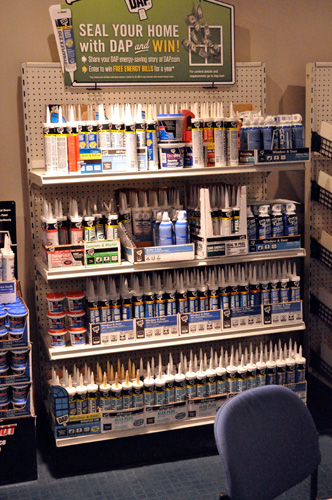
I found it interesting that DAP faces a huge challenge to educate professionals and consumers on the right product for specific applications. All the ingenuity in the world won’t help if users don’t understand where and how a product can be used. Inroads with initiatives like the Seal Your Home website have helped to convey “this is what product X was intended to accomplish.” A great example of this is the difference between caulks and sealants. Many people don’t realize they are not necessarily interchangeable. Caulks are mostly for aesthetic purposes like filling gaps. Sealants are designed to bend and expand to
fill joints.
DAP is really excited about their new Spec Line, a full line of sealants and adhesives purposed to identify industry specifications and provide the product that meets or exceeds minimum qualifications. They’ve even incorporated it into products names. For instance, DAP Dynaflex 920 meets ASTM C920 which sets down guidelines for the properties of an elastomeric joint sealant applied to exterior siding, windows and doors.
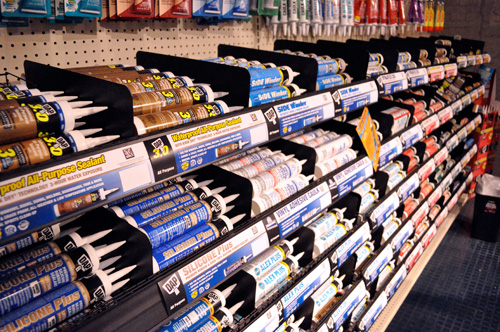
My visit also gave me an appreciation for all the different properties DAP works to optimize in their products. They juggles characteristics like paintability, elasticity, flexibility, cure time, anti-microbial protection, weather-ability, and how well it adheres to different substrates.

I’m thankful to DAP for having me out. Unfortunately, the manufacturing plant wasn’t a part of this visit. Maybe next time.
Young and Invincible: We Put Liquid Nails to the Ultimate Test
December 14, 2011 | by Ethan (email) |
If you’re like me and you like to work hard, you’re no stranger to aches and pains that leave you feeling like an old-timer. In fact, most people assume I’m older than I really am. (If you jump to the end of the post, I’ll share my real age.)
Anyway, every now and then I’ll do something foolhardy that you’d expect from some kid who thinks he’s young and invincible (like eat a raw onion on a dare). I had one of those moments when I was asked to test “Liquid Nails Heavy Duty Construction Adhesive’s exceptional holding power.”
Here’s when I warn everyone not to try this at home.
According to Liquid Nails, their Heavy Duty Construction Adhesive (LN-901/LNP-901) is formulated to fill gaps and provide exceptional holding power. It creates a waterproof and weatherproof bond for even the heaviest materials.
That sounds great, but I wanted to really put Liquid Nails to the test. Their website lists recommended applications like countertops, brick veneer, treated lumber and most common building materials (concrete, lumber, etc.).
It does not list hanging people upside-down.
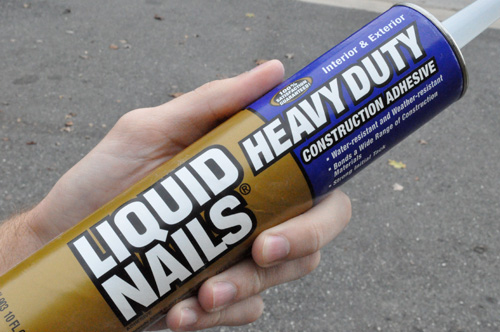
To test Liquid Nails exceptional holding power, I devised a plan to glue a pair of shoes to floor joists and then see if I could dangle from them. I grabbed an old pair of shoes and made some plywood inserts. I screwed the shoes to a pair of 2 x 4’s and used Liquid Nails Construction Adhesive to glue the 2 x 4’s to some floor joists.
I gave the Liquid Nails over seven days to reach full cure, and then I made this video.
I glued the boards and put in a couple screws to hold them in place while it cured. When Fred backs those screws out, all that’s holding me up is the Liquid Nails adhesive. I really felt like I could hang there for hours if it weren’t for the fact that I was slipping out of my sneakers. Next time I’ll use high-tops.
Liquid Nails offers a 100% satisfaction guarantee on their product. I doubt my little stunt would be covered. Even so, I’m a happy customer. Oh, and I’m 28 years old.
Disclosure Language:
Liquid Nails partnered with bloggers such as me to make a short video showing a creative use of Liquid Nails. As part of that program, I received compensation. They did not tell me what to say about their products or how to demonstrate Liquid Nails Construction Adhesive. Liquid Nails believe that consumers and bloggers are free to form their own opinions and share them in their own words. Liquid Nails policies align with WOMMA Ethics Code, FTC guidelines and social media engagement recommendations.
Milwaukee Tools has given the go-ahead to reveal some more cool developments they shared at the 2011 Milwaukee Tool Symposium. Between the new hand tools and fluorescent bulb tester, they’re lifting embargoes about once a month (which sounds like good marketing to me). I normally stay away from press released but once again, Milwaukee is doing something I think is worth sharing.
New Milwaukee M18 FUEL
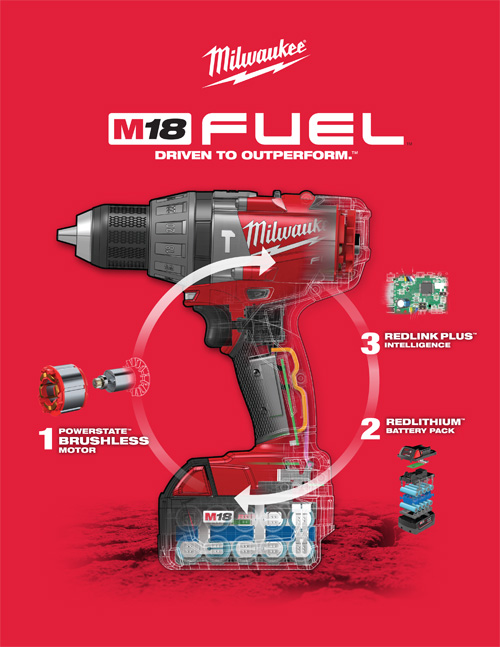
At the tools symposium, Milwaukee temporarily confiscated our cameras and blindfolded us before going into a super-secret portion of the facility. OK that’s not true, but they did walk us behind a very large curtain before unveiling a new cordless drill / driver. M18 FUEL is a new line of “extreme performance cordless power tools.” Milwaukee makes this claim because they’ve integrated three important technologies: the POWERSTATEâ„¢ brushless motor, REDLITHIUMâ„¢ battery technology, and REDLINK PLUSâ„¢ Intelligence. Of the three newly incorporated technologies, the brushless motor is what I think will have the biggest impact, and here’s why.
In simple terms, brushed motors utilize a number of “brushes” that make a physical connection to transfer power to the motor. This design carries some inherent flaws because it relies on friction between the brushes and the commutator, some energy is lost as heat and brushes will wear out over time. I’ll bet that if you open up most of your cordless tools, you’ll find a brushed motor.
To address these issues, brushless motors were created, and they’re different because they use a computer chip to regulate the rotation of the motor and eliminate the need for a physical connection. This results in a more efficient tool, less noise, less heat, and longer lifespan. Even better, brushless motors are more compact which means Milwaukee can make their tools smaller.
Milwaukee isn’t the first manufacturer to take advantage of brushless motors. In fact, Festool and Makita are a few years ahead on this front. You can expect the M18 FUEL line to be available in the spring of 2012, and from what I’ve heard will carry a similar price tag to their current line. Here’s the press release:
11/14/2011 MILWAUKEE, WI – Milwaukee Tool continues to revolutionize cordless power tools with the introduction of M18 FUEL™ –an exclusive line of extreme-performance cordless power tools designed, engineered and built by Milwaukee® to deliver unmatched productivity. As the clear leader in cordless tool development, Milwaukee has integrated three ground-breaking technologies: the POWERSTATE™ brushless motor, REDLITHIUM™ battery technology, and REDLINK PLUS™ Intelligence, to provide a new class in durability, run-time and performance for the professional tradesman.
“With advancements in the battery, electronics and motor, the new M18 FUELâ„¢ products represent game-changing innovation for our entire lithium ecosystem that will provide unprecedented improvements in productivity for the user,†says Steven Richman, president of Milwaukee Tool. “M18 FUELâ„¢ begins with the best components, and maximizes their performance using world-class engineering and job-site testing.â€
The new POWERSTATEâ„¢ brushless motor works harder and lives longer than all leading competitors, while reducing noise and cooling more rapidly to deliver years of maintenance-free performance. Milwaukee POWERSTATEâ„¢ brushless motors convert energy into power and torque more efficiently resulting in superior application performance.
Milwaukee REDLITHIUM™ batteries provide significantly more run-time, power and recharges than any other Lithium product on the market. REDLITHIUM™ also delivers best-in-class performance in extreme job-site conditions. With Milwaukee® durability built into each pack, the REDLITHIUM™ battery operates cooler and performs in climates as low as 0°F/-18°C with fade free power.
REDLINK PLUS™ Intelligence hardware and software is the world’s most advanced system of cordless power tool electronics that will maximize performance and protect the user’s investment. REDLINK PLUS™ Intelligence is a best-in-class system that integrates full-circle communication between tool, battery and charger, and constantly monitors this internal network to maintain ideal conditions.
Available in the Spring of 2012, Milwaukee will launch the M18 FUELâ„¢ system with the introduction of a new line of drills that offer breakthrough performance in a smaller and lighter size than all of its leading competitors. More information on the new M18â„¢ FUELâ„¢ Drill/Driver and M18 FUELâ„¢ Hammer Drill/Driver will be released in January 2012. For more information on M18 FUELâ„¢ in general, please visit www.milwaukeetool.com/fuel.
About Milwaukee Electric Tool Corporation
Milwaukee Electric Tool Corporation, a Brookfield, Wisconsin-based subsidiary of Techtronic Industries Co. Ltd. (TTI) (HKEx stock code: 669, ADR symbol: TTNDY) is an industry leading manufacturer and marketer of professional, heavy duty power tools and accessories. Products include the legendary SAWZALL® reciprocating saws, M12™, M18™ & M28™ LITHIUM cordless tools, HOLE-HAWG® drills, portable band saws, circular saws, driver drills, hammer drills, rotary hammers, grinders, sanders and a line of Test & Measurement and Hand Tools. Accessories include SAWZALL® blades, SWITCHBLADE® self-feed bits, BIG HAWG® hole cutters, THUNDERBOLT® drill bits and SHOCKWAVE Impact Duty™. For more information on the full line of Milwaukee® power tools and accessories, please call 1-800-SAWDUST or visit www.milwaukeetool.com.
In July of this year, I attended the 2011 Milwaukee Tools Symposium. There were a couple topics like some sweet new hand tools that we couldn’t discuss until Milwaukee gave us the go-ahead. A new Fluorescent Light Tester was one such product. It may not sound very interesting, but I think it was one of the coolest “new to world” offerings they showed us.
Imagine you’re the facilities manager for a medium-sized commercial or industrial building. Do you have any idea how many fluorescent light bulbs fall under your purview? We both know it’s a lot! Now imagine the amount of time spent checking and replacing defective bulbs and components. That time adds up, and before long your understaffed crew has no time for anything else. The Milwaukee bulb tester is a small investment that will save a ton of time (and every maintenance crew should have one).
Editors note: I just learned that you can expect the Milwaukee Fluorescent Light Tester to hit stores in February 2012 and it will retail for approximately $199.
How Fluorescent Lights Work
Before we dive into details about the fluorescent bulb tester, I think it’s important to give a quick overview of how fluorescent bulbs work and the common problems that go along with them.
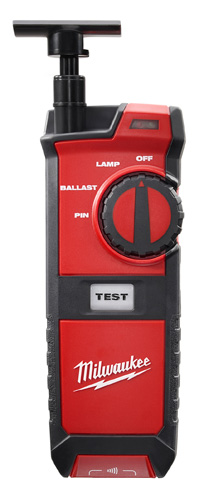
Fluorescent bulbs have two pins on either end that connect to the socket and make the electrical connection. When flip the light switch, an electrode excites the gas within the tube creating light (skipping over the Mercury and Phosphorus coating). Meanwhile, the current is regulated with a mechanism called a ballast. The three most common problems for fluorescent light involve bad pins, ballasts or a defective lamp. The Milwaukee bulb tester lets you check all three so that you’re not just taking a shot in the dark (yes that was a horrible pun).
New Milwaukee Fluorescent Bulb Tester
I got to try out the tester at the symposium, and it made diagnosing a failed fluorescent bulb so fast. To test the lamp, extend the 2.5′ wand and press it against the tube. If the lamp is good, it’ll alternate on and off. To check the ballasts, put the wand near each end and listen for the tone / light. Verifying the pins is the only diagnostic that actually requires you to remove the bulb, and to do it you insert the pins into the base of the bulb tester. Not only can you determine why a bulb won’t function, you can also ensure that new bulbs work before installing.
I like the Milwaukee Fluorescent Bulb tester because it’s efficient and dead-simple to use. The price hasn’t been released yet, and I’m not sure when you can expect it in stores. Here’s a copy of the press release:
10-22-11
MILWAUKEE, WI – Milwaukee Electric Tool Corporation continues to expand their Test and Measurement line with the introduction of a new-to-world product for testing/troubleshooting fluorescent lighting. With the ability to test fluorescent gas, check pin connections and test ballasts, the Milwaukee® Fluorescent Lighting Tester will allow professional Electricians and Building Maintenance Technicians to troubleshoot an entire building in half the time.“There are 1 million electricians and 1.6 million maintenance technicians across the US alone, and Lighting is the #1 or #2 application for both of these groups,†says Jon Morrow, Director of Marketing, Test and Measurement for Milwaukee Electric Tool Corporation. “Fluorescent lights make up the vast majority of the lighting used in commercial and industrial locations, but no complete tester exists in the market. Without a complete solution, professionals have adopted a replace and hope strategy…change the lamp or ballast and hope that fixes the problem. With the new Fluorescent Lighting Tester, professionals can troubleshoot with confidence.â€
Complete with a 2-1/2 foot, fully retractable antenna, users can easily reach all lighting fixtures. And since they will only change the lamps and ballasts that need replacing, users will save invaluable time and money by adding this easy-to-use tool to their arsenal.
Additional features include a removable antenna adaptor to increase “flicker†response, audible and visual indicators for easy readings, a built in LED work light to illuminate dark work spaces, and a rugged over-mold grip for increased durability.
With the introduction of these new products and plans to grow the Test and Measurement line in the future, MILWAUKEE® remains unwavering in their commitment to the trades, and will continue to offer innovative solutions in safety, performance and productivity.
Specifications:
2210-20 Fluorescent Lighting Tester
• Test all T5, T8, T12 fluorescent lamps
• Optimized for T8 electronic ballasts
• Check pin connections on all T5, T8, T12 lampsIncludes 2210-20 Fluorescent Lighting Tester, Adapter, 4 AA Batteries, Manual and Carrying Case.
Sorry, there is no active giveaway at this time.
A Quick Note on Home Improvement Coupons
Most of our home improvement giveaway entrants are also big home improvement deal hunters. If that’s you, you may be interested in checking out our Home Improvement Coupons, and particularly our Lowes Coupons, Home Depot Coupons and Sears Discounts. We update these pages at least once per week, and often much more frequently!
We also work to expand our inventory of home improvement retailers. All of our updates are done by hand, by one of the owner’s of this site, except for a few cases were we have automated data feeds directly from the companies listed (and even in those cases, we usually separate out the automated material). Our goal is to make sure that no broken links exist within our coupon library, and that you get a good discount.
You know you’re in Amish country when you start seeing more horse-drawn buggies than cars and beautiful handmade furniture is available everywhere you look. I took a trip to Mt. Hope, Ohio, and, after recovering from the culture shock, I really enjoyed the wide open country and some of the best Blackberry pie I’ve ever tasted. The Genie garage door opener HQ and Baltic manufacturing plant is nestled right in the middle of all this, and they had me out to tour their facilities and learn more about Genie garage door openers (also called operators).

I know what you’re thinking. Amish country? Garage door openers? It doesn’t sound very interesting, but if you spend five minutes talking to Mike Kridel, President of Genie, his enthusiasm is palpable. Here’s what Genie has been up to and why they’re so excited.
Genie Plant
Genie has four manufacturing facilities in America, and all their garage door operators are assembled here in the U.S. with parts from all over the globe. We toured the Baltic plant, and it was impressive to see the birth of a garage door operator from the very beginning all the way through being boxed up and ready to ship. Everything is QA checked in detail (like verifying how tight the screws are), and 100% of the units are tested to ensure functionality.

In addition, Genie does what is called ¼ life testing where they run a small subset of garage door operators until they reach 5,000 cycles to look for any problems that might not occur right away. In case you were wondering, they expect their operators to perform at least 20,000 cycles and that translates into about 20 years. Genie also runs tests in extreme temperatures as low as -40° F and as high as 158° F to make sure your opener works no matter if you live in Canada or Arizona.

Why Genie?
Like a lot of other competitive industries, Genie is striving to make their products quieter, faster, safer and more powerful. What sets them apart is how they’re achieving that goal. Most of the Genie line features a powerful 140V DC motor. This is noteworthy because DC motors are much lighter (easier to install) and the power can be stepped up or down depending on what is needed, something AC motors can’t do. This results in a much smoother door opening motion. The DC motors also have a Soft Start, Soft Stop feature that slows the door just before it’s all the way open or closed.
Genie also holds a patent on the direct drive technology that you’ll find in screw-drive style openers. If you look closely, you’ll see a long threaded rod much like a screw. The DC motor rotates that screw and the garage door opens (or closes). This type of opener is very powerful and very reliable. Competitors who offer screw-drive openers work around the patent by adding some sort of intermediate mechanism which reduces efficiency and creates a new possible point of failure.
Another way that Genie demonstrates a commitment to customers is by providing a lifetime warranty on the gearbox and motor to the original purchaser. They are that confident in their product. In addition, they promise a minimum of 7 years of support for legacy models after they have been discontinued.
Photo Beams
In 1993 UL started requiring openers to include photo beams as a safety precaution, and it turns out that misaligned photo beams are the #1 problem for homeowners. To address this problem, Genie has introduced cylindrical photo beams to better avoid being caught by hoses, power cords, etc. I’d love to see some creative innovation that achieved the same level of safety without needing something so close to the ground. Maybe Genie can works something out for me (even though I don’t actually have a garage right now). Sunlight can also interfere with photo beams and if you find yourself with that problem, consider choosing a photo-beam with a hood structure.

Intelligent Wall Console
Something I was excited to learn was that Genie is incorporating something called Intelligent Wall Console that will monitor the photo beam status, provide a log of any fault codes, record the number of cycles and even setup a service schedule. I’d argue that most homeowners don’t want to think about their garage door opener, and Intelligent Wall Console makes that a possibility.
Genie is the most popular brand of garage door opener out there. Anyone have feedback, questions or complaints they’d like corporate to hear?
I had the pleasure of attending the 2011 Kobalt Tools launch in New York City last week. There were a couple of tools that really caught my interest including a new double-drive screwdriver that you can expect in stores soon and a sweet battery charger. Read on for pictures, video and full descriptions.
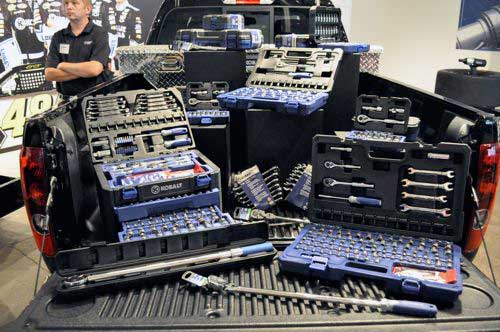
Most of what we saw was already on the shelves, but one exception was the new double-drive screwdriver. You may have seen my recent article about the new Channellock ratcheting screwdrivers. Well Kobalt took a different approach, and the double-drive may be my new favorite. The big advantage this screwdriver brings is the patented double-drive technology that lets you drive a screw twice as fast. If you watch the video, notice that the screw is going in (or out) regardless of which way the screwdriver is turning. This “bi-directional” technology means no wasted motion, something a ratcheting screwdriver can’t claim.
The double drive set comes with 21 bits, 6 nut drivers and a flexible extension. You can expect it to hit stores soon, and it will retail for $19.97.

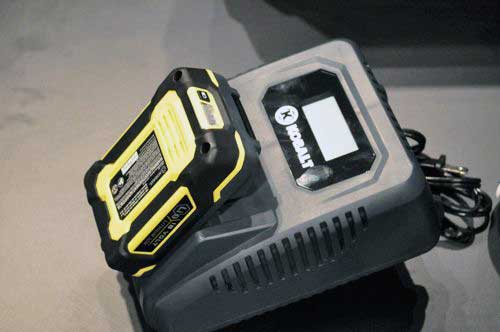
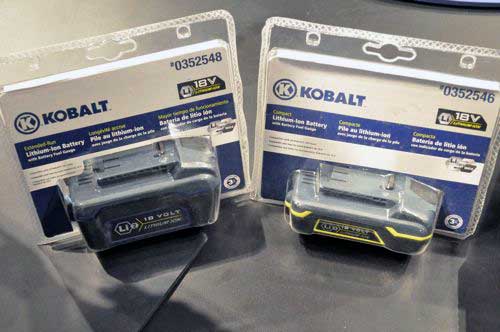
Another thing that captured my attention was a new battery charger. I have a lot of cordless tools so I appreciate a charger that can handle both Li-ion and NiCad batteries. Kobalt added a little LCD display that indicates how much charge a battery has and how much time is needed to reach full charge. You can expect a dead battery to be ready to go in 30 minutes or less (depending on battery). It’s also worth noting that Kobalt has a good warranty offering three year, hassle free guarantee on all batteries.
A cool feature on the new Kobalt reciprocating saw is the blade can rotate a full 360°- no more ejecting the blade to change the direction of the cut.

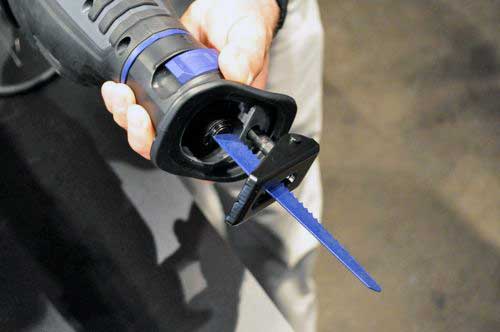
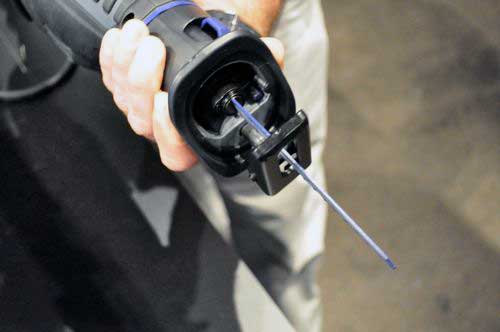
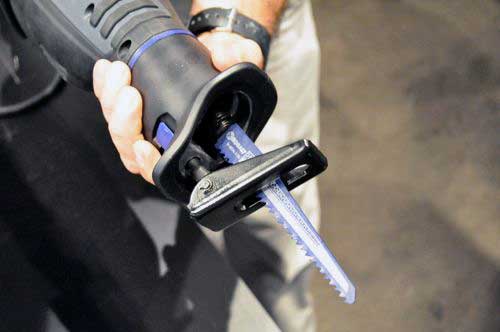
Did you know that Kobalt puts all their mechanics tools in the hands of Jimmie Johnson’s pit crew for feedback?
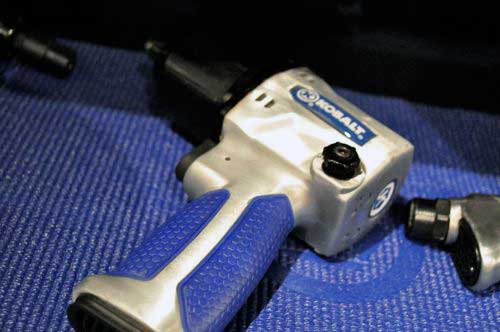
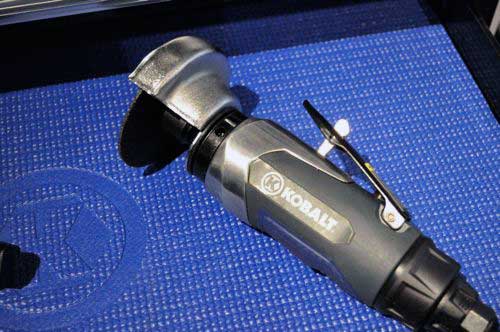
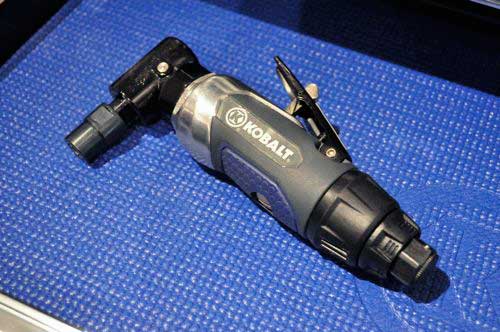
I love competition, and these media events usually include some sort of challenge. Kobalt split us up and had us race to complete a corn hole (a.k.a. bean bag toss) set. Even though a race to the finish isn’t the best idea with power tools, it was a lot of fun, and I’m not just saying that because my team tied for first place.

Kobalt also shared a new venture called MyLowes, which promises to be very cool. This online service allows you to track purchases, manage warranties and registrations, find compatible accessories, retrieve paint selections and log purchases. What I really liked about MyLowes is that the consumer isn’t asked to enter information after the purchase. When you checkout, you can present the keychain mini-card or phone number, and your account will automatically be updated. I suggested they also look to incorporate a parts lookup feature to find suitable replacement parts and see about adding tool rental resources.
If you’d like to see even more pictures, check out the OPC Facebook page.