


If you follow us on Twitter, you know that Bosch was kind enough to invite OPC out to their headquarters located in Mt. Prospect, Illinois. For the past two days, I’ve been getting in-depth information from product managers about new tools that have just come out and tools that haven’t even hit the shelves. Bosch setup a demonstration area where they put each tool in our hands to see for ourselves, and the results were impressive. For even more pictures, check out our new Facebook page.
New From Bosch
Bosch prides itself on innovation, and that’s evident with the new products we saw. Here’s what really stood out:
Compact Tough
The second generation of Compact Tough drill drivers and hammer drill drivers are available as of this month. Right away you should notice that they’ve changed the angle of the drive train relative to the handle (also true for the Brute Tough line). Users perceived that their previous style was bigger and less maneuverable so they incorporated that feedback. As Bosch works to further refine their lineup, there’s a heavy emphasis on improved weight, size and battery life. A new gear train and clutch makes the newest generation of Compact Tough smaller and more compact when compared to the competition and previous models. These drill drivers and hammer drills also boast the lightest weights in their classes- 3.4 lbs. and 3.6 lbs. respectively with slim battery packs. Both lines are powered by 18V Li-ion batteries. To simulate cold temperatures, Bosch froze a pair 18V batteries in blocks of ice. After extracting the batteries, they fired up two drivers without hesitation.
Compact Tough Drill Driver models: DDS180 / DDS181
Compact Tough Hammer Drill models: HDS180 / HDS181
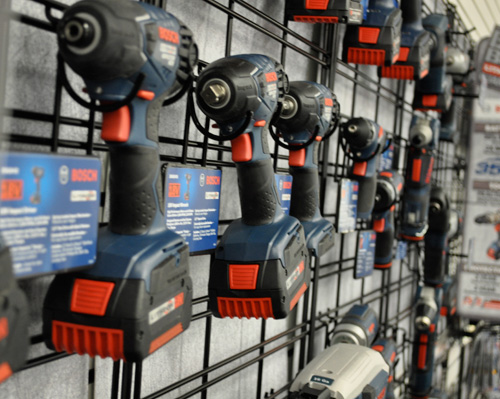
12V Max
The 12V Max lineup has a few additions including an inspection camera, right angle drill and pocket reciprocating saw. The inspection camera is available now with a 2.7″ screen and 36″ long scope. The right angle drill launches in July 2011, and features an articulating head and LED lights. The pocket recip. saw is strikingly similar to the Milwaukee version in design and specifications. It’ll be available in August 2011.
Inspection Camera: PS90-1A, $199
Right Angle Drill: PS11-2A, $149
Pock Reciprocating Saw: PS60-2A, $159
18V System Tools
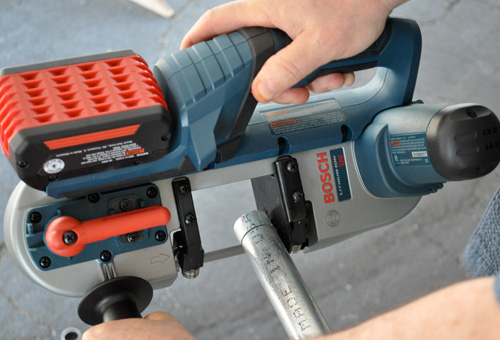
Bosch added several new cordless tools, and the real standout from this group was the cordless band saw. The new BSH180 is the most compact band saw in it’s class. It weighs 7.5 lbs. and measures 13.5″ in length- way better than comparable Milwaukee and Stout models. Putting out 500 Surface Feet Per Minute (SFPM), I was able to slice through metal pipe with ease. The size and weight make it incredibly easy to work overhead, and I’d recommend this to any plumber, electric or HVAC professional. The BSH180 launched in March of this year.
Finish Nailer: FNH180K-16, $449
Work Light: CFLED180, $69
Bandsaw: BSH180, $349
Woodworking
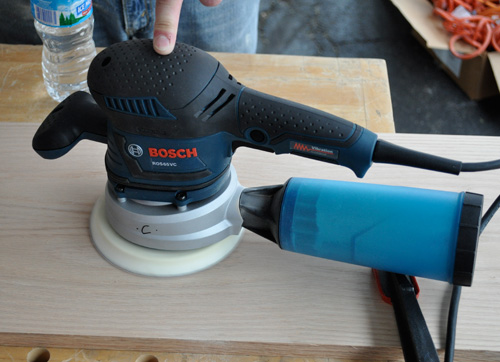
The MX25E, Bosch’s multi-tool offering has been available since March of this year. OMT’s are great, but I was really impressed with their new random orbit sander. The new ROS65EVC5 is a large random orbit sander. It can accept 5″ or 6″ discs and the translucent dust canister is an improvement over previous models. What is so impressive about this sander is the amazing vibration control. I’ve never used a random orbital sander with such smooth handling. Jim Stevens, the product manager, shared that they achieved this by using foam pads to act as a sort of “independent suspension”, separating the housing from the rest of the mechanism. The result is amazing control that I haven’t found elsewhere. Look for the ROS65EVC5 in August 2011.
Oscillating Mult-tool: MX25EK-33, $199
Random Orbit Sander: ROS65EVC5, $229
Putting Bosch to the Test
Bosch wanted to backup their product claims with real experience and they did this in two ways.
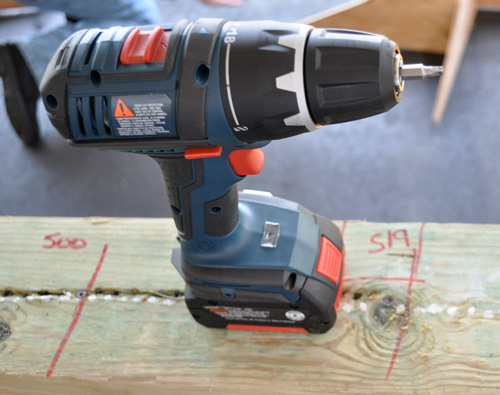
First, imagine four, pressure treated 4X4’s setup lengthwise. Bosch pitted their 18V Li-ion driver against comparable Makita, Milwaukee and DeWalt models to see which cordless would drive the most screws. Everyone took turns driving screws, and eventually all four batteries died. The results? The Bosch battery outlasted them all, surpassing second place by 96 screws.
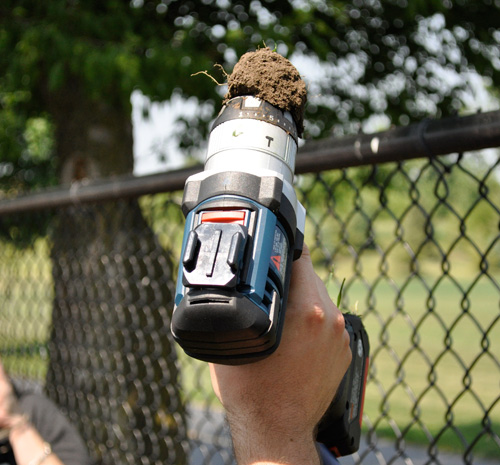
The second demonstration focused on durability. Tools are often dropped on the jobsite so Bosch loosed a pair of hammer drills from a helicopter 532 ft. off the ground. The tools fell to the dirt, and both functioned just fine.
Innovation and Round Tables
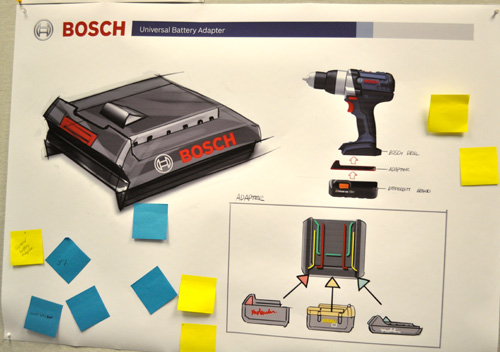
It was great to break into smaller groups to discuss ideas and products we’d like to see in the future. Before attending, everyone submitted ideas for “Tools of Tomorrow”. I’m happy to share that my idea, a universal battery adapter, was voted the top choice by fellow peers and Bosch leadership. Some of the other suggestions included an iPhone app, laser concrete cutter and even a portable beer tap (courtesy of Marc from HomeFixated.com). It was refreshing to see the Bosch product managers so eager for feedback and ideas. They truly want to learn what products the end-users need, and how they can rise to the challenge. If you have some inspiration, leave a comment and I’ll make sure to pass it along.
On March 20, 2011, IRWIN Tools hosted the Ultimate Tradesman Challenge (UTC) finals in Bristol, Tennessee. The competition began a year ago with over 16,000 tradesmen from across the entire world competing to see who could Grip It, Rip It, and Drive It faster than anyone else. The field was narrowed to six finalist representing North America, the United Kingdom, Denmark, Australia, Brazil, and Poland, but the day belonged to England’s Daniel Shepherd, completing the final round in a blazing 25.07 seconds. Shepherd claims the title of the World’s Ultimate Tradesman, and a cash prize of $10,000.
The Ultimate Tradesman Challenge
IRWIN hosted 250 UTC events in 2010 all over the world with over 16,000 tradesmen participating. The challenge consisted of performing a series of tasks to fit a 2″ x 4″ into a specialized channel in a race against the clock. Contestants would remove two pipe fittings with a pair of GrooveLock pliers, mark three specific lines, and use a QUICK-GRIP to clamp the 2″ x 4″ into place. Next, contestants cut the board to size with an IRWIN Universal Handsaw and drill two holes with Speedbor drillbit. If all cuts and holes were made accurately, the board would fit into the channel, stopping the clock. Check out this video for a better explanation:
This may sound easy but I can testify that it’s unbelievable how fast these guys move! Yours truly completed the challenge in a sluggish 55 seconds which means Dan Shepherd could have done the whole thing twice before I finished.

Elevate the Tradesman
IRWIN designed this challenge to give respect to professional tradesmen around the world. “IRWIN’s Ultimate Tradesman Challenge was designed to recognize skilled tradesmen from around the world,†said Curt Rahilly, vice president of marketing for IRWIN Tools. “We’ve been impressed by the skill and passion tradesmen bring to this competition.”
Irwin continues to recognize hardworking tradesmen with their Thank a Tradesman 2011 campaign. It’s easy to sign up and all you have to do is tell them about the tradesman you would like to thank. The top prize packages include a VIP race weekend trip to Bristol, Tennessee with the chance to win $1,000,000! Other winners will receiver a pair of tickets to the Bristol race, an assortment of Irwin tools and hotel accommodations. Pretty sweet huh?!

The Tools
Irwin setup a handful of demonstrations, and I was able to try out some tools first-hand. There are a lot of worthwhile offerings but here’s what caught my attention. Look for reviews coming down the line.
Universal Handsaw
A handsaw doesn’t typically elicit much excitement, but I was truly impressed. Irwin states this saw is up to 3x faster and, after making a half-dozen cuts, I believe it. The real benefit is the unique design that allows you to put so much more power behind each stroke. Todd has a great Universal Handsaw Review over at ToolBoxBuzz if you want more details.
GrooveLock Pliers
I own and use Channellock pliers all the time, but the GrooveLock pliers are strong competition. Irwin got a couple things right with these pliers and the biggest benefit is how much easier it is to adjust the jaw size.
Marathon with WeldTec circ saw blade
Irwin ran a quick demonstration, pitting the Marathon WeldTec against a Freud saw blade. They ran each saw down the length of a board with nails every 5 inches or so to see which blade held up and the Marathon blade performed far better. Irwin states this is because the blade teeth are welded for improved durability.

About IRWIN
Irwin was founded in 1828 in the United Kingdom and grew to have a global footprint with 52% of their 2010 sales take place in the United States. In 2002, Rubbermaid purchased the company and worked to consolidate several brands under the Irwin name including VISE-GRIP® pliers, MARATHON® saw blades, SPEEDBOR® drill bits, STRAIT-LINE® marking tools, and HANSON® taps and dies. Irwin Tools manufactures and distributes a broad line of hand tools and accessories focusing on drilling, cutting, layout and hand-tools.
There’s a drill bit made for just about every scenario, and it’s important to choose the right drill bit for your project. Selecting the right bit makes jobs safer, easier, and ensures your drill bit will last. Here is a reference guide for wood boring / cutting drill bits. For a more complete list, Wikipedia has a rather extensive drill bit article.
Drill Bit Materials
Drill bits are made from different materials, each with different characteristics.
- Carbon Steel Bits – Carbon Steel bits are inexpensive but have relatively short lifespans. They resist heat poorly and so need to be sharpened frequently.
- High Speed Steel Bits (HSS) – Are a step above Carbon steel drill bits. HHS bits resist heat much better and subsequently, maintain a sharp edge longer.
- Titanium Coated – These coated bits will last even longer than HHS bits. Look for Titanium Aluminum Nitride (TiAN) or Titanium Carbon Nitride (TiCN) as these are the best. The downside with coated bits is that they can’t be properly sharpened because that would remove the coating. But if it needs sharpening, the coating may be gone already.
- Carbide-Tipped – Carbide-tipped bits will stay sharper than even Titanium coated bits. They are also more expensive. Carbide-tipped bits dissipate heat quickly but can chip if not used carefully.
- Cobalt Bits – Cobalt bits are very hard and keep a sharp edge even at higher temperatures. They are typically used for drilling into stainless steel and other metals.

Wood Drill Bits
One of the most common tasks for any DIYer is drilling a hole. These are the drill bits suitable for drilling into wood.
- Twist Bit – Twist bits are some of the most common drill bits available. You can find them in many different sizes and materials. The front edge cuts into the material and the flutes channel away debris. Twist bits can be used for drilling in plastic, wood and light metal.
- Brad Point Bit – Brad Point (a.k.a. Spur Point / Lip and Spur) bits look similar to Twist bits except they have a centre brad and sharp corners. The brad pushes into the wood, anchoring the bit, allowing you to drill a precise hole. Again, these bits are effective in wood, plastic, and soft metals.
- Spade Bit – Spade bits (a.k.a. Paddle / Flat) bits are great for boring large, rough holes. They are flat with a long spur in the center. Spade bits come in sizes 1/4″ through 1-1/2″. Fred wrote a great post all about Spade bits. Check it out for more details.
- Auger Bit – Auger bits are ideal for boring deep, large holes. It has deep flutes for chip removal and a self-feeding screw tip that pull this bit into the wood.
- Adjustable Wood Bit – The Adjustable Wood (a.k.a Expansive) bit has a small center pilot followed by an adjustable cutting edge. The edge can be centered for smaller holes, or slide out for larger holes and locks in place with a set screw. This bit is very versatile and provides uncommon bit sizes.
- Hole Saw – A hole saw looks just like it sounds. It’s a circular tube with saw teeth and a centre pilot drill. It’s used for boring large diameter holes like door knob holes. They usually range from 1/2″ to 6″ diameters.
What do you think? Any good info to add?

 Every now and then one of our electric-related articles will surface an old debate: what’s really dangerous: voltage or amperage? The most recent post that raised the issue was last week’s Frigidaire wall oven heating issue where I warned readers to turn off the breaker because “220 volts can be lethal.”
One of our commenters, Katharine, chimed in saying, “Voltage isn’t lethal, amperage (current) is.”
So what really is the dangerous component, voltage or amperage?
The answer is both. It’s actually the combination of voltage and (available) amperage that are dangerous.
To illustrate, let me use one of my favorite analogies for electricity: a flowing river. While not a perfect analogy, it provides a simplified view of electricity in a way we can all understand. If an electrical circuit is a river, voltage is the steepness of the river, while amperage is the amount of water that flows across a section of the river for some set period of time.
So, if voltage is very high, but amperage very low, then a very small amount of water would be flowing down an extremely steep slope like a thin waterfall. If voltage is low and amperage is high, a large amount of water is flowing very slowly, like an almost-stagnant, yet wide river.
If either voltage or amperage are very low, it’s clear that the situation isn’t dangerous. A tiny waterfall or a massive slow moving river probably won’t do you much harm. On the other hand, if both are high (a large, raging waterfall, for example), it would indeed be very dangerous.
Now, the river analogy breaks down because rivers don’t follow Ohm’s law, which says that current and voltage are related by the equation V=IR, where V is Voltage, I is Current, and R is Resistance. This equation tells us that the amount of current that passes through your body (a resistor) is directly proportional to the voltage, because the “R” in the equation (essentially your chest, limbs, etc) is a constant. If you bridge two wires, one in each hand, the amount of current that passes through your body will vary directly with the voltage across the lines.
So what is a dangerous amount of current to flow? According to a great article over at All About Circuits, about 6 miliamps (6/1000 of an amp). That’s when severe pain kicks in but you can still control muscles. 100 miliamps is the point at which heart fibrillation is likely to occur.
It is worth noting here that tissue-damaging currents are measured in milliamps (mA), while over-current protection provided by breakers is measured in amps. In other words, if you bridged 240 volts from one hand to the other (through your chest), you’ll likely be dead long before a breaker trips. This is one reason that GFCIs add safety to circuits, because usually when a circuit is interrupted, the current goes to ground and a GFCI trips before tissue-damaging current can flow.
What is a dangerous amount of voltage? Shock danger generally begins around 30-40 volts and escalates as voltage increases. However, even lower voltages can be dangerous in situations with lower resistance (e.g. when hands are sweaty, or more skin surface area is in contact with the voltage source.) For dry skin with minimal surface contact, 30 volts is the amount of potential necessary for any current to flow through your body.
Generally speaking, this is why you don’t get shocked if you you have dry hands and grab both terminals on a car battery, even though such batteries can deliver up to 300 amps of cranking power to start a car. 12 volts isn’t enough potential to complete the circuit through your body.
(Photo Credit: Frustrated Writer)
We have a reader who is very fervent about purchasing American made tools. He likes to say stuff like “You forgot, this (darn product) is made in Red (non-democratic country), you (insert derogatory name calling)”. He argues that purchasing these tools takes jobs away from hard-working Americans. Well that got me thinking- what qualifies as American made and what companies meet that criteria?
Marketing Lingo
I remember learning about some sneaky marketing tactics used to sell juice. Eventually, the FDA caught on and set down some very specific rules regarding the appropriate terminology and implied messages for juice sellers. Here’s a few excerpts from the FDA Food Labeling Requirements:
- If the beverage contains fruit or vegetable juice, the percentage shall be declared by the words “Contains _ percent” juice
- If the beverage contains 100 percent juice and also contains non-juice ingredients …. it must be accompanied by the phrase “with added ___,”
- If the labeling or color and flavor of the beverage represents, suggests, or implies that fruit or vegetable juice may be present …. then the label shall declare “contains zero (0) percent (or %) juice”.
So I started researching what guidelines exist for the claim “Made in America” and here’s what I found.
What Does “Made in America” mean?
Just like the FDA, the FTC has set down standards for the advertising or labeling claim of “Made in America”, even covering suggestive messages like depicting the American flag. If you’re interested, here’s a good read from the Bureau of Consumer Protection with full details. This is my quick summary:
Unqualified claims that a tool is “Made in the USA” means that “all or virtually all” significant parts and processing are of U.S. origin and the products contain no foreign content – even if the percent is negligible. You need to pay close attention to the verbiage as this is different from qualified claims like “Manufactured in the USA from foreign materials” or “Assembled in the USA”.
Verifying Tools that are Made in the USA
The big question is what tool manufacturers live up to the claim. I searched around and started verifying a few manufacturers. You may be surprised with what I found.
- Leatherman
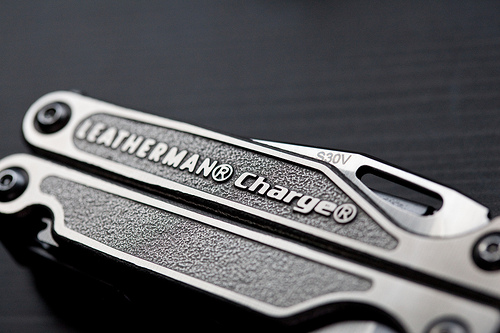
The Leatherman headquarters has been located in Portland, Oregon for over 25 years. That’s also the location of their factory but they cannot claim their products are “Made in the USA”. Here’s the reason (direct from their site):These Leatherman tools were all built and assembled by U.S. workers at U.S. factories using primarily parts made entirely in the United States and some parts processed, in part, in Western Europe, Mexico, or Canada. Unfortunately, Leatherman is not able to procure all of its component parts in the United States because of quality, technological, or economic considerations. But Leatherman Tool Group has never shipped a job overseas, and the company remains committed to keeping and creating as many jobs here as possible.
- Klein Tools
Klein Tools operates nine plants in the US in addition to a plant in Mexico City. They make this information very obvious on their website, including the following statement:Klein Tools de Mexico has operated a plant in Mexico City since 1970. This plant produces products for the Mexican and Central American markets. A few tools that are made here are sold in the US, like our knockout punches, but for the most part Mexican made products are consumed in Mexico.
Klein Tools has never closed a US plant and outsourced manufacturing to other countries – and we have no plans to do so.
Klein Tools does sell some products that are made in other countries to our quality standards. For the most part, these are items that are simply not produced in the US any more – a good example is electronic products like multimeters.
So, you can rest assured that Klein Tools remains firmly committed to US manufacturing and continues to invest in the latest technologies for our US production facilities.
- CHANNELLOCK
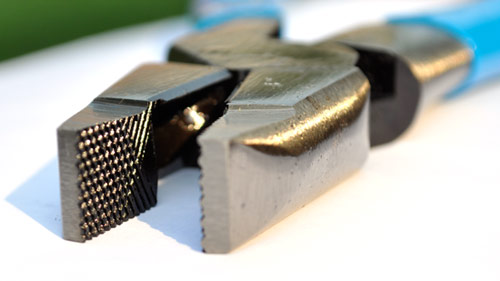
Channellock has a great “factory tour” of the entire process called From Steel to Shining Steel. It describes how every Channellock product starts as high-carbon, North American steel. It’s an impressive video that leaves no doubt that these products are Made in America.
What do you think? What tools do you know are Made in America?
Images courtesy of Brian.ch and lindsayshaver
While traditional oven/stove combinations plug in to either a 3- or 4-prong 240-volt socket, wall ovens and cooktops must be direct wired using appropriate junction boxes, usually installed in the cabinet above or below the wall oven, and/or in the cabinet beneath the cooktop.
One common question is whether a separate cooktop and wall oven can be installed on the same circuit. The answer, according to the 2008 National Electric Code, is YES, provided certain conditions are met in the installation.
In general, the rule in section 220.55 of the NEC says that up to two wall ovens and a cook top can be considered a single appliance, so long as they are installed in the same room and meet other relatively simple conditions. This means they can be installed on the same circuit, and it also provides some benefit when calculating the load limit for the circuit.
Demand Factors for Wall Ovens and Cooktops
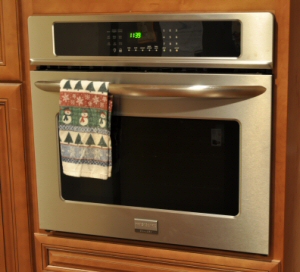
The same section of the code has a table (also numbered 220.55) that shows allowable demand factors and load limits for a given numbers of appliances and total appliance wattage, which allows you to install higher gauge wire and lower over-current protection than the nominal combined wattage would otherwise dictate.
For example, a cooktop and a wall oven might have a nominal combined draw of 12,000 watts (12 kW) if all the elements were on simultaneously; however, the code allows these units to be installed with assuming an 8,000 watts (8kW) of maximum draw. This is because it isn’t really reasonable to expect that all elements of a cook top and wall oven would be running simultaneously. Even when all of the elements are turned on together, they don’t all draw electricity at the same time. Cook tops and wall ovens cycle the elements as dictated by an internal thermostat. When an element reaches the desired temperature, it shuts off.
Follow the NEC, But Don’t Pay For It!
As a result, there are variety of situations and considerations that we can’t cover in this post. If you’re considering doing this job on your own, there’s no need to purchase a copy of the NEC, which will easily cost you $60 at the link above or from Amazon or another bookseller. You can find one in the reference section of your local library and make photocopies of the code section 220 that you’ll need for this installation.
Remember, you should always follow ALL local codes when performing electrical work. Your jurisdiction may require you to be a licensed electrician to do any electrical work, even in your own home. Your local jurisdiction may also have additional requirements (above and beyond the code) for what electric in your area requires. For example, some local codes may not allow an oven and cooktop to be installed on the same circuit, even though the NEC 2008 allows it. You should contact your local regulator and ask what the specific rules are in your area.
The Cost of Licensed Professionals
Of course, it’s always good to contact a licensed professional before tackling this job. We expect that an electrician would want approximately $400-$1000 to run a new circuit for a cook top or wall oven in a home, depending on what accesses are available and how far the cook top is from the main electric panel. Expect to pay a little more if the electrician has to tear out and repair drywall to do the installation.
Want to see the ultimate tropical outdoor bathroom?
About a month ago, Kim and I took our boys on vacation to Guatemala. We visited as much of the highlands and lowlands of the country as practical in 8 days, camera in tow the entire time. Most of the trip didn’t feature home improvement blog-worthy posts (although you can read a whole group of posts over on Kim’s adoption blog, including one where we climbed an active volcano).
One of our stops on the trip was Valhalla Farm, a neat little all-natural macadamia nut plantation that not only features some top-notch macadamia chocolates, but also helps millions of indigenous people worldwide through donations of macadamia nut trees. Valhalla promotes reforestation in many areas of the world, training indigenous people to farm using sustainable methods.
Besides their philanthropic focus, Valhalla has some great buildings, including the best tropical bathroom we’ve ever seen. If you’re looking for some inspiration on making your own tropical bathroom, consider this the perfect source…

Of course, most of you probably don’t live in a climate that would support this type of outdoor bathroom, but we are still inspired by how the space integrates a modern toilet, sink, and mirror in a way that doesn’t look like its “trying too hard”.

Unfortunately, we didn’t get a shot of the outside of the bathroom, but it’s really nothing more than a small outhouse house made of wooden slats and a door. If you’re ever in the area of Antigua, Guatemala, be sure to visit Valhalla, if for nothing more than a pit stop 🙂
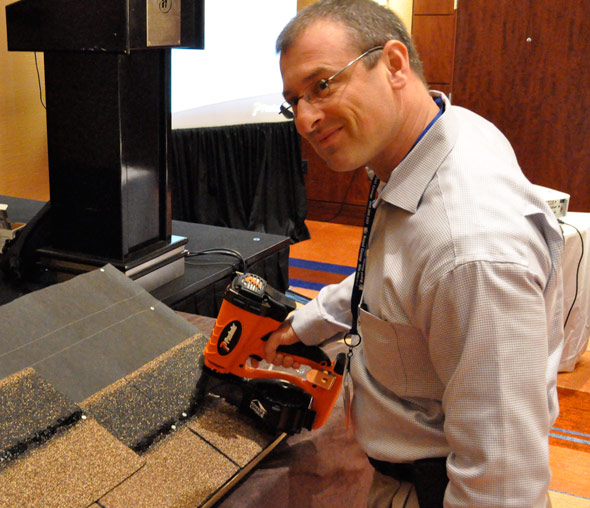
At the Remodeling Show I was able to get my hands on a brand new tool offering from Paslode- the Cordless Roofing Nailer. It was a lot of fun to get a first look and actually try it out. Check out this picture of Rob from A Concord Carpenter nailing some shingles.
Paslode did the research and found a growing number of homeowners looking to repair their roof rather than replace it. They also took a hard look at what tools people use to repair roofs today and how they could be improved. With that in mind, they developed a cordless, lightweight tool that is ready to go in no time.
Features
Roofing Tool Comparison
The two most common roofing nail drivers available are a compressed air nailer and a hammer. Hammers are easy to use and require no setup but even experienced roofers will fatigue over time. Plus, it’s tough to match the speed of a roofing nailer. Pneumatic nailers let you work all day long but require a compressor and a hose- a significant amount of setup time.
Paslode took the best of both worlds. This nailer can drive 2 nails per second utilizing a small fuel cell. There’s no compressor or hose to setup saving an estimated 40 minutes per job. The result is a fast, consistent roofing nailer.
Any Nail
Paslode recommends using their spline nail, coated for better depth of drive. However, these nailers can shoot any standard roofing nail.
Quick Nose Clear
Paslode recognized that even the best nailers jam or misfire and it actually happened at the demo. What impressed me was how easy it was to clear.
The Numbers
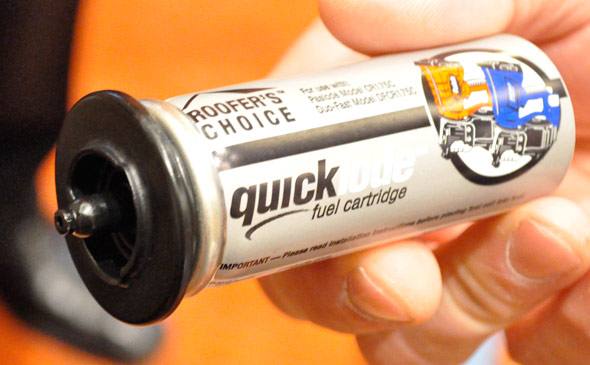
- Fuel cartridge- 1,000 shots
- Battery- 2,000 shots
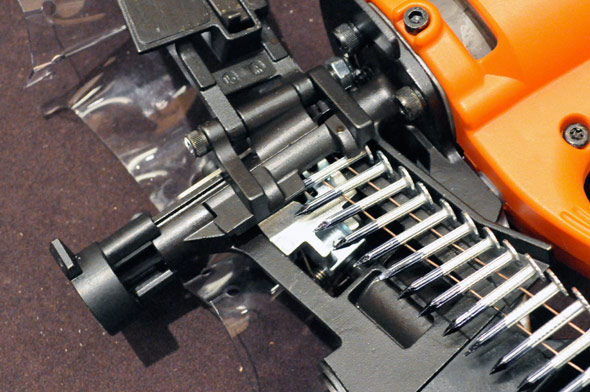
- 120 nails per coil
- 2 nails per second
- First maintenance at 30,000 shots
Repair and More
You can see from the numbers that these tools are not designed to install an entire roof but that doesn’t limit them to roof repair. It’s easy to see lots of applications where roofing nails are appropriate- flashing, dormers, ridge-vents, etc.
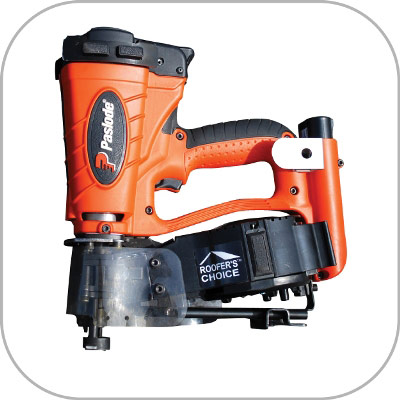
Specifications
- Model CR175C
- Part # 904500
- Weight 7.5 lbs
- Height 16 3/4″
- Length 14 1/8″
- Width 6 5/16″
- Speed 2 Nails/Second
- Nail Capacity 120 – 1 coil
- Nail Range 1¼” – 1¾”
- Nail Collation Wire Coil
- Nail Type Roofer’s Choice Galvanized Fuel + Nail Combo Pack
- Fuel Type Roofer’s Choice quicklodeâ„¢ fuel
- Nails per Fuel Cell 1,000
- Fuel Life 21 months
- Battery Life 2,200
- Warranty 1-year full warranty, 5-year limited
What’s Included & Where to Buy
These nailers haven’t hit stores yet but they’ll probably be sold as a kit. Each kit will retail for about $529.00 and include:
- CR175C Nailer
- Safety tether
- Battery & Charger
- Fuel cell
- 6 coils of nails
- Soft case
What do you think? Think this is a good addition to your toolbox?


I’ve returned from the Delta/Brizo Faucet event in Indianapolis loaded with notes and information, so I expect there will be future posts as we try out and review more of their products here at OPC – which we are eager to do! But in the meantime, having now visited their headquarters and met with many of their company leaders, as well as already having one of their Touch2O faucets in our home, I’m ready to present some of the highlights of the Delta and Brizo brands. We’ll start with Delta today. Look for Brizo later in the week. General Impressions: That Delta set aside the time to invite all of us to their headquarters for this media event set my expectations of their products pretty high. I was not disappointed. The care taken to impact the industry with their innovations, to reach a broad customer base with their designs, and to sell faucets that are long-lasting and of good quality stuck out in each seminar we attended. They have a remarkably energetic, dedicated and friendly team there, too. And that pays off in the products we, the consumers, bring into our homes. Delta’s Technological Advantages: H2OKinetic Technology – We got to play with this one while we were there at DFC headquarters, and I can tell you from my “hands in” experience that there is a big difference between faucet technology that uses smaller droplets in a straight-line-emerging fashion and what Delta has done. The wave pattern and larger droplets do generate better coverage, even while using less water (because you can’t “dodge between the drops” even with your little finger the way their faucets work).
 [photo credit: Charles and Hudson]
Ethan has already covered H2OKinetic Technology in a prior post and caught this great shot of the water pattern in his shower:

But, by all means, check out Delta’s video, too:
[Video Credit: Delta Faucet]This is definitely something I want in our house when we get to remodeling our showers. Touch2O Technology – We’ve already touted this great faucet innovation. For kitchens and for baths, how great is it to be able to turn on a faucet with the touch of an arm, back of the hand, or whatever body part works best when your hands are covered in dirt or germs? [The amusement of watching your friends and guests try to figure the faucet out the first time they come to your house is a secondary benefit.] 🙂
Diamond Seal Technology – Using a diamond coating on their valves gives the faucets more durability over time (they claim in writing “up to 5 million uses”) as well as a smoother range of movement as you maneuver the faucet handle. With their Diamond Seal, Delta has also made the switch to all-in-one PEX-C (polyetheline, crosslinked) tubing and enclosed valves, which eliminate joint and seal leaks and also make installation much simpler.
MagnaTite Docking – For their pull-down spray nozzles, magnets on both the nozzle and spout ensure that that nozzle stays put when you’re done using it and doesn’t start to sag out of place over time:
[Video credit: Delta Faucet]Notes on Installation: About mid-way through our day at Delta, the good people there decided it was time for a mixer/game. And no, it was none of this “facts about the attendees Bingo” nonsense, either. It was Faucet Installation time. Kitchen Faucets and Lavatory Faucets. In groups of 3. Here’s my team. We rocked the installations, if I do say so myself.
 [photo credit: Joe Dusel, CFT411]
That’s Jonathan Sweeney from Housing Zone on the left and Tim Layton from The Remodeling Guy on the right. We took turns being the one lying in the bottom of the base cabinet as we installed and then un-installed our kitchen Touch faucet and then the bathroom faucet. And while it’s never totally comfortable to be lying in a cabinet, facing up and hoping nothing drips on you, these faucets are simpler to install than others I’ve worked with. Having the PEX-C tubing already built into the faucet eliminates having to also purchase hot and cold water connections to go with your faucet. And the PEX-C is flexible, so it’s easier to match up to your hot and cold sources than copper tubing is. Design Details: Of everything I learned while at Delta, the amount of resources and attention they invest toward design was the most surprising. They actively seek to tie in their faucet designs to current and (as best they can tell) up-and-coming fashion and home decor trends. Their designers literally travel the world to get ideas, and the effort shows in their Delta faucet lines (their Brizo lines are even more remarkable, so stay tuned for those as well!)



 [prior 4 faucet photos from Delta Faucet]
Where to Buy Delta Faucets are available at many local and national home project supply stores as well as kitchen and bath showrooms. To find one near you, check the Delta Faucet Retailer Locator. I’ll be back in a few days with Brizo – Delta’s upscale brand. Quite nice, so come on back to read about them, too!
[header photo credit: Charles and Hudson]
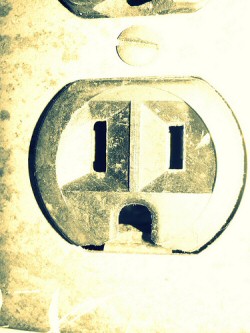 Last week we discussed why outlets and plugs are polarized (it’s a safety feature… if you missed that article, it’s worth a quick read). This week I want to take a minute to describe why modern day electric circuits and appliances are grounded.
Most of the electric circuits in your house have three wires going to them, a black wire (normally hot, or energized), a white wire (normally neutral), and a bare copper wire (always ground). Â The larger left slot in an outlet is connected to the neutral wire; the smaller right slot is connected to the hot wire, and the circular slot beneath them is ground.
In the electrical panel for your home, all of the neutral and ground wires are connected together on a single bus. Â That’s right, neutral and ground are equivalently grounded. So why is it necessary to have two wires going to each appliance?
The reason is safety. Â The bare copper ground wire is connected the metal box of an appliance. Â The ground wire ensures there is a path for electricity to get back to the breaker box if there’s a short circuit in the appliance that bridges the hot wire onto electric-conducting parts of the containing box.
Why Grounding is Necessary in Electrical Circuits
If you didn’t have this safety feature, bad things could ensue. Â Consider this situation: Let’s say the hot wire comes loose in your washing machine and makes contact with the metal box that houses the appliance. Â The box is sitting on rubber feet so there’s no exit path for the current through the ground (rubber is an electrical insulator).
Since the electricity has nowhere to go, the box remains charged.  You unsuspectingly touch the washing machine and the current suddenly finds an exit point–through your body and out your bare feet to the floor.  You get a terrible shock, or worse, you get badly burned or even killed.
Now, consider the same scenario except that the box is grounded. When the initial short circuit occurs, a rapid amount of current flows through the ground back to the electrical panel. Since there’s almost no resistance across the ground, the circuit overloads and the breaker trips almost instantly, sparing you a hair raising experience.
It Doesn’t Take Much to Kill You
While we write about this elsewhere, it’s worth noting here that you will likely be dead before a breaker trips because too much current has flowed through your body. It takes well under 1 amp of current to cause cardiac arrest… and most household circuits are governed at a whopping 15 amps!
This is why GFCI protection is so important on circuits that are more likely to be shorted by humans (such as those in kitchens and baths). This type of protection detects when current passes to ground rather than back through the neutral wire and shuts off the circuit.
The combination of grounding (for all appliances), and GFCI circuits (where humans are likely to bridge a circuit to ground by accident) create a pretty sound safety net. More recently, arc fault protection has also been introduced into the code to protect against current arcing across wires such as in situations where a staple was driven too tightly across the insulation and damages the wires inside.