

Floor Joists: Solid Lumber, TJI’s, LVL and Open Web Floor Trusses
September 30, 2011 | by Ethan (email) |
It’s funny the different things people notice about a house. For instance, I like to check out the type of floor joists in my friends’ homes. You might think it’s strange, but joists can impact lots of things like floor plan, fire safety, what materials can be installed for flooring surfaces, and even indoor air quality. In this article, I’ll review a few different types of joists, and you can decided if they’re important to you too.
Editor’s note: This article originally ran in 2008. We are re-publishing it with updated information and additional perspective from spending more time on job sites. We hope you’ll add to the conversation in the comments section below.
Joists are horizontal supports that span from wall to wall, wall to beam, or beam to beam. Several popular options include solid lumber, LVL, wood I-beams, steel joists and open web floor trusses. Let’s examine three of these materials.
Solid Lumber Joists
Traditional solid lumber joists are still very common. They were the default for some time, but in the early ’90s builders started using engineered products more and more. Initial costs for solid lumber joists are (usually) cheaper than engineered solutions but this benefit is cancelled out by the costs associated with limited span distances and increased framing members.
Span distances depend on several factors including wood species, board size, spacing and acceptable deflection. If you’d like to learn more, try out this handy calculator that lets you enter all the necessary details.
From an environmental perspective, solid lumber joists are expensive. These joists are contiguous boards created from old growth trees- a supply which is quickly being exhausted. Using younger trees often results in warped or bowed wood.
One major advantage is that solid sawn joists will last longer during a fire. This is important when you or a fireman is depending on them to hold weight.
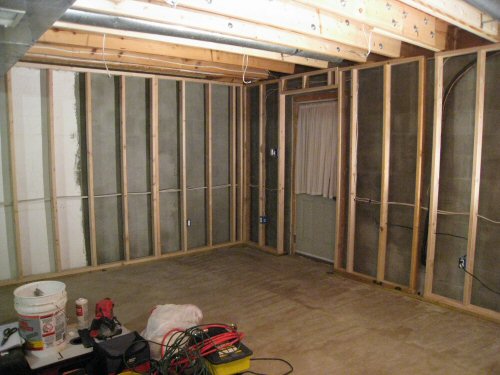
Sistered solid wood joists
I-Beam Joists
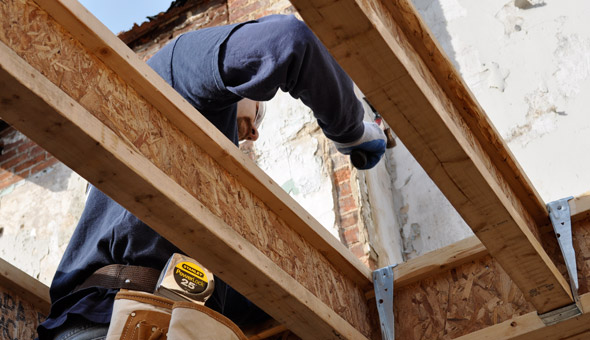
Wood I-joists (sometimes called TJI’s) resemble steel I-beams. They are composed of a top and bottom flange (usually a 2×4) with a piece of plywood or OSB fixed perpendicular in between.
The biggest benefit I-joists bring are the long span distances you can achieve. A TJI 16″ deep and spaced 16″ o.c. can span about 26 feet! The second biggest perk is how little I-joists flex, and if you’ve ever installed ceramic tile, you know how important that can be. They also have a higher load carrying capacity than comparable solid joists, and the materials used result in less twisting, shrinking or bowing. If you see a home with an open layout, odds are the builders used TJI’s.
It’s important to follow manufacturers guidelines when notching or cutting a hole for things like utilities. Cut-outs should have rounded corners to reduce stress and should only be done in the plywood or OSB. Many I-joists are pre-scored or have knockouts to make things easier.
The only downside I can see to TJI’s is that plywood and OSB can pose a small health concern because of off-gassing from the adhesive, and this doesn’t bother me at all. Lots of household products can fall into this category like radon produced by granite countertops. I’m no expert, but I seriously doubt that eliminating I-joists will improve indoor air quality very much.
Open Web Floor Trusses
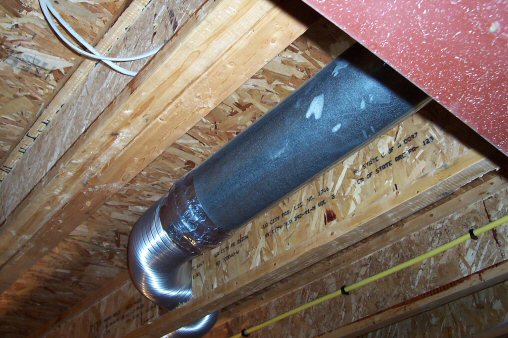
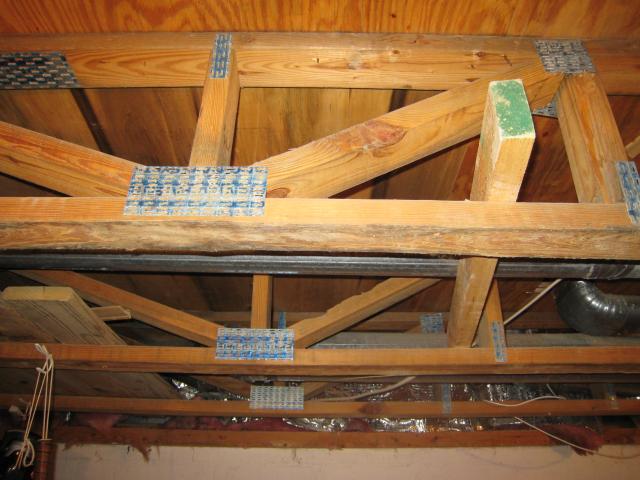
Open web floor trusses are constructed with 2 x 4’s on top and bottom with a sort of “web” in between secured with metal plates. The open space is ideal for running wires, pipes and utilities. I have these in my home, and I use the space for extra storage as you can see in the picture.
These trusses are generally ordered ahead of time and cannot be modified on site (although modifiable trusses do exist). Web trusses are manufactured to eliminate twisting, shrinking, or bowing. They also utilizes less wood than solid joists. Score one for the environment.
The only reason I like TJI’s more is that web trusses will flex more, and I’ve really come to value a floor with limited deflexion.
What do you think? What kind of joists do you have? Any builders want to weigh-in?









Ethan,
Every new home we build uses some type of composite floor beam system. There are so many advantages to use them that the cost never really plays into the decision. The big deal really is span and deflections. Typically floor sizing isn’t governed by load condition. The size of a beam that works for code governed loads typically isn’t as large as a beam sized to produce minimal deflections and vibrations. Now that people are installing beautiful tile floors and granite counter tops the floors need to deflect less. The stiffness of a 2×12 regular floor joist can be less than half the stiffness of a 11.25″ deep TJI. The fire issue is certainly a problem but we find that most people are finishing basements today so a layer of drywall will certainly improve the fire rating drastically.
The cost difference really isn’t a big deal. Especially when you look at the cost savings in additional framing members that can be eliminated with longer spans. Plus when you start trying to get conventional lumber to meet the same deflection criteria you get in trouble really fast. Then there’s the bonus of using younger growth trees from multiple sources. As far as I’m concerned it’s the only way to go in modern wood framed construction. Great post!
@Todd, I knew you were knowledgeable in this area and had hoped you’d offer your two cents. From what I can tell the savings with solid joists are canceled out in the long run of building a house. I installed ceramic in my kitchen and the open web joists are stiff enough that I’m not worried about anything cracking. Thanks for your thoughts.
The cost difference really isn’t a big deal. Especially when you look at the cost savings in additional framing members that can be eliminated with longer spans. Plus when you start trying to get conventional lumber to meet the same deflection criteria you get in trouble really fast. Then there’s the bonus of using younger growth trees from multiple sources. As far as I’m concerned it’s the only way to go in modern wood framed construction.
Off-gassing in tighter homes from poisonous adhesives and plastics are a real problem. Most current OSB I joists and other like products do not belong in a healthy home. Also it took 2 hours for the fire department to get to me for a garage fire, that’s a problem. I say real wood joists or perhaps steel.
@S Bauer, I think it’s a trade off. I-joists use less wood and therefore benefit the enviornment / building costs. It’s true that adhesives can give off toxins but typically not harmful levels. Also some plants can be used to eliminate those toxins. Your right to be concerned with burn rates but if it takes 2 hours, I’m not sure how much it will matter. Hopefully your fire dept. isn’t normally that slow. Thanks for the comment.
Open web wood joists are a great alternative to dimensional lumber although I echo the caveat issued by S. Bauer that it’s best to avoid the laminated/glued products whenever an alternative exists. Personally I avoid even interior plywood at all times (subfloors, cabinets, etc.). Great post.
I am in the beginning stages of building my new home,my contractor has ask
to use web joists.I have read some of the comments on your site,I would think
the enviroment should be considered in any build today.With the proper material in a home ie:5/8 sheetrock on basement ceiling,would slow down any fire.or if
you wish a properly installed sprinkler system will also do the trick (this is being
installed on al floors in my home.).Thanks for the info.
For fire ratings it is best to look at UL Fire Ratings. http://www.usgdesignstudio.com/floorselector.asp (not sure if posting links is OK?) I am not an architect so i do not have a ton of experience with fire ratings but a 1-hr is typical for any single-family dwelling. And there are always codes to help out in this situation.
As per truss v. TJI; TJI’s are more eco friendly, they involve far less wood OSB is made of scraps, the adhesives aren’t all that bad, shipping is easier, no steel plates are used, and the list goes on. A house really shouldn’t need truss unless there is a serious heavy load. I have designed 24ft spans w/ 24″ deep floor trusses for a Live Load of 140 psf (a lot considering a house load is really only 40 psf and 30 psf in sleeping rooms). Trusses handle more load and can be a lot deeper (therefore can span further than a 16″ TJI)
Good luck with the Home Building! and remember if you see the site with just the footing and stem walls it will look a lot smaller than when it has walls up! (ie you may think you made the house too small when it is perfect!)
If span is not an issue, solid joists are best – fire safety, stability (cross bracing elimates any variances). Unless the technology has changed, steel is not a good substitute for solid lumber if fire is a concern. The stell fails structurally under fire than even the engineered wood systems.
I live in a two story home. I was told when I installed new flooring in my kitchen which is the first floor, that I could not go with ceramic tile because the floor trusses were too far apart and they also weren’t connected at the end where it meets us with the wall. My home is about 18 years old. Now I want to know if I can install granite counter tops in my upstairs master bathroom. There are two sinks and a counter in the middle and it is on an outside wall. Do you think that would be too heavy?
Hi Kathy,
I believe the concern with a ceramic floor was not the weight but rather that the floor flexes too much and the tiles would crack. I don’t think the granite counter tops will be a cause for concern with weight either. To be sure, you should get a professional opinion though.
I know that I’m months behind here but someone in a home similar to Kathy’s can always “sister” in some additional joists and blocking to stiffen up the floor. It is much easier (and cleaner) if the ceiling below isn’t finished.
Boy, this is sure something that the average person would give no thought to. Makes me wonder how many people put in heavy items, such as a whirlpool tub, with no consideration as to how much weight the floor will hold.
My parents had their house designed so they could put a hottub in their bathroom, there were twice as many open web trusses where it was going to be sitting.
Far too often!
After installing flooring and new lighting in our condo I’ve come to find we have open web trusses 24″ on center. They are nice because I can feed wires and whatnot through them with ease. However, the downside is I have no way of calculating deflection of my floors so my recent tiling project has been done using the jump test, not exactly perfect science.
Actually I think you could figure out the sag. Put a small scrap of wood in the center of the floor you are trying to figure out. Fasten a string line to one side of the room either with a screw through the carpet or into a stud through the drywall. It should be near the same height as the scrap wood. Pass the string over top of the scrap and fasten to the opposite wall so that the string just grazes the scrap wood. Now add weight near the piece of scrap (invite some friends over) and see if it falls away from the string line.
We have Open Web Floor Trusses and also use it to store things up there. I find they flex a lot too.
Do you have any tips for making a less squeaky floor? We plan on replacing the hardwood in one of the rooms and that floor creaks whenever you walk in. Basement is unfinished so easy access to fixing the problem.
On my carpeted floors I used a product called Squeak No More. I think it works for wood too but you would have to putty the tiny holes left behind.
http://www.google.com/search?q=squeak+no+more
Thanks Jeff never seen this product in Canada. I might have to look for it though could be out there. We have some squeaky floors upstairs too so if not for wood it would help in the carpeted areas.
When they had it on This Old House they called it by a different name but essentially the same product. Home Depot calls it Squeeeeek No More. I couldn’t find it on Amazon.ca but home depot might carry it in store.
Have to disagree with the deflection issue with open web floor trusses Ethan. Floor trusses can be manufactured with specific deflection criteria built in. Most floors are designed L/360, but for a stiffer floor surface, you can specify L/480 and even L/620. You will see increases in lumber grade and connector plates sizes, but ultimately the open web floor trusses have the most design flexability of the three options mentioned in this article. 2×6 strongbacks are recommended on edge every 10′-0″ which will remove most springing felt and eliminate squeeks, while giving lateral stability to the floor system at the weakest point, the verticals that create the duct chase. You can also alter the panel sizes for a stiffer floor, change the design of the webbing (warren vs. K series) or alter the depth and spacing for the greatest span to depth ratio. In my mind, there is no better or more adaptable product than the floor truss to make job specific choices and alternatives. The proof is in the planning!
I didnt see any mention of what would happen to a open web truss in a fire… which is it would burn REAL quick, and it would have zero firestopping capability, so once it gets through the ceiling, it can burn all of the trusses, not just one. while they are supposed to add firestops, it doesnt give nearly as long of a burn time as a solid product (and the Ibeams count…)
I don;t know what kind of Joists i have at my home . it’s a 2 floors house in USA , how can i figure out what kind of it ???, as you get me so interested . Thanks , great article on Floor Joists .
We have what I remember being called laminated beams because of the length and weight the held. Am I understanding correctly that they are not as safe in case of a fire? Not that we plan on having a house fire, but that’s certainly something to think about when building a home for sure. I’m shocked that so many towns still have no codes to follow. No inspectors to check for safety either. My home town, not where I live now, included.
Useful article…thanks. Here is my question: we will be adding a 15’X20′ room in which we want VERY little deflection (TJI?) but also freedom to run utilities in any direction (open web?). We want joists that span the room. So, would it make more sense to cut holes in TJI joists or beef up open web joists? And what value of deflection rating would give the floor a “rock solid” feeling?
Open web trusses have several disadvantages for firefighters. Number one is fire spread. Where engineered beams and dimensional lumber joists create natural fire stops, open web trusses have no ability to prevent heat and smoke from traveling not just the length of the truss, but also the entire width of the floor. You also have gusset plates holding everything together. These flimsy metal plates with very short teeth are very strong when used properly, and not subjected to fire conditions. Under heat, however, they expand and warp, and fall out of the wood, leaving no other fastener to keep the truss together. If they don’t warp and fall out, the wood only has to char a little in depth to release the gusset plate. And the smaller dimensions of the lumber used to make an open web truss mean that the mass is less, and the burn rates of the lumber itself increase over traditional joists. If one piece of the truss or truss system fails, the entire truss or floor could fail, especially when you add the weight of firefighters and water used in suppression.
Engineered beams have some problems, too. The biggest one is how quickly they burn. They’re made of a bunch of wood glued together, all of which burns very well. They’re small and thin, which means is takes no time to burn through one. They fail quickly, like trusses. Many new engineered beams are actually a form of truss. They’re using bent steel to make a truss pattern that is then glued into a channel in the top and bottom chord of the truss. They’re the size of engineered beams, which is often smaller than trusses, but they have the openness of trusses. If fire spreads into this void under the floor, it not only has full run of the floor, but it also now has access to a material that fails faster than wood in fire conditions. Steel expands and weakens at house fire temperatures. The glues that hold the steel in the chords releases, and you have a weak piece of bent metal between two pieces of 2×3 with a groove in them, and nothing holding it all together.
Dimensional lumber may suck for modern house construction because of cost and limited span, but lightweight construction sucks for firefighters because of fast fire spread and early failure. Keep this in mind when building a house for yourself, because if fire has had access to structural members for 5-10 minutes, it ain’t lookin’ good for anyone on top of or underneath those supports.
Has anybody heard of fire insurance? Just saying the percentage of homes that burn down are minimal so save a tree or two and use trusses. Oh by the way u will save labour money on framing, hvac, plumbing and electrical. Enjoy happy building!
Fire issues aside, what impact would water from plumbing leaks or problems have on the engineered beams? I’m always concerned about what water can do to any type of plywood. Perhaps since the laminate is not physically touching the floor above, water damage would be minimal. Just something I’m thinking about while planning on building a new home.
Now I want solid lumber that can span 30 feet with L620 deflection, be perfectly straight, be able to run utilities through it at will, never burn, and not require cutting down of huge old trees. Solve that one for me and I’ll give you a gold star.
Engineered lumber/products have a place but for small residential construction I’d personally use solid lumber. Why:
1. Engineered products typically burn more quickly than solid lumber. This is a bigger concern than people think.
2. They require more primary energy for their manufacture than solid lumber. Not all that green.
3. They’re not made locally. Using locally milled lumber is ‘greener.’
4. The adhesives used in some products may be toxic. A concern with some resins is the release of formaldehyde in the finished product, often seen with urea-formaldehyde bonded products. The building industry has a long track record of being, well, wrong.
5. Cutting and otherwise working with some products can expose workers to toxic compounds.
6. Some engineered wood products, such as those specified for interior use, may be weaker and more prone to humidity-induced warping than equivalent solid woods.
Just some thoughts…happy building!
I am going to start building a home 40×77 this is with a two car garage it’s approx2100 sq ft of living…. It’s all on one floor it’s on a slab I want to elevated witha row of concrete blocks to raise it about 8 off the slab..this property I have own over 30 years… The slab is there used to be a storage building for me..it’s 6 inch thick ..never had any water problems .so I have a few question.first all is there any thing I should be concern .with raising the home the height of a8 inch block number one what type.of floor joinst should I use. ..second what is a ball park price of one joinst ..and I am going to have a standard gable roof…leads me to my second question the trusses It’s a straight across ceiling . 9 high what is a rough price for a trus like this .and what is a going rate ..for framers and what does a framer supply I will be buying the lumber..so will he be supply all the nails and what ever ..and if there’s any other concerns I should have ..the sewer lines are already in there.
What about in 20 or 30 years when the glue starts to break down? Or when you put it under a bathroom or wash room and have a water accident and the water causes the glue to break down? Mobile homes with partial board floors are a mess, the floors get wet from whatever and then it just falls apart! I just do not see this as a good thing.
My Mom is building a new house because their old 130 year old house has mold and fumes causing health problems (termites destruction too, but that’s another issue) I really don’t think the glue will be much of a heath issue but its just another bad thing.
These are not looking ahead a house should last 120 years, how is that going to happen when you make it with glue that will break down over time?
I’m an engineer in the SF Bay area. I’ve been designing homes for the past 20+ years and I’ve read some of your comments. Floor framing has really evolved. when I first started designing in my younger days, we used predomintly 2x dimensioned sawn lumber floor joist. Now….I would say that at least 90% are built using I-joist framing. The other 9.5% would be open-web floor trusses. Open-web floor trusses are most beneficial, in my opinion, for multi-family projects because of duct works but I-joist are still mostly used. Some of you mentioned about deflection criterias for tile/marble siturations. I personally always design a much stiffer floor than the building code requires because the building code minimum, in my opinion, is a very poor quality floor. Floor joist stiffness has most to do with the span of the floor joist. Other than the floor stiffness, I would not recommend going more than 16″o.c. floor joist spacing for I-joist and
19.2″ spacing for Open-web because the floor plywood tends to get bouncy. The reason Open-web can be spaced closer is that it usually has a wider top & bottom chord. I don’t know if anyone mentioned too…and that is 2x solid joist usually will shrink so floor squeeks could be a problem.
Did u mean web joists can be spread closer or farther? Looks like u meant farther.
I bought a new house. In the basement there are 16″ open-web trusses supporting the 1st floor. They span 30′ and are 12″ on center.
The problem is the 1st floor is really springy. When I am sitting on the couch I can feel the 30lb dog bouncing across the room (yes he bounces).
Looking at pictures from the build (the ceiling is now finished) it looks like the stongbacks were not installed everywhere. They are listed on the structural drawings as not required. Even withouth the ceiling it would be nearly impossible to get them i n there at this stage with the trusses being only 12″ apart and the walls bricked up. My understanding is that the strongbacks have to be continuous and can’t be installed in 3′ or 4′ pieces.
One option I considered is adding a load bearing wall about 6′ off the outside wall – effectively cutting my span to 6′ on one side and 24′ on the other. I don’t really want to add columns in the middle – prefer to keep it as open as possible.
Thoughts on this? Would I be better off opening up parts of the ceiling and adding blocking or cross bracing between (thinking this might be the same effect as the strongbacks being installed).
Thoughts or any other ideas?
Joe, I’m an engineer in the SF Bay Area. My first thought when you said 30′ span… Is wow! That’s really a long span for a floor joist & I’m not surprised that the floor is springy. In my opinion, i do not think not having strongbacks is the problem…it is definitely too long a span. In addition to being springy….i bet there might also be alot of vibrations in that floor. As I mentioned in my comment earlier, the building code is lacking when it comes to floor joist design & it is possible to have a floor that meets the building code but is a terrible floor. You mentioned adding an interior support to the floor… I’m sure that would help, but I’d like to warn you about doing that. When you add a support that is unbalanced…i.e. 6 ft & 24 ft, or when one span is much longer that the other, there is a potential of having uplift forces at the shorter end. It is best to add an interior support closer to the mid-point if that is possible. You should definitely have a professional look at that before you do it.
What is the best way to reinforce questionable floor joists? or test if one is rotten. We just moved in to an old farm house that is in a bit of disrepair and the floor in the bathroom seems a bit soft, feels like you can feel the shape of the joists underfoot in some spots. I’m not sure if it goes deeper than the linoleum flooring and plywood and whatever else may be between that and the floor joists them selves. If nothing else I’m going to have to pull up the old flooring and probably the subflooring and I’d like to make sure the joists are solid and sound before sealing the whole thing back up. Based on the age of our house I’d guess we have solid lumber joists though I haven’t visited the crawl space yet. Thanks for any advice!
We are having are kitchen redone the counters will be 3/4 inch granite the counters will be 96 x21 on one side and the other side is 160 x 103 inches – the size of fridge and stove which is 66 inches the stove will be on the wall which is 103 inches and the fridge on the other wall at the end of it what do we need to do to support the weight so we do not have the beam splitting and floor saying thanks.
We are having are kitchen redone the counters will be 3/4 inch granite the counters will be 96 x21 on one side and the other side is 160 x 103 inches – the size of fridge and stove which is 66 inches the stove will be on the wall which is 103 inches and the fridge on the other wall at the end of it what do we need to do to support the weight so we do not have the beam splitting and floor saying thanks.
I have read so many articles about the blogger lovers except this piece of writing is in fact a pleasant article,
keep it up.
I like to use the open web trusses when I need more room for stuff in-between floors. I beams are nice because they don’t tend to twist at all. Solid beams are best when I might need to stack more than one truss to make a larger beam.
It’s been a while since I posted to this blog but I just read one of the later blogs from Charlene because it caught my attention. Charlene, you are concerned about installing basic things in your kitchen. I am an engineer in California and if your home was desgned to code, these things should not be a problem. The code requires that all floors in a residential home be designed for dead load plus live load. The standard code live load is 40 psf. The normal dead load most engineers use are about 15 psf to 20 psf. This includes the weight of the floor framing, plywood sheathing and permanent partition walls. This way of design is usual adequate to handle all residential floor loads.
I had an inspector (California) just shut down a job due to a sub’s sprinkler install which was a first. Installation was through solid joists spanned 13′ which holes centered on standard 2×12 joists (not TJI’s). Above this is an exterior deck which will most likely remain dead load (maybe some chairs in the future but not much. With that being said, has anyone experienced such an issue with sprinkler issues?
Looking at a house with the open web floor truss — looks like there was some sagging and the owners have installed additional steel supports posts in areas. My guess is they went too far of a span. My question – If I glue and screw an additional 2×4 on the under side so as to stagger the seams will that help / eliminate the problem?
There is one item that I’ve not seen anyone mention in regards to open web trusses and stiffening. With the advancements in adhesives now, to me, they can be stiffened by applying adhesive to the top and bottom chord and the sides of the finks, and then a simple piece of 7/16 or 1/2″ plywood ring nailed to them would greatly stiffen the joist, help prevent time sag, and can also provide a fire block as well. As I’m designing my house now, this is what I’m looking at doing in the main living areas to de-bounce and solidify the floors. Thoughts?