
The weather has become cold enough that I get strange looks walking around in shorts. I love the brisk fall days, and they serve as a helpful reminder that here in Maryland colder weather is on the way. If you haven’t weatherized your home, there are simple steps you can take to be ready for seasonal changes. If you have weatherized, it’s a good idea to do a quick audit as I usually find one or two things that need attention.
DAP got in touch with us and asked that we share a weatherization project. When they offered to cover time and expenses with a gift card, I was more than happy to oblige. In fact, I immediately remember a few things that were on my to-do list. How convenient, right?

Where to Weatherize
I think the biggest challenge to weatherizing your home is learning where to look. A good rule of thumb is to seal anywhere something (vents, pipes, wires, etc.) passes through an exterior wall. Here are some culprits worth investigating.
- Windows & Doors- Inspect the trim for cracks and holes. Sealing the joints will prevent air from escaping your home and insects from finding a way inside.
- Vents- Many home have vents for bathroom fans, dryers, microwaves and HVAC units. Again, examine where it passes through the wall (inside and out).
- Pipes- I know that at one point ants where entering my house through the gap for our hose connection. It was almost funny to watch the line of ants going in and out.
- Wires- You might not even realize all the wires that go through exterior walls. Consider taking a look at the cable and satellite connections, HVAC power and freon, and power for exterior outlets.
- Cornerboard- The cornerboard is the vertical board where siding ends at the corner of your home. If you’ve ever seen a thermal scan of a home, you know that corners are problem areas because they’re tough to fully insulate.
- Electrical Fixtures- Take a look at your light switches, electrical outlets, and lighting fixtures. The electrical boxes behind each of these often creates a break in insulation. Sealing any gap around the outside of the electrical box helps reduce air exchange.


For a few more ideas, you might want to check out Seal You Home– a DAP site with information about air leaks and how to seal them.
The Right Product
The next question is what is the right product for the job. I picked up a few things at Lowe’s including DAP 3.0 Advanced All Purpose Sealant, DAPtex plus, and a caulking tool kit. For the latter, I was curious how well it worked, and in the end went back to the old finger swipe method.
I really like DAP 3.0 because it’s a silicone sealant that has better flexibility and durability than acrylic latex. That means it’ll last longer and won’t crack or shrink. Lots of silicone sealants are not paintable, but DAP 3.0 is paintable. Lastly, it’s appropriate for indoor and outdoor applications. It really is “all purpose.” This is the same product I used for painting my aluminum overhang.
DAPtex plus is a foam sealant that is great for filling large gaps. It’s the sort of thing you’d use around a door or window frame (underneath the trim), and I found it really useful around some exhaust pipes. Again, I like that it’s approved for indoor and outdoor use, and it’s paintable.
DAP is the leading manufacturer and supplier of caulks, sealants and insulating foams. They have lots of options to help you weatherize your home. Just check the “suggested uses” to make sure it’s the right product for the job. You can also connect with DAP by following them on Twitter.
What Did I Weatherize?
I only had a short list of things to weatherize as I had already recently re-caulked several windows, doors and above my bay window. I ended up caulking some baseboard, around several wires and my dryer vent. I also used the foam to fill some gaps around some pipes.


Disclosure Language:
DAP partnered with bloggers such as me to participate in the “Seal Your Home†Blogger Challenge. As part of that program, I received compensation (gift cards to cover expenses and fund future OPC projects. Hurray!). They did not tell me what to purchase or what to say about the products used for the “Seal Your Home†Blogger Challenge. DAP believe that consumers and bloggers are free to form their own opinions and share them in their own words. DAP’s policies align with WOMMA Ethics Code, FTC guidelines and social media engagement recommendations.
So I’ve been mentioning Channellock a lot recently. I’ve been a devoted Channellock man for some time now, and they make good, durable products. Plus, I like that everything is “fiercely made in Meadville, PA.” I love my Tongue & Groove pliers, and they are never far from hand. With that said, I think Channellock is losing ground. You may think there isn’t much room for innovation in the world of pliers, but that’s exactly what companies like Irwin and Milwaukee are doing. Six months ago a pair of Irwin GrooveLock pliers found their way into my tool tote, and last July I attended the Milwaukee tool launch where they showcased some impressive hand-tools. Here are the improvements that my Tongue & Groove pliers are missing.

Quick Adjust
The elephant in the room is that Channellock pliers are not as easy to adjust. You have to fully open the jaws before they’ll slide to the next position. Irwin calls it “Press-n-Slide” while Milwaukee calls it “Quick Adjust.” No matter what you name it, you can adjust the jaw size on Irwin and Milwaukee pliers with the press of a button, and in a world that emphasizes faster, lighter, stronger, Channellock loses out.


Jaw Capacity
Have you ever tried to use pliers to grip something bigger than they were intended? I remember trying to get the oil filter off my car (I didn’t have a filter wrench), and just barely being able to grip it. Well the newer locking pliers have a wider jaw capacity than comparable Channellock’s. For instance the 12″ Tongue & Groove pliers have a 2-¼” jaw capacity while the Milwaukee and Irwin models have 2-¾” jaw capacity.

Handles
Milwaukee was smart and added ridges to the handles for reaming pipe. Irwin took a different approach by ensuring the handles never pinch. Tongue & Groove pliers have been around since 1933, and of the 4 changes since, none have had anything to do with adding functionality to the handles.


I’m not trying to bash Channellock, and I’d love to see some data showing me wrong. Unfortunately, I feel like they’re not getting out ahead of the competition, and I bet they’re losing market share. Channellock has unveiled three new levels, and you know I love their new ratcheting screwdrivers. Even so, their most recent patented update for Tongue & Groove pliers was in 1984, and that’s a big gap when you claim “a commitment to innovation.”
What do you think? Am I way off-base or do you expect more from Channellock too?
Floor Joists: Solid Lumber, TJI’s, LVL and Open Web Floor Trusses
September 30, 2011 | by Ethan (email) |
It’s funny the different things people notice about a house. For instance, I like to check out the type of floor joists in my friends’ homes. You might think it’s strange, but joists can impact lots of things like floor plan, fire safety, what materials can be installed for flooring surfaces, and even indoor air quality. In this article, I’ll review a few different types of joists, and you can decided if they’re important to you too.
Editor’s note: This article originally ran in 2008. We are re-publishing it with updated information and additional perspective from spending more time on job sites. We hope you’ll add to the conversation in the comments section below.
Joists are horizontal supports that span from wall to wall, wall to beam, or beam to beam. Several popular options include solid lumber, LVL, wood I-beams, steel joists and open web floor trusses. Let’s examine three of these materials.
Solid Lumber Joists
Traditional solid lumber joists are still very common. They were the default for some time, but in the early ’90s builders started using engineered products more and more. Initial costs for solid lumber joists are (usually) cheaper than engineered solutions but this benefit is cancelled out by the costs associated with limited span distances and increased framing members.
Span distances depend on several factors including wood species, board size, spacing and acceptable deflection. If you’d like to learn more, try out this handy calculator that lets you enter all the necessary details.
From an environmental perspective, solid lumber joists are expensive. These joists are contiguous boards created from old growth trees- a supply which is quickly being exhausted. Using younger trees often results in warped or bowed wood.
One major advantage is that solid sawn joists will last longer during a fire. This is important when you or a fireman is depending on them to hold weight.
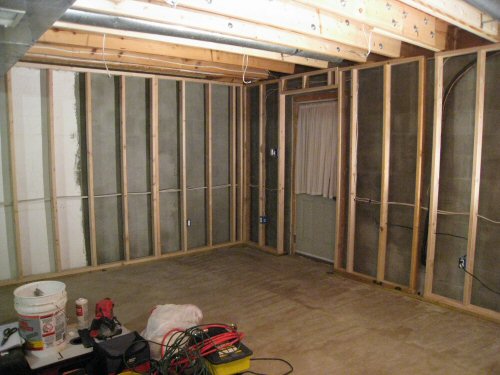
Sistered solid wood joists
I-Beam Joists
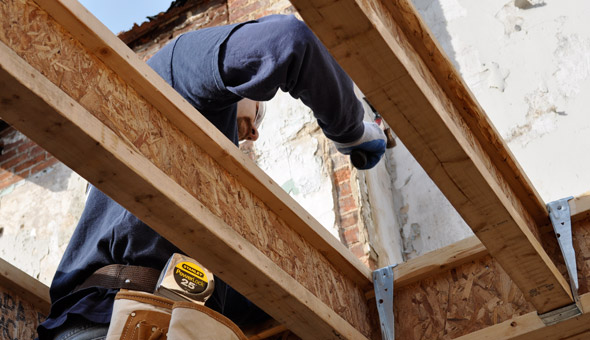
Wood I-joists (sometimes called TJI’s) resemble steel I-beams. They are composed of a top and bottom flange (usually a 2×4) with a piece of plywood or OSB fixed perpendicular in between.
The biggest benefit I-joists bring are the long span distances you can achieve. A TJI 16″ deep and spaced 16″ o.c. can span about 26 feet! The second biggest perk is how little I-joists flex, and if you’ve ever installed ceramic tile, you know how important that can be. They also have a higher load carrying capacity than comparable solid joists, and the materials used result in less twisting, shrinking or bowing. If you see a home with an open layout, odds are the builders used TJI’s.
It’s important to follow manufacturers guidelines when notching or cutting a hole for things like utilities. Cut-outs should have rounded corners to reduce stress and should only be done in the plywood or OSB. Many I-joists are pre-scored or have knockouts to make things easier.
The only downside I can see to TJI’s is that plywood and OSB can pose a small health concern because of off-gassing from the adhesive, and this doesn’t bother me at all. Lots of household products can fall into this category like radon produced by granite countertops. I’m no expert, but I seriously doubt that eliminating I-joists will improve indoor air quality very much.
Open Web Floor Trusses
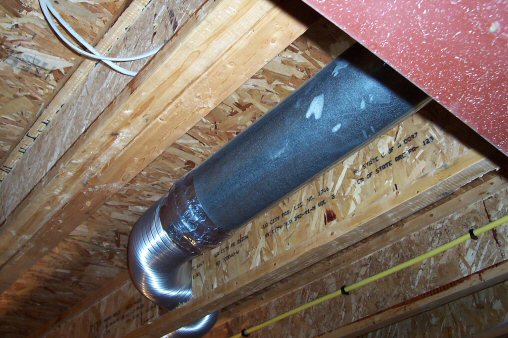
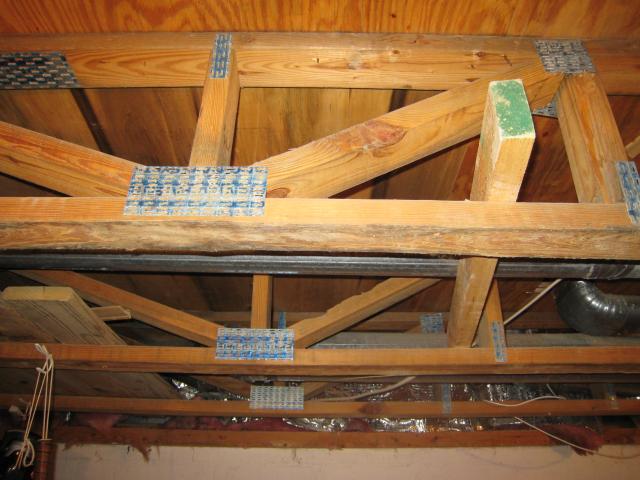
Open web floor trusses are constructed with 2 x 4’s on top and bottom with a sort of “web” in between secured with metal plates. The open space is ideal for running wires, pipes and utilities. I have these in my home, and I use the space for extra storage as you can see in the picture.
These trusses are generally ordered ahead of time and cannot be modified on site (although modifiable trusses do exist). Web trusses are manufactured to eliminate twisting, shrinking, or bowing. They also utilizes less wood than solid joists. Score one for the environment.
The only reason I like TJI’s more is that web trusses will flex more, and I’ve really come to value a floor with limited deflexion.
What do you think? What kind of joists do you have? Any builders want to weigh-in?

The Benjamin Moore Paint Company was started by, you guessed it, Benjamin Moore in 1883. Since that time, this award winning brand has grown to offer the “finest paints, stains, and finishes across North America.” Having used many competitors products like Sherwin Williams, Behr, Valspar, Duron and Ralph Lauren, we were curious how Ben Moore paint would compare and if it could live up to the hype.
To date, we’ve tested two lines of Benjamin Moore paint and can share over three years of durability results. In this article we’ll discuss paint selection, availability, price, coverage and longevity.
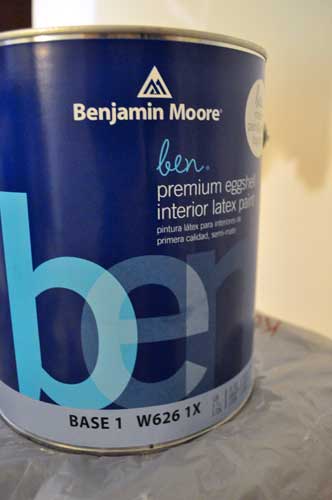
Editors note: This post originally ran in July of 2008. Since that time we’ve received lots of comments, feedback and suggestions. In an effort to continue providing accurate information, we’ve updated this post, and conducted additional testing. Many of the comments may no longer be applicable after this update, but we’ve preserved them to incorporate reader insights.
Benjamin Moore Paint Review
Paint Selection
At every opportunity, we’ve been impressed with the variety and selection Benjamin Moore provides – the colors are stylish and fresh. You can explore the complete catalog of more than 3,400 paint colors online, and view color combinations suggestions based on your choices.
You can even order 1 pint samples online to “try on” a color before making the final purchase. With 1 pint (16 oz) you can apply two coats of paint on approximately 32 sq ft. Orders of two or more colors include a 1″ paint brush, and orders of four or more ship free.
Availability
You won’t find Ben Moore at your local Lowe’s or Home Depot. From the very beginning, BM paint has been sold only through independent retailers. They boast a distribution network of over 4,000 stores across North American including Signature stores, paint and decorating stores, lumber yards and hardware stores. We used the store locator and found several retailers nearby.
This distribution method must be working as Benjamin Moore was rated highest in customer satisfaction with interior paints by J.D. Power and Associates 2011. Click this rating guide to see the details and how the competition ranked.
 Regal Classic Sea Star
Product Lines
There are four main Benjamin Moore interior paint product lines- Aura, Natura, Regal and ben Interior. Each line emphasizes different qualities and carries a different price tag. Prices have risen since 2008, however Benjamin Moore has eliminated hidden costs for color tinting that were not always included.
- Aura:
Aura paint is the premium paint line and claims you’ll never need to apply more than two coats in any color. It’s available in matte, eggshell, satin and semi-gloss sheen, and all of them include the Color Lock Technology to eliminate color rub-off. This self-priming paint also acts as a mildew resistant coating. Aura carries a premium price of $62.99 per gallon.
Aura Product Information | MSDS information (download) - Natura:
Natura paint is a zero-VOC interior paint line (even after tinting). It’s available as a water based primer and eggshell, flat and semi-gloss sheen. Natura is also self-priming, and has “virtually no odor.” This acrylic latex paint is ideally suited for residential applications like walls, ceilings, interior plaster and more. Natura costs $54.99 per gallon.
Natura Product Information | Award Information - Regal:
The third line of Ben Moore paint is called Regal which encompasses Regal Select and Regal Classic, and between the two you can find every sheen possible. Regal Select is newer and claims smoother application and longer durability. Both are washable, fade resistant and mildew resistant. Regal paint is available for $49.99 per gallon.
Regal Select Product Information | Regal Classic Product Information - ben Interior:
ben Interior is the last and most inexpensive line of Ben Moore paint. It’s only available in flat, eggshell and semi-gloss sheen, and is designed to attract consumers who balk at the more expensive options. One gallon of ben Interior cost $35.99.
ben Interior Product Information
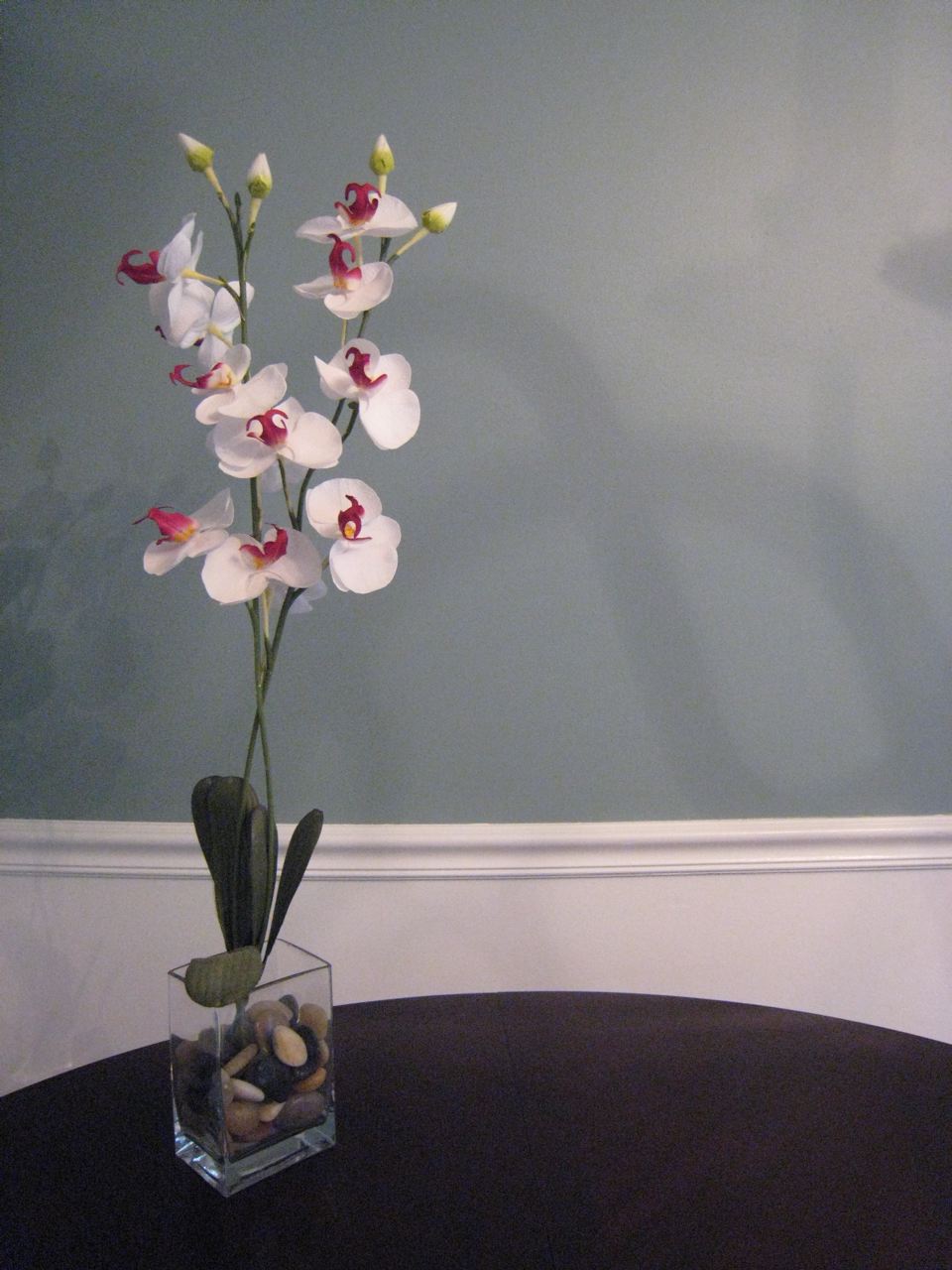
 ben Interior Revere Pewter
Coverage
We’ve tested the Regal Classic and ben Interior product lines and found both to provide smooth, even coverage. One gallon of paint should cover roughly 400 sq ft which we found to be true. Unfortunately, in all of our product testing we had to apply a second coat despite already having primed the walls. Neither line claims one-coat coverage, but for the price, we expected better.
Durability
After three years of daily living (and abuse), we’ve found Regal Classic eggshell to provide superior durability. Ben Moore delivers on the claims that painted surfaces are easy to wash and clean-up. Plus, none of the paint came off, and the walls still look beautiful.

Final Thoughts
In conclusion, we were impressed by the color selection and the smooth application. Many retailers in our area carry all the Ben Moore lines of paint so availability was not an issue. Coverage was a little disappointing especially because Ralph Lauren has a similar price tag and provides true one-coat coverage.
What do you think? What’s your experience with Benjamin Moore paint?
From articles like this Valspar, Duron, Behr, and Ralph Lauren Comparison, we’ve learned that many people have very strong opinions about paint and primer. Some folks boast years of great results while others express their total disappointment with the same product! So how do you make an informed decision? How can you differentiate between brand loyalty and user error? In this article we’ll shed some light on three of the most widely-used primers available, evaluating each for coverage and price.
The Test
We devised a simple test to evaluate the hiding ability of Behr, Kilz and Valspar primer by brushing a generous amount over a dark purple wall. Maintaining consistent lighting, we were able to capture some compelling photographs, and inverting the color scheme reveals a “heat map” making it easy to compare performance. Read on and decide for yourself which primer provided the best coverage.

Editors note: This post originally ran in June, 2008. Since that time we’ve received lots of comments, feedback and suggestions. In an effort to continue providing accurate information, we’ve purchased new primer samples to retest. We’ve also added a lot of pictures so you can see the results for yourself. Many of the comments may no longer be applicable after this update, but we’ve preserved them to incorporate reader insights.
Valspar Interior Primer

We tested Valspar (Lowe’s brand) interior latex primer, which is a suitable base for oil or latex paints. It’s marketed as one-coat coverage and is “ideal for drastic color changes.” We were pleasantly surprised to learn that the price for a gallon of primer has not increased in the last three years.
- Price: $7.48 (quart), $17.98 (gallon) – a quart of this primer is the least expensive of those we tested.
- Notes: Fair coverage; requires multiple coats to completely hide previous color; if you can apply two coats with 1 quart, this is the most cost effective primer.
- Product Description & Specifications
- Lowe’s Coupons


Behr Premium Plus Primer

Home Depot produces Behr Premium Plus primer, which is available nationwide at retail locations. Premium Plus primer is marketed for its ability to adhere to glossy surfaces and hide heavy stains. It’s important to note that nowhere in the product description or specifications does Home Depot state anything about one-coat coverage.
- Price: $8.98 (quart), $18.96 (gallon)- Behr was the most expensive brand of primer we tested (quart and gallon).
- Notes: For the extra cost, you’d expect superior coverage, but Behr primer performed very similarly to Valspar. We also found that globs of the primer would adhere to each other making it very difficult to achieve a smooth application.
- Product Description & Specifications
- Home Depot Coupons


Kilz Original Primer

Kilz oil-based primer features a newly styled look with the same great formula. You can see from the can that it’s designed to act as a primer, sealer and stain blocker. Oil-based products typically go on very smoothly but take longer to dry and have much stronger odor. Both of these are true of Kilz Original. Currently, Kilz is available at Home Depot and Lowe’s so you shouldn’t have a problem with availability.
- Price: $7.98 (quart), $15.96 (gallon)- almost the cheapest option for a quart; cheapest gallon by over $2.00!
- Notes: Kilz primer is noticeably thicker than Behr or Valspar, and it was our top choice. With only a small amount of color showing through, Kilz primer is the closest to providing one-coat coverage. Although it does not affect performance, you’ll notice that this primer appears more off-white than competitors products. Superior coverage combined with a cheaper price make Kilz the obvious winner.
- Product Information | MSDS


Inverted Color Scheme
Comparing performance can be difficult with simple images, and we don’t want you to simply take our word for it. By inverting the color scheme, you can better differentiate between each sample and see which primer provided the thickest, most uniform coverage. It’s also important to know that the darker the inverted image, the brighter the sample meaning less of the previous color is showing through.

Valspar

Behr

Kilz
Get Ready
Now that you’ve seen how each primer compares, read our article comparing four of the top brands of paint available, and check out our painting supplies checklist to make sure you have everything to get the job done right.
Recycle and Paint Disposal
Just about everyone has leftover paint they’d like to get rid of, but it’s important to dispose of paint properly. Did you know that paint can even be recycled into new paint or a completely different product? Check out this great post detailing different solutions to disposing of old paint.
Note: Valspar products are available at Lowes and if this is your prefered brand of paint and/or primer, you should grab our Lowe’s Coupon before making the purchase. It’s always nice to save money and that coupon is good for 10% off any in-store purchase. Happy painting!
Paint Worth the Price? Valspar, Duron, Behr, and Ralph Lauren Review
August 31, 2011 | by Jocie (email) |
A fresh coat of paint is one of the fastest ways to make a space look new again, and it’s one of the most popular DIY projects. But how do you determine which paint to buy? It seems that everyone has their own opinion on the best paint, and brand loyalties run deep. To provide some analysis, we’ve tested several of the top brands available to determine which paint provides the best coverage for the price. In each section, we’ll review coverage, price and availability.
Editors note: This post originally ran in April, 2008. Since that time we’ve received lots of comments, feedback and suggestions. In an effort to continue providing accurate information, we’ve updated this post, and retested new paint samples. We’ve also added a lot of pictures so you can see the results for yourself. Many of the comments may no longer be applicable after this update, but we’ve preserved them to incorporate reader insights.
The Test
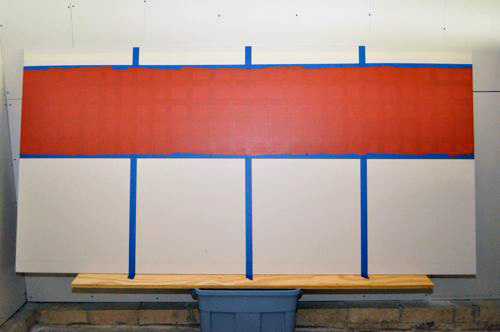
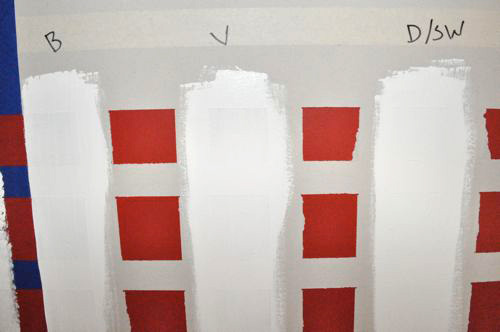
To accurately compare the paints, we needed to devise a balanced test that would be applicable in a real-life scenario. In that effort we setup a sheet of drywall and painted a deep red checkerboard pattern. Each paint was applied to a large section with a fresh roller and paint brush to see how well they covered. Pictures were taken with consistent lighting immediately after application and after allowing the paint to dry. Let’s see how they stack up!




Valspar
We purchased Valspar Signature Interior Semi-gloss which is a paint and primer in one. This is an acrylic latex, interior paint designed for “ultimate hiding.” Valspar is a Lowe’s specific brand and is available nationwide at their retail locations and online. Click here for product details.
- Price: $14.98 (quart), $33.98 (gallon) – comparable to other paint + primer products.
- Coverage: 1 gallon = 400 sq. ft.- Â requires multiple coats to cover dark squares.
- Notes: We’ve had great experience with Valspar customer service.
- Lowe’s store locations

You can still see a faint outline of the red squares

This is an up-close picture of Valspar covering the red squares.
Duron / Sherwin Williams
Sherwin Williams purchased Duron in 2004. They kept the name, mostly for brand recognition according to one sales associate. Sherwin Williams stores can be found nationwide. For this test we used Sherwin Williams SuperPaint Interior Acrylic Latex. It’s another self-priming paint, and is available in over 1,500 colors. Here’s the product page.
- Price: $16.49 (quart), $47.99 (gallon) – higher than alternative products however sale prices are much closer to competitors.
- Coverage: 1 gallon = 350-400 sq. ft. – superior hiding, almost completely covering the red squares with just one coat.
- Notes: Very knowledgeable sales associates as expected from a dedicated paint supplier. At the time of this writing, a gallon of paint is on sale for $33.59.
- Sherwin Williams store locator

You almost can’t detect the red squares after one coat

The square is barely perceptible

The brushed paint yielded similar results
Behr
Behr is Home Depot brand paint and has their own paint with primer offering called Behr Premium Plus Ultra. This acrylic latex paint has the added benefit of having low volatile organic compounds (VOC). This paint is available in 386 exclusive, designer hues or choose from over 2000 standard Behr colors. Behr paint can be found in any Home Depot store and online.
- Price: $14.48 (quart), $33.98 (gallon) – similar prices to Lowe’s.
- Coverage: 1 gallon = 400 sq. ft. – it “felt” very thin during application and would obviously require 2 or more coats.
- Home Depot store finder
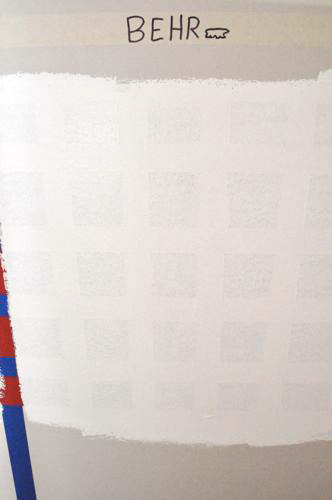
Red squares are plainly evident
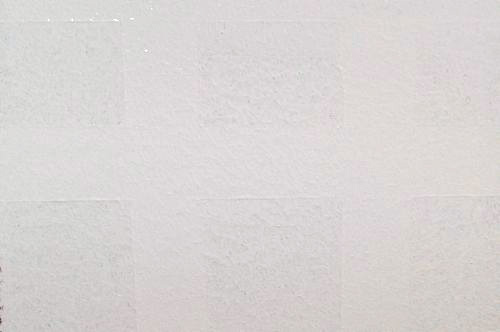
Up close

Brushed paint results are similar
Ralph Lauren
Home Depot stopped carrying Ralph Lauren brand paint in early 2010, and now it is only available from specific distributors. We did not include them in our updated test for the simple reason that the closest store is located about an hour away. We can confirm that right now Ralph Lauren does not make a self-priming paint. For the sake of comparison, we pulled information for a generic interior acrylic latex paint.
- Price: $16.99 (quart) $45.99 (gallon) – on par with other professional paints but still very high.
- Coverage: 1 gallon = 400 sq. ft. – in previous experience we’ve found RL paint to provide superior coverage.
- Notes: Read our full review of Ralph Lauren paint
- Find Ralph Lauren distributors
- Ralph Lauren Paint data sheets
The Verdict
So what paint do you think is worth the cost? None of our test samples proved to be one-coat-wonders, but we didn’t expect any of them to completely conceal the dark red paint. If you couldn’t tell from the individual photographs, Duron / Sherwin Williams was the clear winner. No matter if you roll or brush the paint, we found similar results. Â While it may save some time, you’ll pay for the improved coverage in significantly higher prices. Here are some final pictures if you’re not convinced.
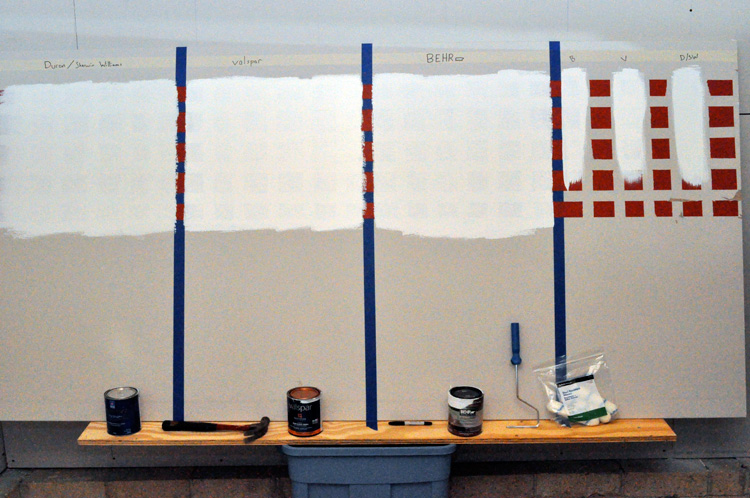
Click to enlarge
Paint Disposal
Many people don’t realize all the different ways to get rid of old paint. Old paint can be donated, recycled, or taken to a paint disposal center. For more complete information about disposal your old paint, check out the link above.
What do you think? Do you agree with the pros and cons? What’s your experience been? What brand would you recommend?
Editor’s note: Valspar paint is offered exclusively at Lowes and before you head out the door, grab a free Lowes Coupon. The same is true of Behr and Home Depot so pickup a Home Depot coupon too. We keep a couple great coupon pages and that one allows you to sign up for 10% off any in-store purchase.
Have you ever had one of those door-to-door salesmen come to your home to push contractor services? They eyeball your house before they knock to see what upgrades your home “needs,” and they have prepared rebuttals for all the counter arguments. Usually I can get rid of them pretty quickly. My roof and windows were replaced within the last 5 years, and the exterior of my house is in decent condition- brick veneer and aluminum siding. Even if that weren’t the case, I hate the high-pressure sales tactics and almost immediately cut off their sales pitch. If you’re like me and prefer to shop around, do your own research, and compare quotes, this window guide will be a helpful reference.
The Cost
There are lots of factors to consider if you’re going to replace your windows, and cost is usually the biggest concern. Paying for new windows and installation can easily run $5,000+ for a small home. If you have lots of windows and want all the bells and whistles, expect to pay three or four times that amount. Here’s another tidbit to consider. Consumer Reports writes that replacing your old windows will result in 10 – 25% in annual savings. That means you won’t recover your investment any time soon. While cost isn’t the only deciding factor, don’t fall into the trap of thinking you’ll make back the money within a few years.
Installing your own windows is a great DIY project, and you’ll save around $300 per window. If you’re considering doing this job yourself, check out our article about installing replacement windows.

R-Values, U-Values, SHGC and VT
R-Value: R-value is a measure of a materials ability to resist heat flow (a.k.a. insulating ability). Higher R-values mean better insulation and result in less heat lost to the outside world. This value is based on the center of the window and is actually lower around the edges. R-values depend on several factors like number of glass panes, size of the air pocket between, glazes used and window frame qualities.
U-Value: U-value indicates how quickly the window will lose heat (transfer energy) due to the indoor and outdoor temperature, and is actually the inverse of the R-value (U = 1 / R). Lower U-values mean less heat loss. U-values lower than 0.35 are considered energy efficient.
SHGC Coefficient: SHGC refers to the solar heat gain coefficient. This is a measure of solar radiation admitted through a window (how much of the sunlight makes it inside as heat). SHGC ranges from 0 to 1. Look for an SHGC rating of 0.4 or lower in warm climates and 0.55 and higher for cold climates. Swing climates should be in-between. If a lot of your windows face east or west, definitely keep this in mind as you’ll have lots of sun hitting your windows.
Visible Transmittance: VT is expressed as a number between 0 and 1, and it measures how much visible light a window lets in. Usually higher VT is better but you should consider what’s right for your home’s lighting needs.

Multiple Glass Panes
Double and triple glazed windows are much more efficient than single pane windows. The space between two panes of glass can act as an additional layer of insulation. This is achieved by measuring the optimal space between the glass panes to increase R-value, and filling that space with an invisible, inert gas such as Argon. The panes are separated by a spacer. Metal (Aluminum) spacers can act as a heat bridge so look for ones composed of materials like  plastic, foam and rubber that are much more efficient.
Energy Efficient Window Glazes
Special glazes can be applied to windows to boost efficiency even higher.
Low-E coating: Low emissivity refers to a super-thin metallic coating that will increase insulation and reflect heat. This will reflect solar heat away during summer months, and reduce heat loss during winter months.
UV block: Windows can also be coated to block around 75% of UV energy. This is important as sun light can fade carpet, furniture and more. We’ve also seen how UV light can lighten/darken the color of hardwood flooring.

Insulated Window Frames
Energy Efficiency shouldn’t stop at the window frame. Frame material and construction is just as important as the window itself.
Wood Frames: Wood frames provide good insulation with an approximate U-value of 0.4. However, they require some maintenance. Wood frames need to be painted or stained. Wood is susceptible to rot, termite and becoming warped. Consider a wood frame clad in vinyl or aluminum for improved durability and decreased maintenance.
Vinyl Frames: Vinyl frames are a great option. Vinyl is durable and also non-conductive (U-value around 0.4). No need to worry about insects, rot or painting vinyl frames. The only complaints are that vinyl can fad over time and they tend to leak air a bit more. Insulated vinyl frames can be pricey but will drop the U-value to around 0.2.
Aluminum Frames: Aluminum frames are not as popular anymore as they are poor insulators with U-values around 2. However, Aluminum is durable and requires little maintenance.
Fixed Windows: Fixed windows are exactly what they sound like- they are fixed in place and won’t open or close. We used of these in our bay window because they are airtight.

All this information should be considered specifically for your climate zone. To help determine what factors are most important use this handy Climate Zone Finder from the Energy Star site.
Graphic from U.S. Department of Energy

I promised in my shed delivery article that I’d be sharing a brief buying guide a week later. I didn’t make good on the timeline, but I didn’t forget the commitment.
In order to produce a buying guide, we needed some additional pictures of a substandard shed to highlight the quality differences between sheds that are built “up to a standard” (like the one we purchased) vs. those that are built “down to a price.” Â Â We’ve also been well distracted by the workshop drywall project.
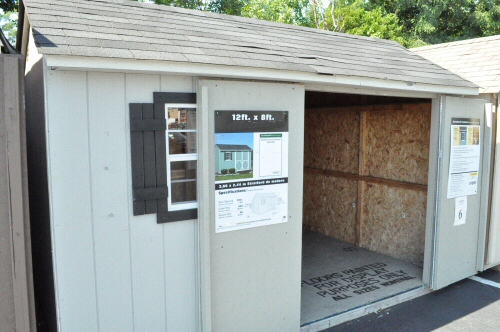
Excuses aside, I think this is an important topic to cover, because I’m sure many of you will be building or buying a shed in the next few years. Ethan took some time earlier this week to head to a local (purposefully unnamed) big box store to snap some pics of a low quality model. Now we’ve got everything we need for the comparison.
Before I get started, it’s worth noting that it is our firm opinion that buying (or building) a shed that meets a high quality specification is worth the additional cost. The shed will last longer and look better than cheaper alternatives. When you’re looking to purchase a shed, make sure to really examine the build quality and compare prices. We found that our local, privately-held shed company was able to build and deliver a shed for nearly the same price as the big box home improvement stores, but with a much higher quality build.
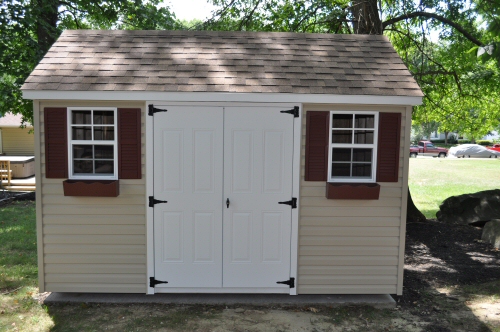
For this buying guide, we’ll be comparing features of our 8×12 custom-built shed with an 8×12 model available at the big box store. Our shed cost us approximately $2,700 with all the options, while the low quality shed costs approximately $1,900. The big ticket items that made our shed more expensive included vinyl siding (about $400) and architectural shingles (about $100). Subtract those, and the price for these models gets within 15% of each other.
While not the subject of this guide, we were able to find a shed that was a near exact match to ours at the big box. The price: a whopping $4,000 delivered and installed. This would be about $1,300 more than we paid.
The Sheds We’ll Compare
Our “High Quality” Shed
The Typical “Low Quality” Shed You’ll Find at Many Stores
Factor 1: Floor Material
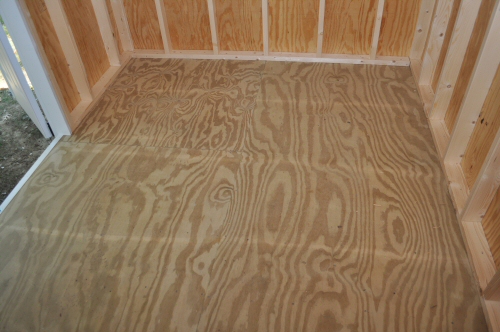
Our shed floor is built with 3/4″ pressure treated plywood over 12″ o.c. joists. The low quality shed is built with 5/8″ untreated oriented strand board (OSB) over 16″ o.c. joists. OSB is particularly susceptible to buckling and warping when exposed to high moisture levels. This is especially the case at the edges/joints. Pressure treated plywood, on the other hand, is a much more durable surface that will handle moderate moisture very well, and could be sealed for additional protection. For the best surface, 3/4″ tongue-and-groove plywood could be used to further abate buckling.
High Quality Floor
Low Quality Floor
Factor 2: Wall Studs and Sheathing
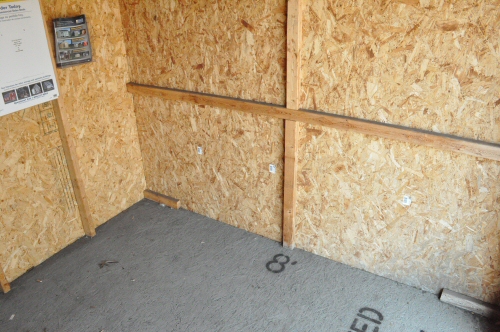
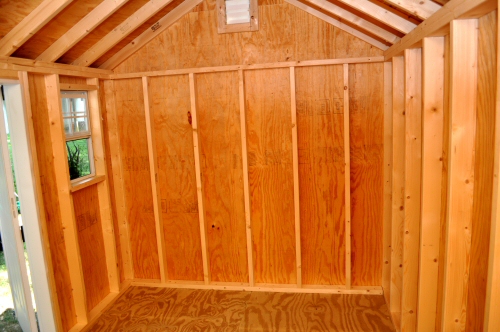
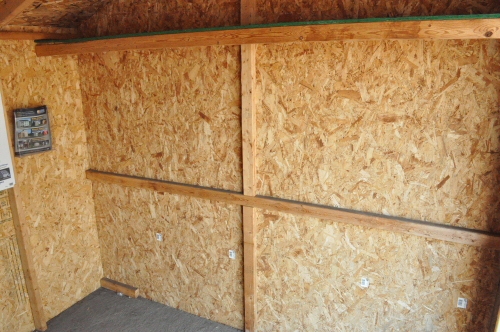
Our shed is constructed with uniform 2×4 studs spaced 16″ o.c. covered with 1/2″ plywood walls. The low quality shed is build with 2×3 lumber spaced 24″ o.c. (and nearly 4′ o.c. on the side walls) with 1/2″ OSB for walls. The walls of the low quality shed are much more likely to buckle over time, especially if the 2x3s and OSB are subject to high moisture. High quality 2×4 lumber provides significantly more structural rigidity in the build.
High Quality Wall Construction
Low Quality Wall Construction
Factor 3: Roof Rafters & Roof Sheathing
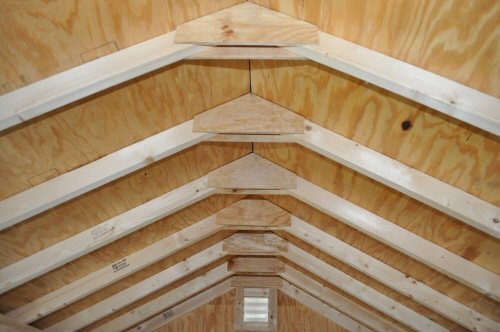
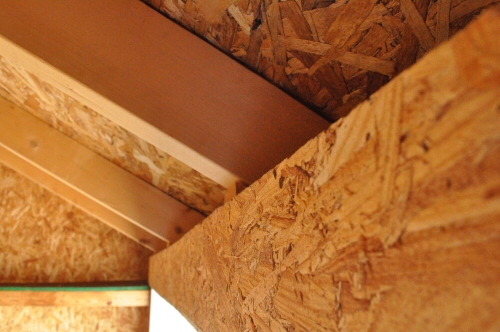
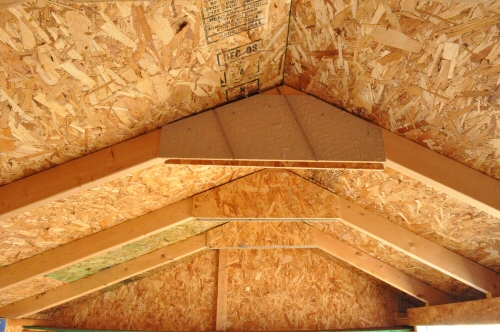
Our shed is constructed with 2×4 roof rafters spaced 16″ o.c. with a 1/2″ plywood sheathing. The low quality shed uses the same 2×3 as are used on its walls, spaced 24″ o.c. with 1/2″ OSB on top. Over time, the roof of the low quality shed is much more likely to sag, especially in a high-moisture environment.
High Quality Roof Construction
Low Quality Roof Construction
Factor 4: Roofing Shingles
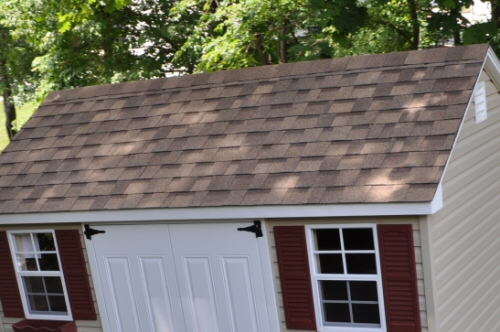
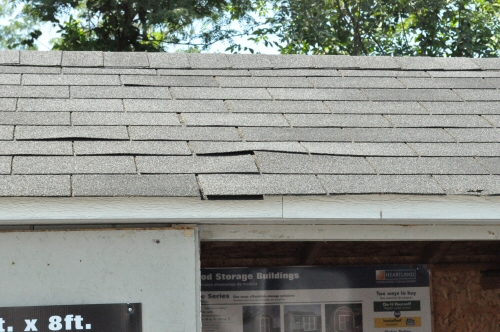
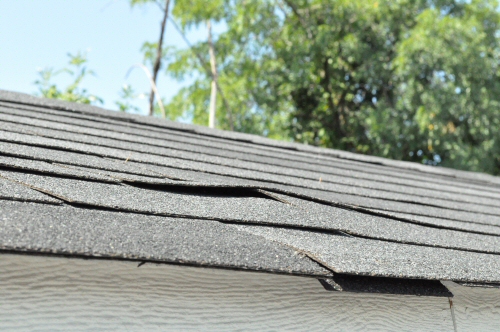
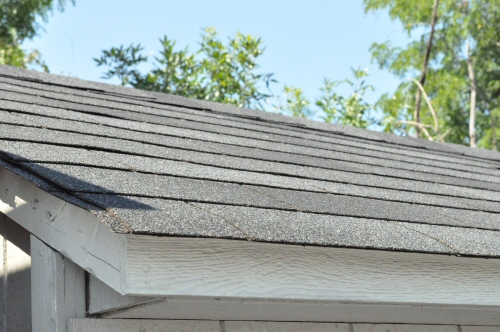
Our shed has 30-year architectural shingles. The low quality shed has 3-tab shingles that don’t look like they’re wearing well even while the shed sits on the lot. Our guess is that those shingles are not rated for installation over OSB and likely have a 15 year warranty, max.
High Quality Shingles
Low Quality Shingles
Factor 5: Siding
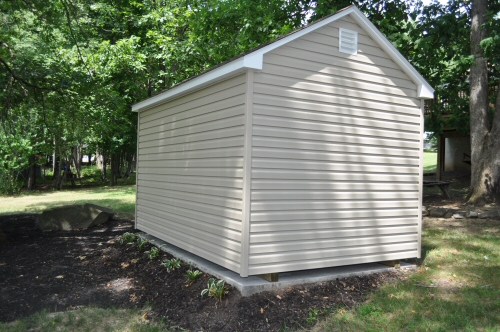
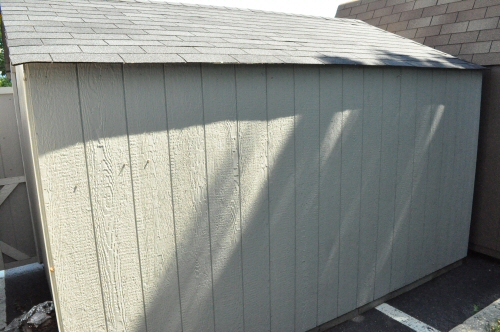
One of the major reasons our shed is more expensive than the low quality version is that we opted for vinyl siding (a $400 upgrade). Vinyl siding is virtually maintenance-free, and with a 2×4-over-plywood substructure, it will last for at least 20 years. The wood siding on the low-quality shed will require painting and will wear out far more quickly. We think vinyl looks much better, too.
High Quality Siding
Low Quality Siding
Factor 6: Shelving / Work Space Materials
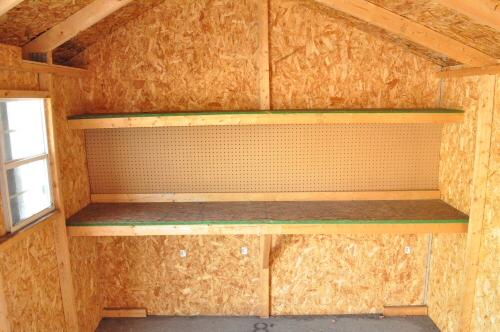
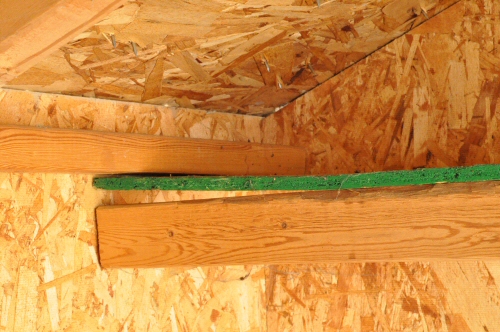
We built three shelves in our shed using 2x4s and 1/2″ plywood at a cost of about $100. Our shelves will last for the life of the shed.The materials used for shelving in the low quality shed are the same as those used for the walls (2x3s, 1/2″ OSB). You can see from the pictures below that these shelves are already warping. Any weight placed on the large shelf will cause it to buckle over time.
High Quality Shelves
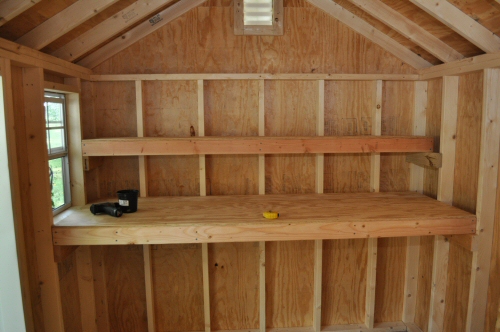
Low Quality Shelves
Factor 7: Door Quality
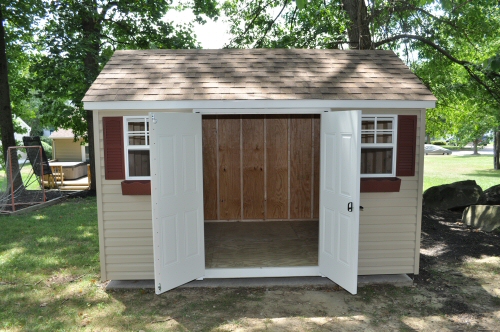
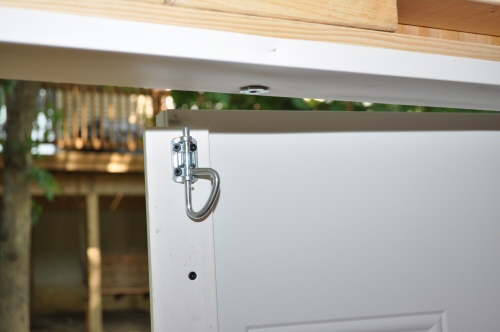
Our shed sports all metal door construction that isn’t likely to sag. The low quality shed includes wood doors that will bend and warp over time. The one drawback for our shed is that metal doors are more likely to dent under abuse. However, we would far prefer to have metal doors over wood ones.
High Quality Doors
Low Quality Doors
Factor 8: Trim Components
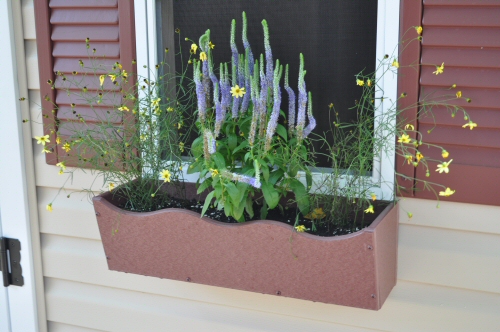
Our shed features window boxes made from rot-proof composite materials. The low quality shed doesn’t have window boxes, but if it did, they would likely be painted wood with plastic inserts (or worse, wood alone, which will rot after just a few years). The trim components this shed does have are already looking worn.
High Quality Trim Components
Low Quality Trim Components
Conclusions
If you’re in the market for a new shed, shop around. The big home improvement stores especially seem to be selling sheds with substandard materials. This is one area where a little bit of legwork can make a huge difference in your return on investment.
Summary of Shed Buying Tips
- Avoid oriented strand board, especially for roofing and sub flooring. Look for plywood construction, and especially 3/4″ pressure treated, tongue-and-groove plywood for the floor.
- Avoid 2x3s, especially if they are spaced far apart. Look for 2x4s no more than 16″ on center.
- Consider roofing and siding materials. Look for shingles with at least a 25 year life.
- Look for rot-proof composite materials.
- Look for quality doors that won’t sag over time.
- Above all, don’t sacrifice quality to save a few bucks. If you’re going to spend $1,900 on a shed, spend $500 more and get something worthwhile.
What do you think? Let us know what you think are the most important qualities of a shed in the comments.
 In addition to our usual DIY escapades, every now and then we publish a reference article that lays out the available tools or materials for a project. This article covers kitchen countertop materials–everything from laminates to stainless steel. We originally ran this article in 2008, and we’ve just updated it to include some of the newer options available, including trendy options like recycled glass and concrete. We hope you enjoy the article and find it a useful reference.
The Factors
Countertops generally differ in the following characteristics. We’ve attempted to provide some discussion of each of these elements in the pros and cons listed with each material below.
- Price (per square foot + extra edging costs)
- Attractiveness of surface
- Availability of colors and textures
- Durability (i.e. resistance to scratches and heat)
- Maintenance requirements
- Surface porosity
- Seamless vs. seamed installation
- Natural vs. manufactured materials
- Renewable vs. non-renewable materials (environmental friendliness)
A Note on Countertop Pictures
There are literally thousands of countertop pictures on the web. Rather than duplicate those collections here, we’ve provided links directly to manufacturers’ and retailers’ picture galleries to help you find all the pictures you’ll need!
We include a single picture with each countertop just so you can have a reference point for that material.
Some Useful Kitchen Designing Tools to Consider
Before getting started on the specifics of the materials, we’ve found a few tools online that really make countertop shopping fun and engaging. We think you might enjoy using them for your project as well.
- DuPont’s Corian Room Designer (We like this one… not too many features but it’s fast.)
- WilsonArt Room Designer (Similar to DuPont’s offering… pretty fast but limited features.)
- Tileworks Room Designer (Java-based, runs slow on most machines but has granite and marble textures.)
- Marble.com’s 2D and 3D Design Tools (an OK site – Java based and slower on some machines. Not a lot of options.)
Countertop Material Options
1. Laminate
Pros: Very inexpensive; enormous variety of colors/patterns; variety of edge types; virtually maintenance-free.
Cons: Less luxurious look; shows seams; less shimmer than solid surface or stone countertops; less expensive versions are easily damaged.
Price Range: $5 to $30 per square foot. Typical price is $15 per square foot.
Brands (photo gallery links): Formica, WilsonArt, Pionite, Nevamar Gallery
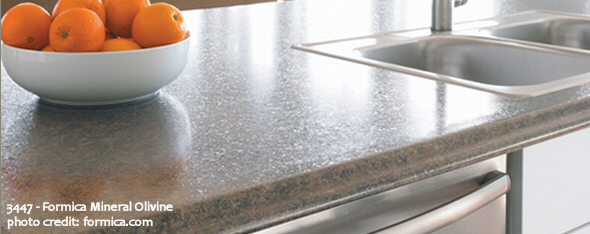
Laminate countertops (often called Formica countertops after their best-known brand) are the most common in the United States. They are constructed by applying a printed veneer surface to a manufactured wood substrate. As one of the cheapest options available, builders often install laminates in low- to mid-grade homes to keep construction costs down. Because it is a manufactured product, laminates are available in an enormous variety of colors and patterns. Knives and high heat can cause noticeable damage, although scratch resistant laminates have recently become available (such as WilsonArt’s HD line with AEON technology).
While laminate countertops are no less functionally capable than more expensive options, most home buyers consider the surface to be “builder’s grade” and wouldn’t view it as particularly desirable. We think this perception holds true even though laminates now offer some of the features that had previously been available only in solid surface, such as integrated sinks (see WilsonArt’s integrated sinks for example).
If you’re upgrading a kitchen in a home worth more than $250,000, we think laminates should be avoided in favor of granite, quartz, or another solid surface. Laminates are still appropriate for trailers and less expensive town homes and single family homes.
2. Solid Granite
Pros: Beautiful all-natural stone look; resists scratches; resists heat damage; with proper care lasts an exceptionally long time.
Cons: Larger installations are not seamless; colors/patterns limited to what occurs in nature; requires sealing (although some newer versions claim 10 years of maintenance free use).
Price: Range: $20- $50 per square foot. Typical price is approximately $40 per square foot. Intricate edging raises the price.
Brand Galleries: Home Depot Granite Page, Eskandari Gallery
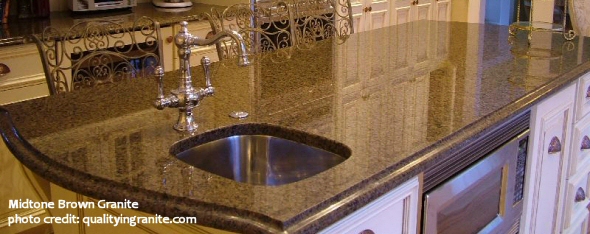
Granite is becoming a very popular option for the natural beauty and durability these countertops offer. It can be found all over the world with the majority originating in India, Brazil, Italy, China and some parts of Africa. Granite features a vast number of colors and veining with no two stones being exactly identical. Buyers should keep that in mind when they’re looking at samples.
Blocks are cut into slabs and treated with a resin before they are polished to a high sheen. Long countertops will often have seams because continuous pieces over 10′ long are difficult to find and they carry a higher price. You can minimize the visibility of seems by selecting a darker and more uniform color.
Granite is formed in extreme heat making it very unlikely to crack or discolor from hot pots and pans. It can chip if you’re not careful with sharp objects. Fortunately, these imperfections can be fixed with a granite dust and epoxy. As a natural product, granite has pores that can absorb liquids and stain. Seal your countertop as recommended to prevent discoloration.
3. Butcher Block
Pros: Beautiful, natural surface; sustainable if a fast-growth tree is used.
Cons: Very high maintenance; scratches easily (but can be repaired); porous surface can lead to bacteria growth; surface must be kept clean and dry; not appropriate for cutting fishes and poultry except if special precautions are taken.
Price Range: $30 -$50 installed.
Brand Galleries: The Butcher Block Top, Butcher Block Company

Butcher Block provides a warm, traditional feel that has remained popular for some time despite the intense care and maintenance required. You can cut directly on the surface, and some people feel the wear and tear adds character.
Butcher Block is a natural product created by fusing wood rails together under high pressure. End grain blocks are formed into the classic checkerboard pattern creating a very durable surface- great for cutting and chopping because the end grains better absorb impact keeping blades sharper. Edge grain Butcher Block features long parallel wood rails resulting in a very flat, uniform surface.
Butcher Block is porous and will absorb moisture causing the wood to expand and weaken. It’s important to keep these countertops dry and clean, and a good steel scraper can help remove most of the moisture. After every use, you should clean the surface with soapy water followed up by a dry cloth to absorb moisture. Every few weeks you should oil the surface to act as a moisture barrier. Butcher Block can be restored to “like-new” condition by sanding the surface with a heavy duty grit sandpaper and re-oiling with pure white mineral oil.
4. Stainless Steel
Pros: Professional, contemporary look; non-porous; easy clean-up.
Cons: Extremely high price;Â scratches easier than others; can dent without a solid sub-surface.
Price Range: $75 – $150 per square foot.
Brand galleries: Stainless Living

Stainless steel countertops are a relatively new trend, creating a professional, contemporary look. Joints are welded, blended and polished to invisibility providing a lot of versatile layout options. Stainless is also an attractive choice for the low maintenance required, but it comes with a steep price point.
Hi grade stainless steel is a tough material that will stand up to high heat and won’t ever stain or rust. The biggest challenge for stainless steel countertops is avoiding scratches which are highly visible. Even deep scratches can be sanded and buffed but you’ll never really reclaim the manufactured finish. It must be installed with a solid sub-layer to help avoid dents- usually waterproof MDF.
5. Manufactured Solid Surface (Corian)
Pros: Seamless installation including seamless sink; wide variety of colors; can be repaired seamlessly; non-porous surface won’t promote bacteria growth.
Cons: Higher price; can melt/discolor under high heat.
Price Range: $35 – $60 per square foot. Fancy edges extra. Integrated backsplash extra.
Brand Galleries: DuPont Corian, Meganite, WilsonArt Solid Surface,
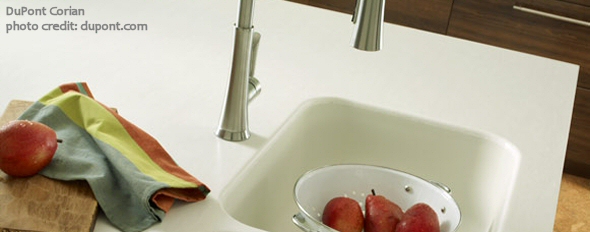
Solid surface countertops are manufactured with an even, consistent color and pattern. They available in a wide range of colors and patterns including stone-like finishes.
Seams in these countertops can be usually be completely hidden, as the artificial surface can be chemically melted together. Solid surfaces countertops are non-porous, meaning you won’t need to seal (and reseal) them to protect against stains; the sealing also makes the surface resistant to bacteria growth. The finish on a solid surface is subject to scratching, but can usually be removed with buffing and sanding.
Cleaning requires minimal effort; use a mild soap and water. You can tackle tough stains with a liquid abrasive cleanser and a sponge.
6. Quartz-based Solid Surface
Pros: Highly durable, fabulous-looking surface; no maintenance; wide variety of colors; heat and scratch resistant.
Cons: High price; more limited selection than artificial surfaces; larger installations may not be seamless.
Price Range: $60 – $100 per square foot.
Brand Galleries: DuPont Zodiaq, Silestone, Caesarstone, Cambria

If you can afford the expense, Quartz-based Solid Surface countertops are a very attractive option. There’s no worry about stains or bacteria because these countertops are non-porous. There are a lot of colors to chose from, and these surfaces are heat and scratch resistant. It’s not recommended but cutting directly on these countertops will actually dull the knives!
There are a few, minor limitations. While slabs are large (5′ x 10′), if you’re kitchen does require two adjacent pieces, seams will be visible. Another downside is the lack of an integrated sink. Currently, you’ll need to pick an over- or under-mount sink. No deal-breakers here!
So how do they pack all these great features into one surface? Quartz based Solid Surface is manufactured from crushed quartz stone and resin than is combined to create a super hard countertop material. Surfaces are beautiful even without the natural variations found in a material like Granite.
7. Stone, Ceramic, or Porcelain Tile
Pros: Low material cost; repairable if a single tile breaks;
Cons: Labor intensive installation; no seamless installation by definition;
Price Range: Starting at about $5 / square foot for materials alone. Installation can be $20 Â per square foot. Often, this is a DIY job.
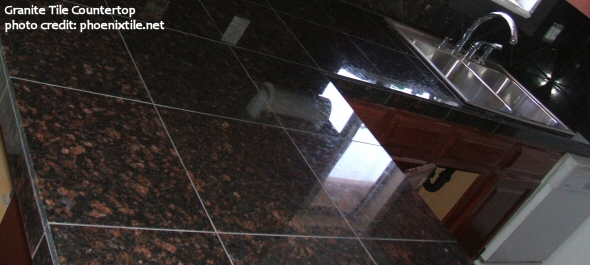
Probably the biggest complaint about natural stone surfaces like Granite and Quartz is the expense, and a contributing factor to higher prices is mining and processing large slabs of rock. If you can embrace grout lines, you can have a beautiful stone countertop for much less.
Depending on the material used, you can obtain a pore-free surface that is heat and stain resistant at a significantly lower cost, especially when you explore ceramic and porcelain tile options. It’s also the sort of installation job an avid DIYer can tackle themselves.
So what are the downsides? While the surface may not be porous, the grout will stain if not properly sealed, and installation requires more work. You should also consider a waterproof membrane in the sub-layer. Tiled countertops are not mainstream even though they offer a lot of versatility in material, color and style.
8. Concrete
Pros: Very durable; custom shape, color, embedments; often incorporate recycled materials.
Cons: Must be sealed; expensive; can develop hairline cracks.
Price Range: $75 – $200 installed.
Brand Galleries: Concrete Network, Concrete Countertop

Concrete is finding it’s way into many modern homes and offices with the number of concrete countertops on the rise. They can be dyed and textured to lots of different styles, and inlayed for unique personalization. Creative installations can even include custom molds and edge forms. Concrete is the most creative kitchen countertop material available. On top of that, it’s easy to incorporate fly ash that would otherwise end up in a landfill.
Concrete is a porous material and requires regular sealing. While concrete is somewhat stain and heat resistant, it really depends on what type of sealer is applied. Concrete-specific waxes can also be used as a second line of defense, repelling liquids and protecting the sealer. Cutting boards should be used to prevent marring the surface. AÂ lot of the cost for concrete countertops is tied to the labor-intensive installation, and it’s important to pick an experienced installer else cracks can develop down the road. Even with the perfect installation, concrete will shrink and may result in hairline cracks.
When you clean concrete countertops, avoid abrasive soaps or cleansers. Acidic substances can stain so clean up things like wine, lemon juice and ketchup immediately.
9. Limestone
Pros: Sophisticated look; natural stone; lots of colors available; potentially visible fossils.
Cons: Easily broken, scratched; acid can etch; must be sealed.
Price Range: $60 – $100 per square foot.
Brand Galleries: Pental, Oregon Tile & Marble
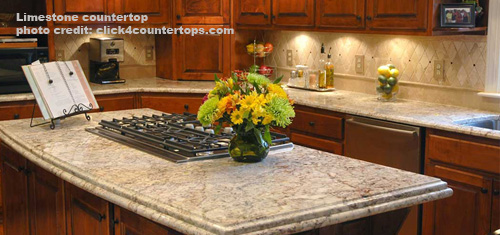
Limestone is another natural stone material, and it’s available in many different colors and hues. It’s often described as very sophisticated because of the depth and variation evident in each piece, similar to marble. Additionally, Limestone is a sedimentary rock  and often includes small fossils and shells for even more character.
Limestone will usually scratch very easily, acid can mar the surface and the hardness depends on the variety chosen. Limestone is very porous meaning it can stain even when properly sealed. For these reason, it’s often not selected for kitchen countertops because they are such high traffic areas.
All varieties withstand heat very well and avid bakers prefer Limestone to cool baked good like pie crusts and pastries.
10. Marble
Pros: Perfectly smooth; beautiful look.
Cons: Easily scratched; must be sealed, susceptible to acid; higher price.
Price Range: $50 – $100
Brand Galleries: Marble.com, Marble City

Marble is very similar to Limestone as it’s a natural stone and available in many different colors. It also falls prey to many of the same problems as Limestone- easily scratched, damaged by mild acid. Marble is very porous resulting in poor stain resistance even with regular sealing. On top of it all, Marble is not heat resistant. Combined with high prices, it doesn’t seem like a good investment.
Even so, Marble has beautiful vein patterns, and if you insist on using it for countertop, chose a low-sheen finish that will better hide wear and tear.
11. Recycled Glass
Pros: Often 100% recycled glass; beautiful mosaic.
Cons: Must be sealed; susceptible to acid; not heat or scratch resistant.
Price Range: $50 – $80
Brand Galleries: Vetrazzo, EnviroGlas

Recycled glass countertops are becoming more and more popular as an eco-friendly option with most countertops utilizing 100% recycled glass. Surfaces are often a mosaic of glass pieces with as many (or few) colors as desired. This glass is placed in a matrix of concrete, and therefore feature some of the same properties. It’s a porous surface and requires regular sealing, otherwise it will stain. Highly acidic substances can deteriorate the original seal and stain the surface. Also like concrete, it’s easy to incorporate fly ash to make this an even greener choice and there are several edge styles to chose from.
Recycled glass countertops can also benefit from regular waxing for additional protection. Quickly wipe up any spills and use a neutral pH solution for daily cleaning. To remove difficult stains, one manufacturer recommends placing a cloth saturated with non-chlorine bleach overtop the stain until it clears. You should always use a cutting board and hot pads to protect the surface.
Editor’s Note: This article was provided by Kohler. We reviewed the article and feel it meets our guest posting standards; however, this is not authored by one of our writers or editors.
Every year, millions of homes lose power for hours – even days – at a time. Being prepared is the best defense for such energy emergencies. And for many homeowners, that means investing in a standby generator – one that is fully automatic and permanently installed outside the home.
While virtually all home owners can benefit from having a standby unit, reliable power is especially important in homes with elderly residents or young children who are more dependent upon heating, air conditioning and other of life’s necessities. It’s also important for home businesses and for travelers who are not home to deal with the damaging consequences of a power outage.
If you’ve made the decision to purchase a standby generator for your home, it’s helpful to be familiar with what is involved in regards to the installation process. This article IS NOT intended to serve as a step-by-step guide. It is highly recommended that all standby generators be installed by a licensed contractor – not the homeowner. Improper installation can cause damage to the unit and could potentially void the warranty. However, knowledge is power and understanding the installation process will help you properly screen and oversee a contractor during the installation process.