


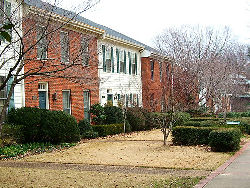
 Our community recently voted in a new HOA board of directors and architectural committee. The new committee is taking a more active role in enforcing the community’s covenants than previous committees have, creating some anxiety, disagreement and resentment among homeowners.
Without getting into specifics, some of the community’s covenants have not been enforced for years–one home was in violation for more than 10 years–and homeowners feel rather blindsided by the the committee’s recent hard line stance. Since some of the folks in our community read this blog, I don’t want to get into the actual issues. Instead, I thought I’d write some key thoughts on the essential elements of running a successful HOA architectural committee.
This list is based on years of experience working on non-profit boards and committees, and years of living within the confines of an HOA.
Know the Community’s Rules
An architectural committee is charged with reviewing and approving changes to the exterior of a home and enforcing the rules for unreviewed exterior changes or run-down exteriors that violate the community’s rules. In order to know whether or not to approve a project, or whether a home is in violation of the rules, committee members must know the rules. Each member of the committee should have a thorough understand of what is and is not allowed in the community.
Enforce the Rules Consistently
Since many architectural committees are staffed by unpaid volunteers, it is easy for these groups to slack on their responsibility for covenant enforcement. Worse yet, committee members may only enforce the rules for homes that are within site of their property, ignoring other properties in violation throughout the community. Some committee members might want to give friends special breaks. Consistent application of the rules is paramount. Committee members should be able to clearly rationalize each decision the committee makes, and that decision should map back to a rule or bylaw.
Make Sure Everything Is in Writing
When a committee charges a community member with a violation, it is imperative that the committee notifies the member in writing and clearly describes the violation, refering the guideline or bylaw the member has violated. Â It is not acceptable to remain silent, as that Washington Post article describes.
All official correspondence should be in writing, and minutes should be taken at each meeting to record the activities of the committee. Since most architectural committees rotate members each year, the written record serves to inform new members of previous actions.  Some committees (such as the Vieux Carre Commission) have begun to store this information online for residents to gain easy access. The committee should also encourage alleged violaters to correspond in writing and keep copies of their mailings. This ensures everyone remains on the same page and can be a great help if legal action results.
Always Be Gracious
Many residents in a community will make an honest mistake in not notifying the committee of a change to their property. These people may have lived in the community for 20 years and honestly believed they weren’t doing anything wrong. In some cases, required repairs/changes to a home could cost many thousands of dollars. Some members of the community will likely not be able to pay that up front. The committee should make every attempt to work with a homeowner to make the change to bring a home back into the community’s standards.
While patience is not legally required, it almost always results in a better outcome. The reality is if a homeowner cannot afford to change their property to get it back in conformance with HOA regulations, the committee has few options other than to pay for the changes themselves with community monies, which may never be repaid by the homeowner. While a lien can be put on a property, that lien is subordinate to a first mortgage, and with many houses underwater, there is no guarantee of repayment.
Follow Through on Actions
Being gracious does not eliminate the need for rigorous enforcement. While the committee should make every effort to work with a homeowner, in the end, a homeowner in violation of the covenants must repair / change their property. If a committee does not follow-through on actions, the community association will slowly disintegrate. This could mean pursuing legal action against a community member, such as assessing a lien against their property. Following-through will require resolve and dedication, but it’s important for the future of the community.
Get Legal Counsel
When dealing with homeowners who refuse to repair or change their property after repeated notices, it is wise for the committee to engage professional legal assistance. The law surrounding HOAs and POAs is complicated. An attorney can help navigate these waters and ensure the HOA doesn’t find itself on the wrong side of the law.
What do you think? Did I miss something in this list? Have you found yourself at odds with an HOA?










Those sound like fair guidelines, and helpful for the people that want the safety and consistency provided by a HOA.
That being said, it’s EXACTLY why my husband and I didn’t look at ANY house that had ANY sort of an HOA associated with it when we were buying. I’d personally rather have the ugly house at the end of the block that is fenced by BICYCLES next to the cute house next to the house overtaken by two huge willows next to mine than have to worry if my salvaged fence that I saved from the landfill (and matches most of the rest of the fencing around here) would past muster to others.
It’s nice that there are HOA’s in some neighborhoods for those people that really care about consistency in looks in a neighborhood, and whether houses are kept up, etc. I’m glad they aren’t everywhere so we can all choose where to live, though!
Its definitely a personal decision. But, if you buy into a nice neighborhood that has an HOA than you probably like the home ln large part due to the HOA. The nicest house in the world with Clark Griswalds cousin next door may not be that attractive.
All members, not just committee members, should be made aware of the rules. Often problems could be avoided by ensuring everyone in the HOA knows the rules and responsibilities of living in their particular community. Regular updates, reminders and a designated community liaison member are proactive steps that should be taken and can obviate costly litigation.
@Jennifer- you’re right on here. Each person has to decide what type of community they want to live in. It’s nice this country has both!
@modernemama- amen. If everyone knew the rules, problems would be much more infrequent.
Hello, we are a fairly new HOA (03) and we are very WEAK we pay dues qtrly. and all that has afforded us is front lawn service,wich we FLOOR VOTED on when the homeowners took over(from developer) we chose to keep the service, however we have minamal funds to maintain/repair the common area fence because of this.
I am the ACC chair and have suggested reallocation of said dues to cover the much needed repair. this has not set well with several homeowners they want to keep front yard care,(we allready mow our own backyards) Ive even suggested to do this for 1 year, and who knows maybe lower the dues and continue to maintain our own lots.The responce from the board was “they dont want to police the neighbor’s yards” If we can’t agree to do this what hope do we have as an HOA? PLEASE GIVE INPUT
Kelly,
HOAs are complicated beasts…. problems like the one you cite are political to the core. Some people like yard mowing, other people like repaired fences. The key is to build consensus among the residents (to the degree possible), and then try to find the path that suits everyone the best.
Ultimately, the board of directors for most HOAs set the dues for the year. You should determine how much money you need to maintain the fence, and then determine how much additional assessment is required to meet this. Once you know, present your findings to the board and ask for direction. Ultimately, it is the board’s responsibility to communicate these types of issues to the community. Should they raise dues? Should they allocate money from dues to the fences rather than the lawns? These are decisions that the board must make.
Unfortunately, if enough of the community doesn’t want to get the fence fixed, then you are basically sunk…
Fred
Fred, you mean to tell me that I/we have to report and fine homeowners if they dont comply with the Bilaws & CCRs? This fence is not cosmetic and parts are dryrotted,molded,and the HOA doesnt follow the same guidlines to maintain the integrirty of the neighborhood? How can we tell a homeowner to fix something or remove something and yet we do nothing. We are only 11 homes and have small lots and collectivley we pay over 7000 a year ,to raise or ask for more money is insane and selfish.
thanks for the input!
Kelly
Kelly,
I’m not sure I understand your first sentence in your reply, but I re-read your message and I think I understand the issue.
Unfortunately, the answer is simple: Your HOA has $7000 (or a little more) each year to work with. The board wants to keep the front lawn care because you don’t want to have to police the yards. If you do that, sounds like you don’t have enough for the fence. There are three options: (1) stop the yard care and pay for the fence, (2) raise dues and keep the yard care while fixing the fence, or (3) let the fence continue to deteriorate and keep the yard care.
The only think you can do is convince your board of how best to spend the money…. or you can pay to fix the fence yourself (i’m sure they wouldn’t mind). I realize that’s probably not an option…
Good luck!
Great piece. One thing I feel always bears repeating/amplifying, is that if a board member is on an architectural committee (or the board acts as the architectural committee), their fiduciary duty requires that they act in the best interest of the entire association. In other words, (as you do a good job of point out) the rules must be enforced reasonably and consistently. No special deals. If a board member ever puts an individual’s interest above the the interest of the association as a whole, they place themselves at some level of personal legal risk.
Matt, excellent point and thanks for the addition to the conversation. It is important for the committee member to remember they are a representative of the entire association… now if we could only get our elected officials to follow those same guidelines, America could be a better place.
Im chiming in here late with response to Kelly’s comment. Its actually the first time I have heard of an HOA with such a small number of homes in their community. Since funding is obviously so low, it almost begs to consider what should be a homeowners responsibility vs the HOA, which is essentially the homeowners as a collective group represented by elected Board members. To me, I would see personal upkeep per individual homeowner as more feasible with such a small HOA rather than spending funds on a grounds keeper.
We have 93 units and pay under $1,000 for gardening so I would imagine the cost for 11 homes is probably much lower. Still, it is funding that can go elsewhere should residents take up gradening on their own.
We are also a new HOA in a 93 unit complex that was renovated from an apartment building and did not start with very much at all. In fact, we have had to deal with several things given the age of the complex, such as wood-rot under a tile platform which caused a 10 by 15 foot section to collapse and plumbing issues.
With only 11 homes, I would find it interesting to see what is actually classified as common area grounds and what is stated about its upkeep. Anyway, I have some suggestions.
Some cities have have regulations about unsightly conditions, unkept yards, etc. If the situation is a visual contrast to the surrounding community than sooner or later the HOA is going to receive a nice little letter from the city to resolve the problem which will force the allocation of funds. An anonymous tip?
Check witht he city and see if funding is available for beautification projects. The city may actually give the HOA the funds for the needed repair or match a certain cost.
Check with local lumber yards to see if they offer any discounts on wood fencing. Get multiple quotes. Seek volunteers from the HOA community for the man power. Afterall, its their community interest (property value) they are protecting.
Analyze the actual necessity of the fence. Should it be kept or removed all together?
If needed, analyze longevity. Maybe replacing it with something more cosmetically appealing, such as brick, might entice the Board to vote for repairing. Brick is more weather resistant than wood.
Steve
THANK YOU STEVE! Our “governing docs” do state what is common area AND that the HOA is to maintain it/them, we have now takin a FIRM stand against the HOA and explained that our dues are for maintaning “HOA’s” common area not homeowners lots, so we declined to pay dues directly to them and have placed the dues in a separate bank account-with the HOAs name on it and we would gladly surender said dues when said repairs and maint. is completed. We have contacted a 3rd attorney ( all have said to sue) for a demand letter ,she to said to sue that there is much more wrong and/or illeagal than what we were trying to fix. When told by the board that they would “turn us over to collections” I said go ahead and we will sue. So now the entire board (only 3 pos) has resigned….
I guess my next question is ..If they are so right on how things are being ran ..why did they all quit?
Thanks for listening, Kelly
Seize the opportunity then to get the right people on the Board and get things settled!
Steve
Well guys if it were only that easy, remember we are only 11 homes and everyone else don’t want to re allocate the funds and since we are depositing are dues they do not allow us to vote who knows they might have had a meeting without notifing us.We just want our contract followed!
Thanks for listening,again!
Kelly
Hi Kelly,
There are a few issues that I’ve thought of:
(1) It is the board’s responsibility to execute their duties within the bylaws of the community. If the bylaws give the board discretion on how to spend the funds (common areas or collective lawn mowing of front yards), then they can do that. If the by-laws require the board to maintain the common areas but not the lawns (or other personal property), than it would seem like a misappropriation of funds to apply the funds beyond the scope of their authority.
(2) There are usually provisions to modify the bylaws (requiring 2/3 consent of the homeowners in most cases). Even if the 2/3 of homeowners vote for the regulations, HOAs are limited in the types of rules they can pass. For instance, an HOA cannot dictate anything about the interior of a home (to my knowledge).
If your board of directors wants to run the community by a different set of rules, they need the entire community to vote on changes, and all of those changes must be within the bounds of the HOA’s legal jurisdiction.
Sounds like things aren’t going too well… Hope you guys can work together to get through it.
Our HOA has 800 owners. The board wants to (and in fact has began) replace every bathroom ‘drop ceiling’ (which are look good and are not any problem), with a completely different type of drop ceiling. According to our Bylaws the ceilings are our individual and sole property. State law has the same description of our property boundaries. I have given the board copies of these even though they did say they consulted an attorney. They justify altering our property with … the AC system will use less energy. That does not give them the right to break the law.
On top of it, they are using $50,000 of HOA general funds to pay for these “private ceilings”. I highly object to paying for other’s private property “inside” their unit.
I would appreciate knowing how many / which / laws they have broken. And when an HOA board ignores (not the first time) the bylaws & state laws, what can owners do to stop this? … asap! They are currently speeding the construction by doing as many units as possible at the same time.
Hi Sam,
It sounds like the HOA has stepped over their bounds. We’re not qualified to give you legal advice, which honestly is probably what you need in this case.
Suggest trying to get a free consultation with a local attorney and see what they think. It doesn’t sound legal, but I’m not sure whether it’s criminal or only civil.
If the developer has not handed over the running of the HOA to the neighborhood, how do you police them? Is there a standard letter we could send asking how the funds are being used?
I moved into a HOA in Florida 26 years ago because the developer had stocked the ponds for membership to fish. Just recently the agriculture committee decided to prohibit fishing because of the liability. Has the committee the power to make up rules without the members majority vote. I thought the agriculture committee was there to enforce the covenants not make up rules without the vote of the members???