


Acclimating hardwoods is the process of matching the wood’s humidity and temperature to the ambient humidity and temperature of your home. Because wood expands and contracts with changes in temperature and moisture, it is important to “synchronize” the wood with the normal living conditions in your house to the greatest extent possible.
If you fail to properly acclimate hardwoods, they will likely be mismatched to the house, which could lead to two unfortunate consequences. Â If the wood is at a higher relative humidity than the house, it will likely contract shortly after installation. Even though you install the boards tightly against one another, gaps will develop in the floor–as much as 3/32 of an inch per 3.25″ board. With prefinished floors this is particularly troubling because you don’t have a puttying and sanding step to allow you to fill the gaps.
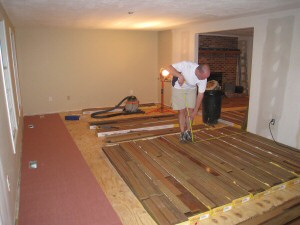
Perhaps even worse than the development of gaps happens when the house is at a much higher humidity than the floors. In this case, as the hardwoods take on moisture, they expand, potentially forcing the boards out against perimeter walls, or worse, buckling at the joints, cupping, and pulling fasteners out of the floor.
This article is part of our hardwood flooring installation instructions. Click that link for an index of all the articles in the series.
How Long to Acclimate Wood Floors
Unfortunately, there is no 100% correct answer for how long to acclimate floors. A good “rule of thumb” is 7-10 days for installation over wood subfloors. Â If you have a moisture-meter on hand, you can test the wood; it should be at 11% moisture content or less (the goal would be the average of normal moisture content year round) Â The subfloor should be equally dry. Â Do not install wood over a wet or damp subfloor.
Note: If you plan to install over concrete, we suggest using an engineered wood rather than a solid. The slab should be dry and additional subfloor prep is required. This scenario is beyond the scope of this series of articles, because issues such as moisture wicking through the slab must be considered. Â Many engineered woods do not require acclimation.
How to Acclimate Hardwood Flooring
Acclimation Location: Hardwoods should be acclimated in the same room/level where they will be installed.  Don’t make the mistake of acclimating the hardwoods in a basement when they are to be installed on the first floor.  Basements are moisture-prone since higher humidity air is heavier and sinks. Even though it may present a sizable inconvenience, you should acclimate the wood in the same area as the installation.
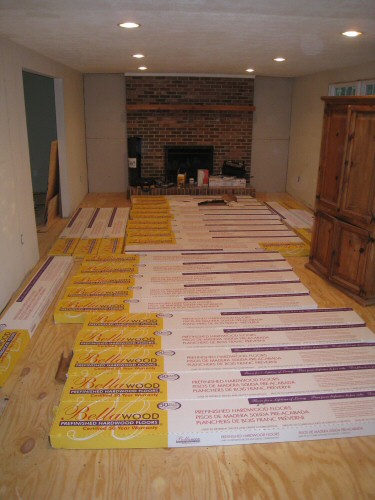
Don’t Stack Boxes: Some hardwoods (especially exotics like Brazilian Walnut) are very heavy. You need to spread the boxes out around the floor. Â Do not stack 1000 square feet of flooring in the center of a single room, or you run the risk of floor damage/collapse. Â Further, stacking boxes doesn’t support good acclimation. Instead, place all the boxes flat on the sub-floor.
Open Boxes for Best Results: If possible, opening the boxes exposes the hardwoods to more direct airflow, which supports the acclimation process.
Run the Air Conditioner / Heat Normally: Run the air conditioner or heat just like you usually do. Don’t attempt to dramatically modify the house or the woods. Â Your air conditioner should have been running for at least 5 days prior to bringing in the woods (in other words, if you just got back from a month long vacation where the A/C was off, wait a week before bringing the woods into the house, and then another 7-10 days for acclimation).
Don’t Allow Hardwoods to Get Wet: You should always keep the hardwoods stored in a well ventilated area and away from any condensate. For most homes, this isn’t a problem. Never let hardwoods sit outside through a rainstorm.
Don’t Acclimate Too Soon after Construction: Some compounds, like drywall compound for instance, will put moisture into the air as they dry.  Wait until all compound has dried and the house has stabilized around normal occupancy conditions.
Best Season to Install Hardwood Flooring
In the heat and high humidity of mid-Summer, even a well-cooled house may be at a much higher humidity than normal. While Summer is a very convenient time for hardwood installation, it may be better to wait until milder months, like those in Spring and Fall, so that the normal living condition of the house is best matched to the floor and an “average” moisture content level is reached.
Conversely, Winter installations can be problematic if the humidity is extremely low in the house, leading the floors to significantly expand and create forces across the floor when the humidity peaks in the Summer.
Consequences of Not Properly Acclimating
Talk to folks at the flooring store and you’ll likely hear some real installation horror stories. Don’t skip proper acclimation. Â Read manufacturer’s instructions. You cannot rush the process, and if you do, you may end up with a sub-par installation.










Our home is 15 month old. Hardwood floors 3/4 red oak sand and finish . When you walk across the floor there is a “popping” sound. It occurs in many places across the rooms. They will pop and then if you bounce up and down they quiten. Then later on hrs or a day , the same area will pop again. The floors are installed on 2/10 syp 16″ oc. 3/4 t/g osb. Floors were installed within 2 days of delivery. Crawl space has plastic mositure barrier. I think it might be a nailing issue. Please advise with enough ammunition to go to my builder with.
Thanks,, Chris cC Aiken SC
Hi,
When sampling stain colors for my newly installed red oak floor, I told my installer that I would like it a tad bit darker. So I asked him to give the sample area another layer of stain. He responded that another layer of stain would not darken it all. But he said that if he wet the entire floor prior to staining it that would darken the floor. It seem to work but now Im thinking that was not a good idea because I see the floor almost like splintering down the middle. So I guess my question is it a good idea to wet the entire wood no matter the reasoning for doing it?
Hi,
Thanks for the helpful information. I think I might have a potential flooring nightmare on my hands. You see, I’m 30 years old, my mortgage is $3,500. I’m broke! In an effort to cut down on hardwood flooring price…I bought 1,400sq ft of 5″plank 3/4″ thick Angelim Pedra (exotic) from a less than reputable wholesaler that received it directly from Brazil the previous day that I bought it.
After unloading all of it into my basement I noticed it started to cup and in some of the long pieces, warp IMMEDIATELY. But then it seemed to adjust to the temp/humidity level of the basement and go back to a more normal state. I’ve now moved half of the lot into my living room and the same thing is happening again. I’ve now realized I bought “green” hardwood where it wasn’t properly kiln dried.
Given my situation, what can I do to to dry it out? To make matters worse, I’m under the gun to install it ASAP, which is necessary for the re-finance that I must do no later than August 2011. HELP!!!!
I
Will, yep, that sounds like a mess…. Is there any way you can take the wood back to the wholesaler and say that they sold you a product that isn’t appropriate for installation? Otherwise, it sounds like you’re in a pickle. I am not a hardwood species/acclimation/processing expert, so I don’t know whether simply letting the boards acclimate will be sufficient.
We are building a new home,and have just finished the dry wall,the windows and doors are installed,but of course we have no heat on at this time.We are wanting to have solid red oak installed,over a concrete slab.Our installer is wanting to to install at this time,saying he could complete the job in one day,which means no pre- acclimation,he’s telling me that the floors will acclimate during the 3 week period before he comes back to sand ,scrape,stain,and seal.Does this sound right? ive used this contractor for wood flooring before on a remodel,in the summer months and we let the wood acclimate a few days,and had no problems.The home is in oklahoma,temps have been in the 60s in the day and 40s at night
Jerry, with unfinished flooring and a sanding coming, your contractor’s plan might not be unreasonable. He’ll be able to fill any gaps that come during acclimation prior to sanding and finishing. If he’s done this type of work before in your area, I’d probably trust his judgment. There’s a lot of factors that go into whether or not this will work (relative humidity of the flooring and the current state of the slab being the 2 biggest). I would say if he’s confident it will work and he’s trustworthy, I’d probably let him.
I have had red oak flooring installed about 2-3 weeks ago, how long before I must have the floor treated and sealed??
Donna, 2-3 weeks should be sufficient, based on the wood I’ve laid in the past.
Hi ,
I am installing red oak unfinished hardwood at my house. My installer told me that he will give 4 days acclimation before installing the wood in Dallas area. he bought the hardwood later yesterday. I went to work today. but when I came from work today, he hdad isntalled half of the hardwood on concrete floor with plywood in between them. what should I do now? do I need to tell him to not sand or seal it for at least 1 week or the damage is already done? Please reply me. also the outside temp is 60’s during day and 40’s during night. thanks
jattsaan, I would ask him to wait at least 7 days before filling, sanding, and staining. Sounds like he got a little over eager.
Hi,
I had natural red oak flooring installed in June 2011, the flooring was delivered and installed on the same day, I was told by the company that I purchased the flooring from that it did not need to acclimate because it was summer. Approximately 2 weeks after instalation I began noticing that it was denting very easy and the denting that was occuring actually dented and then it seemed to crack around the dent which I have never seen before I understand harwood will dent but I have never actually seen it crack around the dent. Now forward to January of this year I noticed 4 planks that are actually cracking down the middle and I just noticed a 5th one doing the same thing this week. Is this normal for a hardwood floor because I have had harwoods in the past and never seen anything like this and the company that I purchased from nor the distributer of the flooring are willing to help they submitted a claim and said that it could possibly be because the floor was not properly acclimated. Please help!!!
Cheryl, if the flooring is solid 3/4″ red oak flooring, it definitely should not have been delivered and installed on the same day. I have not heard of the cracking/splitting situation you are describing, but I suppose that un-acclimated wood could lead to this situation.
Now, I doubt that the denting was an acclimation issue. That’s probably just an issue of the red oak not being a particularly hard wood. Compared to other woods, such as Ipe (Brazilian Walnut) or Jatoba (Brazillian Cherry), red oak is pretty soft. You can easily dent red oak walking on it with heels.
We are in a home built in 1955. It went on the market after sitting vacant 3 years. We have bought the home and are in the process of remodel. When we took possession, within a couple of days I noticed that the vents on the pier and beam home were covered. I removed those. We have knocked out wall, added sheet rock, etc. The installers have put 2 1/2 redwood to be sanded onsite in. The old wood has a moisture reading of 12 and new wood 7. I believe it is because of all the additional work being done in the house. Do we wait to sand and finish the old and new to match?
My installer is new and nervous. I think we should just be patience and wait for everything to settle. I called the NWFA and was told the old floors are acclimated to whatever they are acclimated to. Any suggestions on what to do?
We are installing 3/4 white wood solid hardwood to put in our living room. It should be at our house on Friday and the installers say it will be fine to install on Saturday and let it sit for 7 days before the sanding and coat. We are not sure if we should do it or acclimate it for 7 days. If he installs it and then lets it sit will it be ok in 7 days. We live in Birmingham Alabama and I think the wood is coming from Virginia. I am desperate for any help you can provide. Thanks
Jennifer,
Probably would be best to let it sit but might not be a problem. They will likely fill gaps and sand in 7 days – since the wood is unfinished it will likely acclimate faster than a prefinished wood. If you have the option, I’d rather acclimate for 7 days, install, and then wait 7 days to sand, fill, finish, and seal.
Fred
We had our hardwood installer mess up and deliver white oak, instead of red oak. The white oak acclimated, in the house for 7 days, but it was wrong so he took away, delivered red oak and proceeded to install. We are waiting 2 weeks to sand and stain. We live in CA and will keep the house around 68 degrees. Not a lot of humidity here except for rainy season and some fog. Do you think we are okay or should we make him take up the floor and acclimate the wood first. Though I think we are a little late for that.
Thank you.
Wendi, with the two week wait for sanding and staining, I think you’ll be OK. Hopefully they will fill any cracks that develop over the two weeks. You should keep your house at normal humidity and I might ask the installer to confirm that the wood matches the surrounding wood’s moisture content with a moisture meter. Not sure if that is really practical after the hardwood is covered.
Hi Fred;
We are very excited at getting Hickory hardwood in a mocha color to install downstairs having read that it is harder than oak (entry hall and into family room)…but I’ve been reading about the unstability of Hickory & am very worried now. I would think acclimation would be extra important for HIckory. We live in Connecticut. We want to be sure we do a GREAT acclimation….what do you suggest..3 days, 2 weeks, 3 weeks? I’ve been hearing all different time frames. Also, should we Not do it until Spring? We had wanted it in before Christmas but would wait if you thought it was best? Please advise, I find your forum VERY INFORMATIVE. …Thanks so much! Yvonne
I ordered Anderson Hickory hardwood hand scrapped, pre-finished, for my house. Just wondering how long we should leave the wood to acclimate? I’m hoping no more than a week. I live in Georgia and we have had rain on and off for the past two weeks.
Sub floor is showing an11 with the meter and the flooring I have is showing a 6 (it is Bellawood Brazilian Teak). Question is when to install ? Do the numbers have to match or is there a variable?
Thanks
I am not sure what the tolerance is, but that gap seems pretty high. Recommend contacting LL and asking.
Hi Fred.
Not sure if you are still replying to questions on this site, but was hoping you can answer our question.
I wondered if there is a standard amount of sanding that should be done to 1/2″ solid white oak hardwood floors, before they are compromised?
We had new floors put in and are having issues with peeling/splinters. They applied wood flour cement, replaced boards and sanded 5 times already and are still seeing splinters. We are pushing for new wood, but wondered if there is a standard to go off of, as nails are also starting to pop up.
I am matching existing red oak 3/4″ x 2 1/4″ for new kitchen in a 40 year old ranch house. i bought 150 sqft unfinished & whole place will be sanded & sealed. New wood reads 6%. Existing floor @ 6-10%. Plywood subfloor in kitchen @ 12%. Planning on using 15 lb felt paper. I dont know if rest of floor has felt paper under it. Basement ceiling is sheetrocked w/ insulation & has full time fan running; w/ dehumidifier on high humidity days. No issues with existing oak floor.
Can I install new floor immediately? If so, I am probably looking at 1 week minimum before sand/finish. Does this sound ok?
Kurt here again. Kitchen subfloor @ 8-10% actually. Using moisture content meter. I misread earlier
New to this
How long can the flooring sit before installation? Say I buy oak strip from a reputable dealer and reputable manufacturer October 1. I contact the installer in March. I get the sale price, stuff sure is acclimated, but is that too long a time?
We just had our red oak 3/4″ installed. It has acclimated for a few weeks prior. The installer wants to have it acclimate an additional 2 weeks before sanding, staining, and finishing. We have other work being finished in the house as well as children who likely will want to walk all over the place. I had thought to lay painter paper and tape on top of the floors to protect them from any incidental work or accidents, but will this inhibit the post install acclimation? If so, any suggestions on how to best protect the floors?
Thanks!
I am concerned with this situation. We ordered prefinished red oak hardwood flooring through the professional doing our floors. The wood was supposed to be delivered Monday, now we’re told on Tuesday (10/28). The installer said he would do everything in one day (tear out carpeting, lay down wood floor) and that is Wednesday 10/29. That means the wood will be in the house for 24 hours at most. I asked him about the acclimation process and he said it only applied to unfinished wood, not prefinished wood. I’m suspicious. Please advise.
Hello, my contractors just delivered my birch hardwood on a Sat evening and we are storing it in my living room for laying of floor upstairs on the monday. Is this too soon?
?We installed unfinished red oak hardwood in the living room sanded and finished. Since then its been cracking and popping. Since then the has been numerous wide cracks down the middle of some of the boards. can you help {repair suggestions without ripping out the floor and replacing}. I’m pretty sure we did not get it house friendly before.
Thank You
Kelly Oliver
I am a builder and had a 3/4″ solid oak floor installed in December, 2013. The heat was on. The floor wasn’t finished until April. When I got a call in November that the floor was cupped, I wondered if it was inproperly acclimated. Then we found standing water under the house because the homeowner had covered the outlet of the perimeter drain and had installed a pourous patio at a high level of the step down footing.
We didn’t do moisture readings before we installed the floor. But would signs of improper acclimation show up in the 4 months between install and finish?
Floor is cupped up on edges.
Hi, my house is in western NC & I bought sold Hickery wood to install in my home. When the company came out to deliver it they put it on my porch & it has been raining for 2 days. It hasn’t got wet but the moisture is high around 14. My house is around 7 to 8. The installer brought the wood in and open the boxes. It is Wednesday & They are going to install on MondayIs that to soon. Thank you
Lori Porter
I just bought tigerwood flooring. The planks are 3/4 X3 1/4 pre finished-How long should they sit? Do you just take off cardboard or do they have to be laid out flat?
We are leaving for our home in Florida Can I leave temp at 55-60 degrees for 6 months?
We bought reclaimed 80+ year old solid wood flooring. It was delivered outside on pallets. I covered it with a tarp, tied. Last night a storm tore the tarp off and now it’s all wet.. Still raining! Is it ruined or anything that can be done later to fix it? I have no space to put 700 sq ft of lumber (other than installed in my house) and no mechanical way to move it.
My husband bought real hardwood and let it acclimate for 4 days but then realized it was the wrong color. He returned the other wood and then bought finished red-oak wood and installed it over the course of two days. He did not let it acclimate and he installed it this past weekend, Feb 27 and 28th. We live in Connecticut. Should we be worried that it will warp come the summer? What can we do now to prevent it from buckling or warping?
I wondered if there is a standard amount of sanding that should be done to 1/2″ solid white oak hardwood floors, before they are compromised?
We had new floors put in and are having issues with peeling/splinters. They applied wood flour cement, replaced boards and sanded 5 times already and are still seeing splinters. We are pushing for new wood, but wondered if there is a standard to go off of, as nails are also starting to pop up.
Hi i have some reclaimed white oak thats very old 1953 i think from williams j.l. and sons hkw woukd i store this oak till i find a buyer ive pulled it uo in the last week and have it in my woodshed in prosses. Of removing nails the owner was just going to raze it down it was so beautiful i had to save it any eay you coukd helo me qould be great thanks i have whjte select and clear rift and quarter sawn i bwlive most feon williams j.l. and sons arkansa shweidwn and the rest feom micheys lumber warren arkansa. Neither of these comoanys exist anymore so thanks for your ear
My hardwood floor company wants to install floor & finish 2-3 weeks later. It is 3/4 random red oak wood. Is it correct to install floor on floor to acclimate wood or bring in boxes to sit?? Is there any problem installing wood on floor & then let it acclimate?
[…] how how long to acclimate solid hardwood floors one project closer Laminate Flooring Acclimate Size: 375 X 500 | Source: http://www.oneprojectcloser.com […]
I would like to install an oak hardwood floor in our den replacing carpet. At the doorway is a Schluter metal transition piece (thin) to tile. How do install the flooring with a slight gap maybe 1/8 at the transition doorway and not have problems. The plank ends wood be at the doorway. Around the rest of the room I can do the typical 3/4in.
I know it can be done without problems because the original builder did it in another area of the house and we haven’t had any problems with it in 20 years.
Any ideas how it should be done.
THANK YOU