


Editor’s note: This article originally ran in 2008. We’ve come a long way in terms of quality pictures since then, but the information is still useful for tackling this project.
—–
Ever since we moved to this house, Kim and I have been longing for a master bedroom ceiling fan. In our first home, we had a Hampton Bay fan hanging over the foot of our bed. We grew accustomed to having the white noise & gentle air circulation usher us to sleep each night. Since our new home didn’t come with this feature, we’ve had a floor fan running almost every night. It’s not a perfect substitute for a ceiling fan, but it works.
You can imagine our delight when Home Depot contacted us and asked us to pick out and review a ceiling fan from the hundreds they offer. We’d love to jump right into a review, but the reality is we had to follow a few steps to get this fan installed. So, this is the first in a series of three or four articles on ceiling fan installation that wll conclude with that review. After you’re done here, you might check out Home Depot’s YouTube video on installing and replacing a ceiling fan. Home Depot regularly publishes YouTube videos on common household projects. If you like what you read here, you might consider subscribing to their YouTube feed.
The Environment for Our Installation
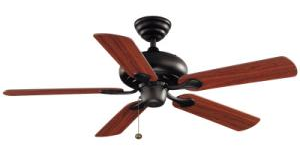 In our current home, our master bedroom is on the top floor and has attic access. The room had no overhead lighting. In fact, nearly every room in our home has a wall switch wired to a nearby receptacle, a common cost-savings strategy builders use to avoid paying for light fixtures. Since we wanted that switch to control our fan and future overheads lights, we had to rewire the switch to control the overhead fan. This article focuses on the first step of installing a ceiling fan in a room that didn’t previously have a fan: installing a ceiling fan electric box strong enough to hold the fan.
Selecting a Ceiling Fan Eletrical Box System
There are two types of ceiling fan mount kits: those designed to mount directly to the side of a joist, and those designed to be suspended between joists. Our attic consists of a 2×4 truss system with each truss spaced 24 inches on center (a common attic setup). Without measuring to find the center of the room in advance, we knew the odds were good that the fan box would need to sit between two joists. If the center of the room happened to fall on a joist, we could move the box 2 inches off that joist without creating a visual detractor in the room. So, we opted to buy a mount system designed to suspend between two joists. (This later proved a good decision, the center of the room is between two joists).
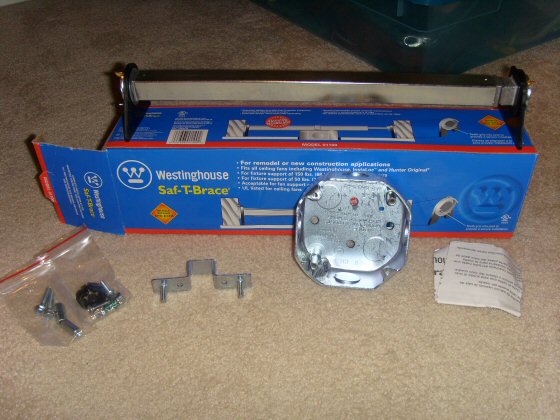
We chose the Westinghouse Saf-T-Brace for its promise of simple, quick installation, and relatively inexpensive price ($14.95 from the local HD). When suspended between joists 24 inches on center, the Saf-T-Brace is rated to hold 50 lbs. This correlated to the minimum strength required by the ceiling fan we picked. (At 16 inches, the rating increases to 150 lbs. If we wanted to hang a heavier fan, we would have simply added some blocking to the joists.)
The Saf-T-Brace turned out to be an extremely well-engineered system. You can see in the picture below the brace consists of a square metal shaft with a corkscrew-style expansion bar. Each end of the Saf-T-Bar has a triangular plastic piece that sits on the overhead drywall to ensure proper vertical spacing. The ends terminate with a circular metal component with spikes that dig into the joists on both ends. The result: a brace between the joists strong enough to support a fan.
How to Install a Ceiling Fan Box Between Joists
Here’s the simple steps we followed to install the ceiling mount box. Note that these instructions are not a replacement for the ones that come with the Saf-T-Bar. Always follow manufacturers’ instructions when performing home improvement projects.
- Step 1: Measure to find the center of the room and mark the center point with a pencil.
- Step 2: Use a stud finder to ensure that no joist is close to the center point, and that two joists will be reachable by the Saf-T-Bar within a 24″ span.
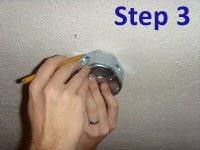 Step 3: Hold the metal ceiling fan box that comes with the Saf-T-Bar to the ceiling, centered on the pencil mark. Trace the ceiling box with a pencil so that the ceiling box shape is on the ceiling.
- Step 4: Use a drywall saw to pierce and cut out the shape of the box in the ceiling.
- Step 5: Move any insulation impeding your access to the joists on either side of the mounting box. This may be easier to do from the attic-side depending on the type of insulation. (Note, the Saf-T-Bar claims that one doesn’t need attic access for the installation, but we think its much easier if you have the access to go ahead and use it).
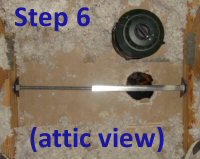 Step 6: Push the Saf-T-Bar into the ceiling and start unscrewing the cork screw to expand the shaft. Ensure that the Saf-T-Bar stays centered over your access hole while unscrewing the shaft. Keep unscrewing the shaft until a strong bond is reached between the ends of the shaft and the nearby joists.
- Step 7: Place the U-shaped bracket over the rectangular section of the shaft and screw the mounting box to U-shaped bracket.
- Step 8: Remove one of the punch-outs on the box and run electric into the box (note: a wire holding insert for the punch-out is included).
- Step 9: Replace the insulation and continue the installation from the room below.
What do you think? Have you installed a ceiling mount box in your home? Leave a message here and let us know your experience.










This, for me, was one of those projects that had me wondering what the previous owners were thinking.
In my house, they had replaced the existing ceiling fixtures with office-like fluorescent tubes(!). Efficient, but not very attractive. However, none of the electrical work had been replaced.
Nearly the whole house (built ca. 1935) is wired with the old-style knob & tube wiring, and the boxes are all “old project” electrical fixtures, which are smaller and shallower than the modern jobbies. So the first thing we had to do was replace the boxes, since nothing from the fans fit correctly.
This was no easy project, as the house had plaster ceilings over lath, which had subsequently been covered by concealed-spline 12×12 tiles. In at least once case, I had to use a box cutter to widen the hole in the tile to about a 10″ circle just to see what I was doing. Then it was a matter of finding a means of bracing the new box in the ceiling somehow. In some cases (I’ve done this in three rooms so far, with at least one more to go), this meant sistering the joist so that the box would be well-mounted; in another it appeared that the box was attached to nothing at all. How the fixture never fell is a mystery. I wound up making a bigger hole in the ceiling (at least a foot all around), breaking up a bunch of plaster, then taking a piece of 3/4″ plywood and drilling a hole in it to accommodate the wire. I used about ten screws to attach this to the lathing and then screwed the electrical box directly to the plywood. It wasn’t pretty but it was sturdy. Because of all the damage I’d caused, I had to use ceiling medallions to cover up the holes which were now much larger than the fan canopies.
Usually a ceiling fan is about an hour’s worth of work for me, but in this house I’ve never managed it in under four hours.
Claude–Thanks for sharing the story! Working with plaster certainly adds to the challenge – no question about that! Glad to hear you’ve been successfully… the plywood idea seems like a good one to me.
Our fan install took about 3 hours to add the box, run the electric, and install the fan. If you’ve got the first two parts done, an hour is usually enough to get the job done.
I’ve installed several ceiling fans and now my wife would like a ceiling fan in our family room. The only problem is, we have ceiling cable heat in this house and I’d really hate to cut a wire and short the room out. So is this a safe/feasible project or should I just tell her to forget it.
Ron, I’m not familiar with ceiling cable heat, so I can’t answer for sure. If there’s a risk of cutting the cable while installing the mount box, then I would say you’ve got a predicament. If you can work around it, leaving a safe distance, you’ll probably be fine.
How would you install a box to support a ceiling fan on a beam? Would you recommend just putting screws straight up? Is there some kind of bracket that stradle the beam, so screws can go in the sides?
Thanks
Bob
Bob, There are both top-mount and side-mount ceiling fan boxes that will attach directly to the beam. You should be able to find a good selection at one of the local home improvement stores, but the bracket is *not* the only way to go.
I just installed a ceiling fan in my daughter’s room. This was a first for me, and I made more mistakes than what I did right. However, in the end, I think it is going to be ok. (There isnt much insulation in that part of the attic any more, but, you know, stuff happens.)
The last big issue is the canopy. The part that it is supposed to hook on to is up in the ceiling – apparently we needed a deeper box. However, there is NO WAY I am going to take it all down and try again. Anyone have any ideas for how I can stick the canopy to the medallion [which is plastic and glued to the ceiling…yeah, we had lots of issues:) ]?? Thanks in advance for your time!
Aprille, Can you give a little more details on the project? It’s hard to visualize exactly what your problem is from what you described here… Is the issue that you can’t get the fan to hang on the box?
Well, not exactly.
We had to install a brace in the ceiling, because the rafter was not close. Then the box hung on to the brace. Then we attached the bracket on to the box, and then the fan on to the bracket. The fan is now hanging and is operational. The problem is that the bracket that the fan is hanging on is recessed into the ceiling a bit – we didnt realize that it should not be flush with the ceiling. So, when we went to put the canopy on it, there was no way to get to it with a screwdriver and put the screws in (except to hack away way too much of the ceiling). So the canopy is just hanging on the downrod and all the wires show and stuff.
I tried to glue the canopy to the medallion with epoxy, but it wouldnt stick.
I thought about gluing styrofoam to the medallion and very gently putting the screws into the foam – because the canopy isn’t weight bearing, only for looks – but then I got afraid the foam would melt.
This is what happens when you try to jury-rig something!
Aprille, from what you described, it sounds like your best option is to install a spacer between the box and the bracket. The wiring will be covered by the canopy anyway, and it should get the brace low enough to be able to properly mount the canopy. You can find spacers at any of the big boxes, and you should be able to find some screws that are 1/2″ to 1″ longer than the ones that shipped standard.
Unfortunately, that’s my best guess without seeing it.
Fred
Hi, I am trying to install a saf-t-brace model 1400 for a ceiling fan. I installed the bracket/rod between the 2 boards. this is fine, but when i install the box onto the bracket, I try to secure it with the 2 locknuts. It tells you not to force them. I managed just to get them on the bolt part way. It wont go any further. The electrical box hangs loosely. Is this normal?
Sally,
Can’t say for sure without pictures and being there, but my guess is no. Locking nuts usually have a rubber-like material in the threads that prevents them from being hand tightened. You should use a wrench / ratchet to tighten the nuts. You don’t want to over-tighten, but the box definitely shouldn’t hang loose. Hope that helps!
Fred
Anyone aware of a smaller version of the Saf-T Brace. My joists are spaced 12″ aparts, and I’ll I can find is the one of 16-24″ spacings.
I used the Safety brace mentioned is 13 inches completely closed. Westing house makes a plastic Fan support that connects directly TO the joist from the side and from underneath.Its model 02525-11 called Fan Master jr. The fan will connect to the wood joist not to the plastic itself. There are also plastic celing fan outlet boxes that attach to the joist made by carlon. I bought all these from The Home Depot.
My attic has 24 inch spans and the downstairs uses 16 inch spans.
I have a 2 story house with an attic which is no pleasure to get up in as there is no subfloor and gets crazy hot in the spring and summer. So I had to work in the middle of the night.
Thing to be careful of when using the safety brace. Make sure you make your hole placement closer to the joist as opposed to the center as there will be wobble and then you will have to place shims of some sort to keep the box from wobbling.
Invest in a good box saw blade slightly larger than 4 inches so you dont have to manually cut those holes. You will have a cleaner hole and much less mess to clean up.
I am trying to install fans in my home. There is no attic and the crawl space above the cieling is about 12 inches, in other words no access. I am trying to find the Saf-T-Brace but cannot find one. Home Depot, Lowes, and even Dixieline do not have them in stock. Anyone know where I can find one? I may have to special order it.
Also, I have the same problem with the light switch controlling the outlets in the room. Did you have to destroy the drywall to re-wire the switch for the fan? I am going to attempt using fish tape to feed the cables through. Thanks
Is there any quick fix to installing a ceiling fan to a Cathedral Ceiling that already has drywall?
Quick Fix? Not really but you can use the saf-t-brace. Just use a stud finder to locate the centerline between to studs. Outline the juction box onto the cieling and cut out with a key hole saw. If you need to run the power cable I Recommend using a fish tape, this is what I had to do because the is no over head access. Make sure your downrod for the fan takes the blades past the angled ceiling. If you cannot access a switch for the fan you can purchase remote for around 30 bucks. REMEMBER to set the dip switches prior to hanging the fan or you will have to start over. If you have no idea what a dip switch is right now, it will be obvious once you purchase the remote. You can use the remote on the light as well. Just follow the instructions on the box if you need to. I use a remote in my living room, i can dim the light and even adjust the fan speed. I highly recommend the remote but make sure it comes with a holder that can be mounted to the wall. If you have questions shoot this way.
Thanks Steve, forgot to mention that I already have a junction box and it’s wired for a fan as well as the former light that I removed, both running to a wall switch. I bought a new fan with light. Then I used a 18″ downrod, but the opening in canopy wouldn’t allow the fan to hang vertical because of the way the junction box is currently installed in the Cathderal ceiling. However, I think I may have found a solution for the slanted ceiling. Here’s a website http://www.aifittings.com/n_4.htm The only missing part now is to get up in the attic and find out how to attach this mounting box to a rafter.
Are there any Safe-T-Brace for joists spaced 12 inch apart?
I couldn’t find one for 12 inch joist spacing. But on amazon.com reviews for the model 01100 Saf-T-Brace I read about people pulling the cast plug out of the bar. Then cutting 4″ off the bar and 4″ off the spiral screw. It’s pretty easy to do with a hacksaw since the metal is not too hard. I used a large vice to hold the cast plug while I wiggled the bar off it. Also used the vice to hold the bar and later the spiral screw while I cut 4″ off them. Just to be neat I used a grinding wheel to square up the end of the tube to take the burrs off the spiral screw. Then held the tube in the vice while I pounded the plug back in. The modification didn’t take long and worked very well for 12″ centers.
Hey, great info..
I am wondering how to use the saf-t-brace system.. Im installing a new fan and want to use this type of box. Do the legs just get pushed up against each joist? Or are u supposed to use screws aswell? Is so, how are you supposed to screw it? Do you bend the tabs out before u install the box or after??
So confused, please help.
Thanks,
Lou
Hey Lou – the legs just push up against the brace (they are serrated)… No Screws.
Thanks for reading.
Fred
i just installed one of these today, very easy. after i hand tightened the brace, i used channel locks and gave it a turn ot 2. is that ok?
Joe – Yep, you should be good to go.
I looked on the westinghouse site, I too have 12 inches between my joists. I don’t see a product. Is there another recommendation?
Use a ceiling fan box that attaches directly to the joist from the side.
HELLO I WOULD LIKE TO KNOW IF THEIR IS ANY PLACE TO BUY A CEILING FAN MOUNT. I AM IN THE PROCESS OF REPAIRING A HOUSE AND WE TOOK THE OLD FANS DOWN TO PAINT AND A FAN MOUNT GOT THROW AWAY. THE MOUNT NEEDS TO BE 11″ ACROSS AND WHERE THE MOTOR MOUNTS OR SLIDES INTO THE FAN BRACKET IS 1 5/8 ” ANY HELP IN WHERE I COULD BUY ONE WOULD BE APPRECIATED THANKS BILL
My ceiling fan box is shy of being flush with the 1/2″ sheet rock. Can’t completely tighten bracket to box without destroying the rock. If I leave it this way will it cause wobble?? The box is secure and rated for ceiling fan. It is wobbling and balancing the blades is proving difficult. any advice?? Thanks
Make sure you’re tightening each side of the bracket evenly. Hold the brace flush with the ceiling and then tighten the screws evenly all the way up. If you still have problems getting a tight fit try smaller (or longer) screws for the brace. If all else fails you may need to re-aline your box. The balancing kit that comes with the fans are for minor adjustments only. If the wobble is noticable, normally, the kit will not help. On a side note, make sure all of the blades are nice and tight and evenly spaced apart. If even one blade is loose you will have balance problems. Hope this helps.
Our hanging light fixture in our kitchen let go last night. The previous owners had used a plastic box nailed to a joist and the plactic broke. The ceiling is vaulted and angled and I have no access from above and the nearest other joist is over 2.5 feet away. How do I fix this so I again have light in my kitchen? Help
Bryan, it would help if you sent a picture… you can do this through our forums (look at the link above)…. You may have to pull some drywall out, put in a new box, and patch the drywall.
I installed the Westinghouse Saf-T-Brace/box/bar. Are the two 10-32 screws holding the entire weight of the fan? Or am I missing a piece? Seems like when I installed one years ago the box had a hook that the pin on the downrod of the fan went through to hold the weight and swung from that. What is the thread pullout force on a 10-32 screw if one were to fail during an earthquake load? Would the single remaining 10-32 screw hold the fan at this point so it would not fall and injure someone?
My box is not flush with the plasterboard. Are the two hex female stand-offs provided with the Saf-T-box for this purpose? If so, can you cut them to give the right spacing and then I assume the 10-32 screws through the spacers and on into the threads of the box to hold the fan mounting bracket. The fan comes with two short screws and washers. I see using the longer 10-32 screws or even to replace them if longer ones are even needed. Just thought there used to be a hook in the box to pickup the horizontal pin in the fan verticle downrod. This would be the safest and make it bullet proof but then there is the wiring coming throught downrod which could rub and eventually short. Thanks for any clarification you can provide.
Do you know if these work with engineered joists?
Patrick, we’ve never done this, but I would think it will work. You would be tightening the hanger between the pieces of wood on the bottom.
I see JM and Ian asked the same question and I didn’t see a answer. I have the same situation. There is no access from above so we are working from below and the joists are approx. 13.25 inches apart and the Westinghouse bracket is too big. Do they make a 12 in backet? Is there any way to retro the 16″ bracket without compromising the intigrity of the bracket?
Chris, unfortunately, I’ve not seen a shorter one in my travels. Doesn’t mean it doesn’t exist, but we haven’t seen it.
The joists in my 1868 loft are 12×3 on 12 inch centers and I had the same problem with the Westing house bracket. My solution was to shorten the unextended span of the bracket. I started by drilling out the spot welds on the nut at the end if the square tube. This let me separate the tube and the expansion screw. Using a hack saw I cut 5 inches from the tube and then the screw. I re-assembled the bracket. There was no need to worry about the welds to hold the parts together since the burrs from the sawing were enough to hold things in place. Once the bracket was fully expanded in the welds were not an issue since they are not critical to the load bearing; the force of the screw against the joists takes care of that.
The Hunter Type-A I installed is totally secure in this way.
So smart. Never thought of that.
Chris… I ended up removing the end piece and cut the tube using a reciprocating saw. hack saw will not work. I cut quite a bit off so that when you put it in place it will tighten to the right size. I have had it up for months now and it is completely fine.
Ian, what make of bracket did you have? We’re using the Westinghouse from Home Depot and then we got one from Lowes. Which end are you cutting? I’m assuming that it is the inside end, not the end that has the feet on it.
Chris… i took the end with the static foot off. Had to pull of the metal washer etc. then pulled off the end cap. then cut off a chunk of the bar. then put all the pieces back on to it like they were before. make sure you have a clean cut and file it down a bit. It took about 5 secs to cut through the square tube. Once you do it you will realize how easy it is. Trick is you need the saw to do it.
Sorry. yes mine is the westinghouse as well.
Hi Ian, thanks. Someone did it for me, however, they took the thread off (where it screws together) and put it back together. Installed on Friday and it worked like a champ! Thanks for your input.
I have an old house built in the 20s. I want to hang a ceiling fan in a bedroom. No access from ceiling. A handy man hung fans in our other bedrooms but I didnt watch him do it and I no longer have his number (kick myself). But I know it can be done without much work because it didn’t take him long. We have very old hardware from which a light currently hangs in this bedroom. The light fixture mounts on a center screw type black box. I looks like there is a stud behind the black box. I bought a Saf T box to use to hang the fan. I don’t know how to remove the black box thats already up there or if I should. Can the Saf T box go over it somehow? Are you familiar with these old black “boxes”/mounting devices (I don’t know if its really a box) with the center mounting screw?
I am a resident of an old frame house built in 1907. We have the original lathe and plaster walls and ceilings Back in the twenties or thirties these old gas pipes were converted into conduit for running the electric wires. The wires are the ancient cloth covered and there are no electrical boxes, just the round-ish black in color, natural gas type, (boxes if you will) you often hear about in old homes. In the front room, there is nothing and of course, this is where I want to install a fan.
I have seen ceiling fans that have some sort of molding to cover the exposed exterior wiring that leads to a receptacle where a single switch to control the fan is usually installed. How is this type of mission accomplished? Where can I get all the information needed to do this successfully and inexpensively? Can you kindly explain in detail the steps for me? I would gratefully appreciate it.
I have a relatively new house with engineered joists 12″ apart and installed 2 of these braces (2 separate ceiling fan installations) following Ian’s suggestions up above. I unscrewed the brace and cut off 5″ each from the square tube part and the round screw part. (Cutting 4″ off left the brace still just a little too long to fit easily between the joists.) I punched out the end cap with a screwdriver and hammer and put it back onto the cut square tube, screwed in the round screw part and it was good to go. Installed easily into my ceiling. I made sure to have 2 of the 3 hooks on each end lodge into the bottoms of the joists by rotating them accordingly before tightening the brace. It ended up being very sturdy. No wobble when I installed the ceiling fans. Definitely use a power saw when cutting the pieces of the brace.
There was some trickiness trying to install the safety cable of the fan. Had to install the safety screw first then install the ceiling box onto the brace. And yes you do need to use a wrench or pliers to screw on the locking nuts to secure the ceiling box.
My question is about mounting the electrical box for the fan. Should the box be flush with the ceiling surface, or recessed below the surface of the plaster? If so, how much should it be recessed? Thanks
Leonard: Flush is correct. You don’t want it to sit below the surface.
when installing the safe t bracket, can all this work be done from the room, or do you have to climb into the attic at any time?
Lance, they are designed so that all the work *should* be able to be done from the room… but there’s always exceptions.
I am trying to install ceiling fan where there is no attic access. The new fan requires the bracket to be mounted to the building structure not the outlet box(bracket is larger than the outlet box.)The problem I’m having is that there is no solid wood under the drywall to mount the bracket to. How can I get a piece of solid wood in the crawl space to mount the bracket to. I only have the hole from the outlet box to work with.
Ceiling Fan installation, Is there a bracket that mounts on the outside of the sheetroct in the ceiling.
The bracket I purchased states that it comes pre-set for 1/2″ drywall. I have 3/4″ drywall on a angled ceiling. How do I extend the box to make it flush with the ceiling or do I need to purchase a different box? Thanks
@Wade
I suppose you might get a 1/4″ thick metal spacer of some kind, line it up with the U-shaped bracket and drill holes for the screws, and then place it between the U-shaped bracket and the ceiling box to get the box flush with the drywall. You may have to get longer screws if the supplied ones aren’t long enough.
I’m installing a Harbor Breeze 52″ Crosswinds ceiling fan and a medallion (to hide some sins while removing the old box). When I removed the box I found an original metal brace, nailed into the bottom of the joist with a bend in it to allow the original light box to be flush with the plaster. I didn’t feel comfortable with this old bracket being nailed into the bottom of the joists, as it was loose to begin with so I cut it, hoping to bend it out of the way. I bent it up but I’m going to have to expand the hole a couple of inches and use the Saf-T-brace, something I had planned anyway. I purchased a 12″ medallion with a hole in the center, about 3 1/2 inches. When I get the hole widened, the brace/box installed flush with the ceiling, and I’m ready for the fan installation, I believe I should be installing the medallion before i go to town on the fan bracket, etc. My question is, should I cut out the medallion centre wider so the fan canopy sits inside (and flush with the ceiling) or should I put the medallion on and put the fan bracket on (screwed through it) into the box? The medallion is about 3/4″ thick, so I believe I’d need longer mounting screws
Gerry, I am sorry it took me so long to reply. I would say that it’s best to mount the box flush with the medallion and have the fan sit on top of it. Otherwise, it will be hard to get the medallion cut to look good with the fan base. I hope your project goes/has gone well!
I bought and installed an allen + roth twin breeze ceiling fan from lowe’s yesterday. It’s mounted in a downstairs room to an I-beam. The fan has a considerable wobble when running on high speed. I tried balancing the blades with the included weights but this did nothing to fix the problem. Could the beam be the problem? Do you have any ideas on how I can resolve this issue?
Joshua, My guess is the box just isn’t mounted well against the beam? Does the whole fan shake? Would guess you need to re-mound the box maybe using the saf-t-brace or something like it so that it is mounted on two beams. Was the original box rated for a fan or just a regular light fixture? If the latter, then that’s definitely your problem.
SO excited to have found you guys! I’m an experienced DIY’er, and have looked through here for an answer to my situation, which I’m certain others have encountered, but haven’t found exactly what I’m after. Hoping Fred or someone here can help! (And thanks for being so generous with the advice, by the way!)
Before the long back story, the question: are there any places I can get “standard” canopy screws with the special heads for trim-ring keyholes, and in lengths of 1″ to 1-1/4″?
The story:
I have installed a 52″ Hampton Bay ceiling fan (unique model called “Ansley” where the light kit is ABOVE the blades, but that’s not germane to the story). I put a medallion over it, and the canopy will HIT THE MEDALLION, not sit inside the recessed center part very near the ceiling.
Anyway, all’s gone fine until I go to attach the canopy to the bracket which holds the fan, and I realize that because of the thickness of the medallion, the screws aren’t long enough to catch in the bracket.
I go to Ace, figure that I simply need to match the screw and get 1/2″ or so longer. I’m aware that the head needs to be the same (or very similar), so that they will “set” into the keyholes on the canopy trim ring to allow it to rotate and “click” into place, thereby hiding the screwheads.
I determine they’re 8-32 screws, get about four different kinds in both 1″ and 1.5″ lengths, and head home. NONE worked. Seems you need the EXACT head, because the keyholes are so non-standard: one went into the hole because it had the right diameter head, but it was too “thick” a head to let the trim piece rotate. Others were thin heads, but too large in diameter.
All the while, I’m perched on the tip-top of a ladder (I know, I know, “This step is not for standing or sitting”), and I’m working within a space of about 2 inches, because the canopy is of course already on the downrod, making it really difficult to juggle everything in the wee bit of clearance between the top of the canopy and the bottom of the medallion.
Like someone earlier, I do NOT want to take it all down and put spacers up in the box. I also thought about gluing the canopy to the medallion (because I’m not going to try to cut the center medallion hole larger and hack it all up), but there’s so little surface area on the edge of the canopy, I don’t think that will work.
Bottom line, again: are there any places I can get “standard” canopy screws with the special head for trim-ring keyholes, and in lengths of 1″ to 1-1/4″?
(And while I’m at it, this fixture has six candelabra bulbs. Max wattage of 15W each, and this is NOT enough light for the room, not by a long shot. Larger candelabra bulbs are too big to allow the glass globe/shade to cover. Anyone know of perhaps LEDs or something, so I can get more lumens with low wattage AND in a smaller size bulb?)
Thanks SO much!
Michael
Michael, thanks for joining in. Unfortunately, I don’t know (other than a typical hardware store, or calling the manufacturer) where you could get the screws you are looking for…
Good article Fred, but could you link the article for rewiring the switch and running it up the wall for the ceiling fan electrical box? I am dealing with the same exact issues you had.
Thanks
Randy, I will update the article. Here’s the link:
https://www.oneprojectcloser.com/rewire-a-switch-that-controls-an-outlet-to-control-an-overhead-light-or-fan/
There was a question on running a wire up the wall from the switch to the ceiling fan. I did that using fish tape. Remember that the switch will only have hot (for the fan motor) and switched hot (for the light), and the green wire ground. The neutral will have to picked up from a near-by outlet. I had to enlarge the hole for the wire going into the attic so I could hit it with the fish tape. My nephew is an electrician and says he has some “fish sticks” (no joke) that are a bunch of semi-flexible three foot sections that screw together and go up they wall. Since they don’t bend it makes it a lot easier to move them around to hit holes . But I got it done with normal fish tape.
Terry, this is normally done by running 3 wire (3+ground) from the switch to the fan (for fans with lights and blades). You can also get an electronic box that will allow independent control of the fan and lights with only two wire. You should run all of the current carrying conductors and neutral wires in the same romex to be code-compliant.
interesting that you use the fan to create “White Noise”. Our fans came with an attachment to reduce the noise the blades make.
While I think this product is great and would use it myself if I didn’t have attic access or if installing one between floors. One can always just cut a 2×4 or 2×6 to span flat between two trusses and then screw a round metal box to the board.
Definitely true. This is the solution when attic access is restricted. It’s also a bit easier because fewer tools are needed, even if you do have access.
Fred,
On a preexisting 4 ceiling light installation, the lights are gradually failing. When I replace the bulb, the lights fail to come on. Do I need to replace the individual fixtures, or is the whole lamp/ fan assembly failing?
I have one replacement fixture ready to go.
Tom
Tom, this sounds like the fixture is going bad to me… Obviously it could be an electrical short up the chain somewhere. My first try would be to replace the fixture with the spare you’ve got and see where that takes you.
Is it possible to screw my existing light box to the ceiling joist from inside the box of an older house??? The fan I had installed was working fine, although it was not attached to a fan/light box. Unfortunatly I took it down to add a remote control which was almost to big for the fan bracket, and after tugging & prying to get it back onto the bracket, I have loosened the light box from the joist. I am trying to get by without installing a safe t bracket if possible. The existing box is nailed from the hidden side of the joist into the box. I don’t see why I can’t use some type of screw from the inside of the box to tighten it up to the joist again??????????
Iary,
Well, lots of things are possible 🙂 I would recommend going with the safety brace, but beyond that, I would think that any wood screw could be used. Problem is that it’s not to code and not safe (most likely) – because if you get an electrical short from the screw into the joist, you’re in trouble (big fire hazard). If you can do the Saf-T-Brace thing, you’ll have a safer solution.
Also, I wouldn’t hang a fan from a box like that, but that’s just me 🙂
Thanks for the comment. Good luck with your project.
Fred
We are trying to install a ceiling fan. when we took down the previous fan it had a large round (mount) and there was a wide amount of damage, so i bought a medallion to cover the damage. Problem is when we try to put in the screws to mount the canopy there isnt enough room to get them in, an yes we tried spacers but that leaves too much space from the medallion to the canopy but any closer and we cant get the screws in eeerrrrrgggggghhhhhh, what is your suggestion?
Lauren, this is one of those cases where a picture might be helpful. I’m having trouble picturing what you means when you say, “there isn’t enough room to get them in”… Do you simply need to get some longer screws to account for the depth that the medallion adds to the ceiling?
I want to install a ceiling fan with light kit where there is currently a ceiling light fixture. I want to use the Westinghouse Saf-t-brace, but need to remove the current 4″ Slater round box without destroying the ceiling. Any suggestions? Attic access is out of the question as that is already finished.
I am installing a brace for a heavy chandelier. I hand tightened the brace and suddenly the outer sleeve of the brace lost resistance. On the visible end there are threads visible and the prongs are engaged into the joists with good stability but the outer aluminum sleeve feels loose. Not sure it will even unscrew now. Is this common? Can I proceed with the chandelier? I can pretty much hang on the brace without movement. Thanks
Ross, hard to picture what you mean, but if it will support your weight, my guess is that it is OK. It could be that the outer aluminium sheath is a cover for what really holds the bracket to the joists, which is a screwn-type mechanism beneath. Good luck.
The unit I live in has in its ceiling, small plates covering the area to install a ceiling fan. I removed it today to install a ceiling fan I purchased, but I found that the already installed box (that is in the ceiling of my unit) is smaller than the bracket that came with my fan, thus I can not hang my ceiling fan.
What can I do about this? Do I need to purchase another box or fan? Could you let me know please, Thanks Chris
I AM THRILLED TO FIND THIS WEB SITE. I BELIEVE INSTALLING A CEILING FAN IN AN EXISTING HOME COULD BE A CASE STUDY AT THE HARVARD BUSINEESS SCHOOL. I AM GALD YOU ARE HELPING THESE DIYs TO GET THE JOB DONE!
ROBERT
Hi,
I am installing a hunter ceiling fan in a new construction condo, the electrical box is already installed. When i try and mount the fan hardware to the box, the screws do not go in. I drilled the recommended 9/64 pilot holes but the screws do not hold. after trying a few times the threads on the screws stripped and now cannot be used.
Any help would be great. thanks.
Fred (and all), this is a very helpful thread! But I’ve noticed that a lot of folks have asked questions (without responses) about installing the brace when no attic access is possible, i.e. between floors. That’s my case. I guess my first question would be, how do I get the old elec. box (chandelier) out? (without destroying the ceiling?). I suppose it’s side-mounted to the joist, but – without removing more sheetrock – can’t figure out how I would get to it?
The answer is that you may not be able to get it out without destroying a bit of the sheetrock. The mounting bar is designed to be installed from below the ceiling, but if you can’t get everything out of the way, it may be impossible to do it.
Bill,
In my case, the box was attached to a thin bar that was nailed into the joists. After unscrewing the box I was able to bend/break the bar away.
Your method for hacking the fan support for 12″ joists worked perfectly. With a hacksaw, took 4-5″ off both the bar (side with the thread, not the foot) and the screw. Then popped the thread out easily enough with a screwdriver and rubber mallet, as someone had suggested, and replaced it into the shortened bar. This worked just about perfectly. i ended up with a minimal amount of wobble on the fan; might go up into the box one of these days and give the support screw one extra turn with a wrench.
Thanks
Edit – the fan-provided balancing kit solved the wobble 100%. 6g on one blade, 3g on the next. Perfect!
Hi,
I am planning to install a ceiling fan, but I have no ceiling box. I researched and understand how to mount the box on the brace between the joists. However, I am not sure about the wiring. I assume that I need to crawl up into the attic and carefully walk on the joist. I assume the best start is to push a nail up the ceiling, where I will cut out the opening and go up into the attic and start crawling. I guess I will carry the wiring from the opening to where my room light switch is. Do I staple down the wiring along the joists? Is this the best approach to laying down the wiring? Any better or professional steps?
Thanks
Jc, if this is your first time wiring, I highly recommend getting a book like Stanley’s basic home wiring guide. There really are too many nuances to wiring to cover them all here.
Fred
I have a balcony over a ground level patio. The base of the balcony ice approx 1.5 inch thick concrete.
I want to add a overhead fan to the balcony base to cool the patio.
How would I attach the fan, what kind of electrical connection box etc.
You will likely need to get a box that can mount to concrete, and you’ll need to run the electric in conduit. Sounds like a job for an electrician.
We have had 2 Original Classic Hunter ceiling fans (w/o light kits) installed on my living room vaulted ceiling spinning for over 25 YEARS now with only an occasional oiling. Since my opinion of these fans was nothing less than superb, we finally decided to go all the way and purchase FOUR MORE Original Classics (this time with Hunter accessory light kits) to install in three bedrooms and one in the kitchen.
This is where my Original Classic nightmare began. We called a (professional?) installer since I am not much of a DIY guy. Here are the facts: We purchased three model 23856 52″ fans for two of the bedrooms and the kitchen. We also got one model 23827 44″ fan for a smaller bedroom (four in all). As you might guess, this cost us a small fortune. Three of the four fans had ceiling pot lights installed which were removed by the installer. The kitchen had no ceiling light where the fan would be going so we will start fresh there. Our installer picked up some plastic medallions to cover the larger holes left in the ceiling after removal of the pot lights and three Saf-T-Braces to go between the attic ceiling rafters (which are spaced 24″ on center). ALL THREE of the newly installed fan/light kits have problems of various types:
One of the 52″ fan/withlight kit wobbled SEVERELY — The balancing kit did nothing for this. The installer said he thought the problem was caused by the light kit. Hunter Tech support said they doubted that and told us to take off the fan blades but leave the irons installed to the motor. With the fan blades off, the fan’s wobble stopped. Hunter then shipped me 5 new blades which I just received today They have not been installed yet. They seem to think that the fan’s wobble will go away after the NEW replacement blades are installed (remains to be seen).
Another of the 52″ fans/with light kit wobbles (not too badly) and makes a loud ticking sound but ONLY when on medium speed. When on low and high speeds, the problem goes away, but the fan is right over our bed and high speed moves too much air, and the low speed not enough.
The 44″ fan/with light kit in the smaller bedroom wobbles a bit in all three speeds, but makes no noise.
The remaining 52″ fan/with light kit is still boxed and hasn’t been installed yet.
Here are my observations, and welcome any and all support I can get:
Three out of four Hunter fans with problems SUCKS!
The Hunter Original Classic fans used to be made in the US, but now are mfg
in China.
Hunter fan blades (according to Hunter Tech Support) are on back order through October, indicating MAYBE there is a quality control problem with the blades.
The Westinghouse Saf-T-Braces Model 01400 purchased at Home Depot say they are rated for fixture support of 50 lbs. OR LESS on 24″ centers. Since my attic floor joists are 24″ on center and my fans weigh up to 50 lbs. each, I’d say that is cutting it pretty close, even though the box also says the braces are acceptable for fan support of 70 lbs. OR LESS. This confuses me a bit. My installer assured me that these braces would hold my Hunter fans with no problems.
My light kits are all the same … Hunter accessory kit model 22343.
I really hate to take down all the fans, take out the Westinghouse Saf-T-Braces and replace with 2×4 or 2×6 braces between attic floor joists, but will if I have too. (This would also be quite expensive and more dangerous ).
Please help, as I have no idea what could be causing these various problems.
Louis, tough problems, for sure. The balancing issue is likely due to poorly manufactured blades. Perhaps they are not uniform in shape/weight by such an amount as the balancers cannot fix the problems. I’d install the new blades and see what’s up.
The ticking on medium speed is also a tough problem, and honestly I’m not sure where to go with it. Maybe try oiling the fan and try using a balancer kit to change the balance a bit in case that’s a problem?
Fortunately (and unfortunately) most everything is made in China these days. The cheaper labor costs and lack of regulations make it an economically superior option, even when the quality lacks…. My guess is that 99% + of ceiling fans are manufactured overseas at this point.
Thanks Fred….I’ll try replacing the blades. If that doesn’t work, I’ll consider returning ALL the fans and start fresh next year with different fans (possibly Casablanca). If anyone else has any ideas, I welcome them. Thanks again.
Louis
Can you give me any hints as to how I can install a fan in a Mobile Home…. The problem isn;t installing t on the ceiling, it’s how to wire it up. Should I go external wiring and box or is there an easier way. Do you have any suggestions ?
Unfortunately I have no idea on this one… Probably would check with a mobile home retailer or manufacturer.
I’m confused by why the pound rating for 16″ joist separation is 70 fan and 150 fixture but the rating for 24″ joist separation is 70 fan and 50 fixture. Why does the ceiling fan rating stay the same for the different separations but the fixture rating decrease so much? I would think that a fixture rating would always be higher than a fan rating because a fan generates extra downward stress when it spins. What am I missing here?
I’m installing a ceiling fan in an older house with lathe and plaster ceilings. There is no overhead access. The wiring in the house appears to be Romex cable with woven insulation on the wires. There is a lighting fixture there now but the box is really old and shallow and is held in place by drywall screws in the lathe. There is not a lot of play with the wiring. It looks like I will have to use a Saf-T-Brace to support the fan. I’m not sure what the thickness of the lathe and plaster is but I think I will probably have to shim the electrical box in some way so it ends up being flush with the ceiling. Any ideas on how best to do that so the box is solid and does not result in a wobble problem? Any other tips you might have when installing in a lathe and plaster ceiling? Thanks!
Hi Mike, I’ve not got much experience with plaster ceilings, so I’m not sure I can be much help. The problem I think you’ve got is that the box is tightened pretty well to the saf-t-brace and doesn’t really have a depth adjustment. If the box ends up recessed a little bit that might not be a problem as long as you have long enough screws and the box itself is very tight. You can also find box extensions at some hardware sites online and that may be something that could help.
Hi Fred,
Thanks for your response. The idea that I got from an employee at Home Depot is to measure the width of the triangle shaped tabs on each end of the brace to see how much I can safely trim without compromising the strength of the support. The brace is designed to have the electrical box be flush with a ceiling that has 1/2 inch sheetrock once it is installed, so if the lath and plaster ceiling that I am working with is 1 inch thick, I can make the box flush with the ceiling by trimming 1/2 inch off the end tabs on the brace. The tabs are made of plastic so I think I can trim them using a fine tooth hack saw. That’s what I plan to do. I’ll let you know how it works. What do you thimk of the idea?
Mike
I have installed 3 safety bars and ceiling fans and have used the same model, except today I noticed the ceiling fan and box have a little play from sided to side.
I recall when I first installed the safety bar, part of the bar that is used to tighten the bar had a little circular play in it while the set part has no play. The bar is firmly secured despite the small amount of play and will never come down. I decided to uninstall the ceiling fan, go back up in the attic to see if I could eliminate the play so I reversed the bar to where the solid part of the bar that has no play is above the hole.
The steady part is smaller in circumference resulting in a bracket for the box that is tightened as much as it can be tightened but because of the smaller diameter of this section of the bar there is once again room for play! Having decided to research this a bit on the internet and discovering your instructions and clear photo of the bracket, low and behold I see that your safety bar is square, as is the bracket, which makes far more sense then what I have, which is a round bar with round bracket (perhaps an older version of the same model). So now I must decide whether to either wrap something around the bar to make for a tighter fit or replace the safety bar with the newer square version. Something so simple yet sooo annoying. Thank you for your great website and valuable information!
I want to hang a ceiling fan, but the wire box is nailed to the side of the joist. I do not want to cut another hole in the ceiling. Will the t bar work?
Hard to know, but probably. I think the box can scoot pretty much all of the way to one side.
Yep the box does scoot pretty much all the way over. My original light fixtures were nailed to the side of the joists and I had no problems positioning the box over the existing holes. (Refer to my post of September 2010 for details on modifying the Saf-T-Brace for 12″ joists.)
I have the same issue as an old commenter with the electric box not securing tight to the bar on the Saf-T-Brace. Unless I use a wrench to tighten the nylon nuts their will be almost 1/2 inch from the box to being tight against the bar/u-bracket that fits over the bar. If you are not supposed to over tighted(as you strip out the nylon) you have a very loose box. It won’t fall but I suppose there will be a lot of wobble with the fan.
Perhaps they are shipping the wrong screws or bolts but I called tem and they could not explain what to do. Any comments with this?
I have been trying to install a Hampton Bay ceiling fan with remote in a house with a flat roof so the box is very shallow. How do I do it? The ceilings are too low to use the down rod. I have to use the close-to-ceiling mount. There is no space to stuff the wires.
I sure hope that you can help me solve a ceiling fan issue I love this old fan…we’ve had it 24 yrs.
The fan blade dropped about 5 inches on one side So it hangs crooked and low…and of course wont spin,
I imagine there must be a internal plastic piece that cracked? How would I go about getting this repaired?
Any help is appreciated!
Thanks in advance for your response and ideas,
Diane
The cealing joist measure 25.5″ center to center.any ideas for bracing to install a ceiling fan in place of a lighter weight chandelier
I have a similar problem. Joists are 36″ apart. Anyone have any ideas for solving this problem?
Just installed a Hunter ceiling fan with remote. Could not get the receiver in the canopy, so put it in the attic on top of the junction box and ran the wiring for the receiver into the junction box. Everything works fine, but just wondering if this could cause a problem.
I was considering using one of these braces but when I spoke to an electrician today he said that he knew a person who used one and put so much tension on the joists that over a few weeks the nails started to poke through the drywall in the ceiling. Has anyone encountered anything like this? In all my research and forum hunting I haven’t come across anyone mentioning it so I’m curious just how rare this problem actually is. Thanks
Hasn’t happened to me in the 5 years since putting these up. If the nails are popping out, then those joists must not be very fixed for the brace to be able push them apart.
Hi, I am installing a ceiling fan with a drop ceiling. Length of room-odd no. of panels, Width – even no. of panels. I have a Westinghouse type ceiling fan mount. How can I mount center of room with even no. of panels Width wise. The center spot falls right where the grid work is. Thank you so much. Greg A. Pickerel
Ceiling fan install issues! The space started life as a porch, which was enclosed some time in the very early 20th century. It appears that the original fixture in the ceiling may have been for a gas light. The fitting beneath the old light fixture is a plate screwed into the wood of the ceiling, with a ridge about 1/4 inch around the circumference and a central hole about 1″ in diameter through which two conductors protrude. The existing wiring appears to be know and tube.
The ridge around the edge of the plate prevents the mounting of the fan bracket flush against the ceiling. I have no idea how to work around this issue.
I _think_ the old gas line (disconnected) will provide an adequate ground for the fan.Is that a reasonable assumption?
The existing electrical line is under the floor of a room above this space, with no access. I have been unable to trace the wiring to anyplace useful.
Here are some suggestions to help you maintain your fan.
1. Some connections may become loose because of the fan’s natural operation. Please check the support connections, brackets, and blade attachments twice a year. Make sure they are secure. (It is not necessary to remove fan from ceiling)
2. Clean your fan periodically to help maintain its new appearance over the years. Do not use water when cleaning. Use only a soft brush or lint-free cloth to avoid scratching the finish. The plating is sealed with a lacquer to minimize discoloration, or tarnishing. This could damage the motor, or the wood, or possibly cause an electrical shock.
3. There is no need to oil your fan. The motor has permanently lubricated sealed ball bearings.
I would like to install a ceiling fan for my daughter. I’ve installed several fans over the years in my house and camp. HOWEVER, she lives on the ground floor of a three story condo. It is drywall ceiling with no electric or electrical box for light or fan and, of course, no access to do so. I can determine the location of a “stud” near the center of the room and the only switch in the room controls the outlets in the room. Is it possible to extend that box for a surface mount to provide electric and run some type of conduit up and over to a surface mount box for a fan? And then, is there such a fan that can mount to that “external” box?
With all the knowledge and help you guys provide, I thought I’d ask before telling her to continue using her free standing floor fan 🙂
Thnaks
I want to replace a recessed can fixture with a ceiling fan box. The current box is between two joists that are not parallel, but at a 45 degree angle to due to hip roof construction. Will the Safe-T-Brace work between these joists?
I am trying to replace existing light ceiling boxes from plastic boxes to metal boxes that hold 100 plus lbs. I have some that have attic access and then I have some that are first floor so there is not attic access to replace. I would have to do the replacement through the opening of where the light hangs from.
I’m trying to mount 2 ceiling fans with 1.25″ foam medallions. One spot has a recessed light now and the other has a fan box that is flush with the ceiling. The recessed light is mounted between 2 24″engineered joists. Any ideas for properly placed boxes? I was thinking about mounting a fan box on a fan box to get the depth I needed. Also using between joist brace type box for box number on on the engineered joists once I get the can and it’s hardware out.