

Metal Gauged Spreader Alternative for Self Leveling Mortar Over Radiant Heating Wires
June 27, 2008 | by Fred (email) |
[This article was originally published in 2008. I have aggregated all of the articles from our Self Leveling project into a new, more complete article with links to each of the individual articles, including the one below. Complete article:Â How to Pour Self Leveler Over a Large Area]
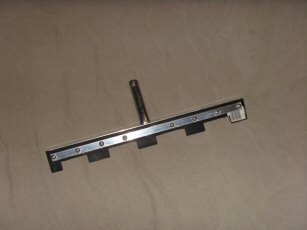
If you’re pondering how to get self leveling mortar to spread evenly over electric radiant heating wire (or, in fact, any other fragile surface), this article might give you just the help you were looking for.
We recently faced this problem in our basement, where we’re laying a retro-fit electric radiant heating system over a concrete slab. The instructions on the side of the self leveling underlayment we chose indicated that you need to drag a guaged spreader through the underlayment as you pour it in order to ensure that it spreads out evenly over the surface. The problem with this approach is that the spreader is highly likely to pull up the heating wires while you’re dragging it over the surface. In a worst case scenario, the spreader might even cut/knick a heating wire, which would render the heating mat useless.
You might be thinking to yourself, “But isn’t this stuff to supposed to be self leveling? Why do we even need to drag a spreader through it?” That’s a good question. The answer is that even though it’s called self leveling mortar (or underlayment, or cement), it really is only self leveling to a point. The reason it doesn’t completely self level has to do with other forces present in the material that make it tend to hold together rather than spread out completely. The best way to visualize the problem is to picture pouring a moderately thick pancake batter into a large pan. The batter is self leveling to a point, but not entirely. Now, if you drag a fork back and forth through the batter, you can eventually get it to cover the entire pan bottom. The same concept holds true for spreading self leveling mortar over a substrate. If you drag a spreader through the mortar, you will eventually spread it out sufficiently to cover the entire floor.
In order to preserve the heating mat, a metal guaged spreader is simply not an option. So we considered attaching a squeegee to the end of an extendable pole and using that to spread out the mortar. The squeegee is flexible, and not likely to damage the wires. This was somewhat successful; however, it still left high and low points in the surface. The reason? It’s a little easier to conceptualize from the pancake analogy: If you used a spatula instead of a fork to spread out the batter in the pan, the likelihood of pushing the pancake mix into one area (thus creating a hill and a valley) is much higher. The squeegee acted like a spatula. It was better at spreading out the mortar, but it still created a slightly uneven surface.
Finally, we arrived at the conclusion you see in the picture at the top-right of this article – a squeegee with gaps cut into the rubber to create teeth. When we poured the self leveling mortar over the next area of radiant heating wires, we dragged the modified squeegee back and forth over the mortar as we poured. The holes between the teeth prevented the squeegee from pulling too much or too little mortar into one area. The result: a perfectly level floor, even over a very large 250 sq. ft. area.
Note that in our example, the radiant heating wires were actually hot glued to the slab at short intervals. This created a strong bond between the heating wire and the slab, and was necessary to ensure the heating wire didn’t come up as we were dragging our improvised spreader across it.
Using this squeegee method is only one part of achieving a level floor. For more information, see my article on achieving level floors using a self leveling mortar.
What do you think? Was this article helpful? Have you had any successes or failures with self leveling mortars?










That’s a great idea! You should market that!
Could you have used a magnesium float instead and never touched the wires at all?
Todd–I don’t think so and here’s why. With LevelQuik ES (and most other fast-drying self-levelers) you only get 8-10 minutes of flow time, which means you need to be mixing and pouring the leveler on the floors very fast. In the case of the basement area we did, we mixed 14 5-gallon buckets in a 10 minute period. You wouldn’t be able to use the float because there simply isn’t time to be down on your hands and knees – you’re pouring too quickly. I have seen some videos with men walking around with bags on their feet and spreading with a squeegee. I think this is the generally accepted method for working on a large floor — but, as I said in the post, this generates hills and valleys (although not huge ones — we’re talking about 1/4″ over maybe 4′ or so. The slotted squeegee yielded a perfectly level floor (as in, <1/16" over 4').
Jennifer - Maybe I should market it.. I need a fancy name - and maybe that guy on the commercials that's always yelling to explain to everyone why they NEED this product.
Electric radiant floor heat can be an efficient and energy saving method to produce warmth in the home. Simply put, heat is channeled in the floor to provide a warm and cozy feeling. The system uses the convection principle where the heat rises from the floor by natural circulation of heat.
Has anyone simply laid tile over radiant heat with a direct application of thin set rather than self leveling mortar?
The slotted squeegee worked great–I did 1″ “teeth” with 2.25″ spaces between them cut into an 18″ driveway squeegee. It more “encourages” the leveler to go where you want it, rather than pushing large quantities.
TEC’s Smooth Start flowed much better than the Custom’s LevelQuik RS. Using enough to pour the ENTIRE floor at once made it work better as well. My only low spots were places I had leaks, but they’re limited enough I can fill them with thinset.
I also made my life easier by pushing a floor heating vent down below the subfloor and covered over the hole with duct tape so I didn’t have to work around it. One of my next steps will be to cut it back out.
Richard, glad it worked for you, and great tip on the vent! I hope you’ll come back and continue to participate at OPC. We’re a fun gang!
Couldn’t you just use something like this? http://www.upsidedownsupply.com/index.html/Gauge_Rake_Epoxy_Spreader?ScreenID=1378