


Copper pipes can spring leaks for many reasons: corrision, freezing and bursting, inadequate soldering, or human accident. For large holes, cracks, or bends, you’ll need to replace the portion of the copper line that broke with a new piece of copper. This involves a fair amount of plumbing know-how, but can be achieved by a do-it-yourselfer following our sweat soldering instructions.
If you’re not comfortable with the idea of cutting, heating, and solder-joining pipes, you’ll need to call a plumber to fix a large/unusual leak situation.
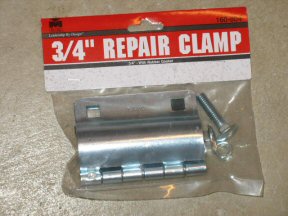
For very small leaks (also known as “pinhole” leaks), one easier solution is to use a repair clamp purchased at your local home improvement store for about $5.00. Repair clamps are metal sleeves with a flexible rubber pad inside that clamp over the pipe in the area where the leak has sprung. They are straightforward to use, and can be applied in under 5 minutes. When applied properly, a repair clamp will last as long as the rest of the plumbing structure.
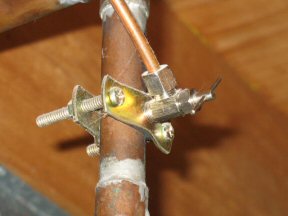
In the picture above, a self-tapping valve for a refrigerator water line has been installed on the main water pipe. This valve has malfunctioned, and will no longer completely close (not an unusual problem for self-tapping valves). The house is to be sold without a refrigerator, so this tap valve must be replaced. It would not have been wise to replace the valve with another self-tapping valve in the same location because it would suffer the same problem. Instead, we’ll repair the hole created by the tap valve with a repair clamp, and the new owner can tap the line in another location when the next refrigerator is installed.
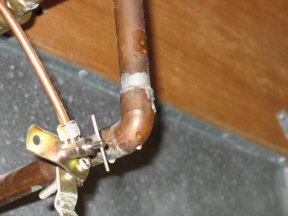
The picture above shows the small hole created by the self-tapping valve. This hole size is well within the range of the type of leak that can be repaired with a repair clamp. You can see in the picture a small area on the pipe where the self-tapping valuve was that is particularly shiny. This is the area that the rubber pad inside the self-tapping valve was touching. A repair clamp uses the same principle to close the hole as the self-tapping valve was using to prevent the water from spraying out the sides.
How to Install a Repair Clamp
To install the repair clamp, simply place the repair clamp on the pipe with the flexible rubber pad centered over the hole.  Place the metal clamp over the pad, and tighten the two screws and nuts until the rubber pad is compressed over the hole.  Be careful not to over-tighten the screws, as this could bend the copper pipe.
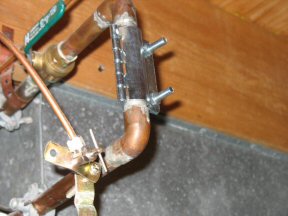
The finished project is shown above. In this case, a repair clamp saved us the cost of calling a plumber (about $120 just for the visit in this area). Instead, with $5.00 and 5 minutes we repaired the problem ourselves.
What do you think? Was this article helpful? Have you ever used a repair clamp to fix a plumbing problem?










Great repair tip. In our previous house that had copper water lines I kept a 1/2″ and 3/4″ repair clamp on hand in case of an emergency leak. The things are easy to install and darn cheap. One of the leading causes of pin holes in copper pipes is left over flux inside the pipe. Over time that flux eats through the copper and creates a pin hole.
Our new home has all PEX tubing in it so it shouldn’t ever get pin holes like that. However, it makes me wonder if there is another similar product on the market to fix a hole should you puncture the tubing some how.
I’ve bookmarked this for future reference – thanks
? cant seem to stop the water despite closing the valve, slows it quite a bit but still a small constant flow, does the pipe need to be dry when repair clamp is applied for it to get a good seal or will it work like a cork and a dry pipe not neccessary?
joannie – each situation is different so its tough to say without seeing the problem. However, you should definitely close the valve further up the line (water main to the house?) make sure its totally dry, and then apply the pipe clamp with the rubber insert squarely over the hole in the pipe. If you can’t get a good seal, you might put some plumbers putty over the hole first and then attach the repair clamp over that.
Can you give any indication of how big the hole can be and a repair clamp still be useable? I drilled a hole into my pipe with a 7mm bit, which sounds a bit big from what you said but at least it’s a clean hole. It’s a galvanized steel pipe.
I think you are crook. Pipe clamps are temporary at best. If I were the home buyer, I would refuse your repair. You are also exposing yourself to a potential lawsuit if the home buyer discovers, even post-factum, that you attempted to make a temporary repair and characterize it as permanent. Careful partner. You are asking for trouble.
I’m betting you’re a plumber or somehow in the plumbing biz or involved with it in some way. This guy Fred has gone to alot of trouble to save poor schmucks like me, who have NO money to pay a plumber, a way to fix small leaks in their copper pipes without having to take a loan. I am DEEPLY, HUMBLY GRATEFUL to him and think you’re a flaming butthole for the tone of the post you made. God forbid anyone should be able to make a plumbing repair without calling someone who’s gonna make their car payment from what they charge for the call, right ?
THANKS so much Fred, and you, Ms. Piacere ( by the way, no pleasure at all) can kiss my entire fanny.
Pieacere,
A repair clamp is more than adequate for a minor pinhole repair, especially when that repair is due to the removal of another tap valve. Replacing the pipe would be a large, unnecessary cost. In fact, the same technology that a repair clamp uses is what almost ALL refrigerator and humidifer tap valves use. The notion that a pipe clamp is inadequate is indicative of your lack of experience with this type of work.
Further, most homes are sold as-is, with the onus on the buyer’s inspector to find issues with the house. The idea that a reasonable repair would put you in jeopardy in the future is putting fear where there is no need.
I have this small leak that I just found coming from the attached hose that runs from just inside my garage door to an outside water spout. I found it because there was a freeze a couple of days ago and the weather is still pretty cold and ice is forming on the base wall of the garage right under the spout. Due to storage I can’t find a place to turn off the water for that part of the pipe. Would plumbers putty work to initially stop the leak so I can put a clamp on it? Desperate for an answer – Single Mom
would this work with home airconditioning copper tubing hole made by a screw?
Virgilio, most likely, yes, if you can fit it into the space where the problem is.
Fred, could you advise what to do with a leaky joint?
Hi Vasili, your only option for fixing a leaking joint it to replace it. This will require un-sweating and re-sweating the pipes. Take a look at this article for more information:
How to Sweat Solder Pipes
Hi there,
I was wondering if this fix would work on pinhole leaks on the elbow also? Do they make a clamp for this? No plumbing experience at all.
Thanks
Fred,
Thanks for the advice. Last days I searched for miracles and, I think, I found one:
http://www.pipemanproducts.com/Insta-Clamp.html
I ordered the clamp and I spoke over the phone Steve McCallister for about 10 minutes.
the leak I have is on the smaller copper pipe…it appears to be in the ‘seam’..will a clamp work on this? I am anxious to try this!
My leak is from the spot where one copper pipe is inserted into another. I do believe that the seal bonding the two pipes has been broken. I fairly certain a re-sweating of the pipes would do the trick, but I would like to not have to pay a plumber and I can’t do the job myself. I would be willing to try the clamp if you think it would do the job. Thanks for your response.
Hi Joe,
Unfortunately, I don’t think a clamp will work for that. Have you considered re-sweating the pipes yourself? It really isn’t that hard, check out this article on the subject:
http://www.oneprojectcloser.com/projects/how-to-sweat-solder-copper-water-pipes-for-a-watertight-seal/
Hi Joe and Fred,
In my case the clamp did not work. However, I purchased at my Home Depot a SharkBite connector and it has been good for me. No soldering required.
Details could be read here http://www.cashacme.com/ The same technique is edvised by “This Old House”. But frankly speaking I do not understand how it works!
I bought a 3/4″ repair clamp from Home Depot for $5 fixed a pin hole stream leak problem on the output pipe of the hot water tank. I found the clamp alone cannot fix the problem. We have to use the plumbers putty together with the clamp to get the best result. Thank you very much for sharing.
Great Tip on repairing ..
Will be repairing a pin-hole leak today. From reading the other posts it appears the combination of plumbers putty and the clamp is the best course of action. Thanks for the advice.
I have had good success doing the following. Turn off water and release pressure. Sand the area around the pinhole with 120grit and apply a thin coating of JB Weld. Wrap the pipe with a piece of car heater hose -5/8/ID works for 1/2 Copper- tighten a radiator hose clamp-screw type -around the pipe, let sit 30 minutes and turn on the water. Never had it fail. Even worked with a 1/16″ saw cut.
We have 3 leaks (cracks) in my copper water pipes from freezing. We found them all, one of which is in the ceiling. the water has been off for about 3 days now, waiting for my uncle to come home before we do any major repairs. The ceiling break may require a hole in the dry-wall. I didn’t want to do that without his permission. However, after reading all the forums I think I’m going to try to clamp it. My wife’s small enough to crawl into the crawl space in the ceiling. That’s why I married her! She’s willing to get dirty. Thanks for the help. I’m going to go look for all of the stuff everyone recommended so I’m not making trip after trip. What I don’t need i’ll just return. Thanks again…
I have a very small drip, only occassional, right at an elbow where I don’t think the clamp pictured is going to work. Is there some sort of sealant that has any good effect on something like that? It’s just in a really hard position to get at.
Thanks, Ted
Hi Ted, you’re probably going to have to resweat the pipes. See this article:
http://www.oneprojectcloser.com/how-to-sweat-solder-copper-water-pipes-for-a-watertight-seal/
I’m a homeowner and rental property owner who has dealt with all sorts of leaks over the years. I’ve never used these clamps, but think they are a good idea for a temporary fix. Pinhole problems could be fixed when you have a more serious need for a plumber to visit your home…and it would take them 10 minutes to perform a real repair on it. The idea of using one of these and not disclosing it and showing it to a buyer of your home is disingenuous.
Basically, this clamp is attempting to defy the laws of physics by implying that a rubber pad, with pressure applied, is as good as a solid wall of copper in confining water. This just cannot be considered a permanent fix — a patch is a patch….
Hi, thanks for all the info. I just tagged a brand new copper heating pipe with a sheetrock screw. The screw did not go into the pipe completely, but it did make a pretty significant pinhole-sized indentation. The line is pressurized and currently does not leak, but I’m wondering if I have to worry about future leaks. Could I install a repair clamp before I finish sheetrocking to prevent the pinhole from eventually giving way and springing a leak? Thanks in advance for any insight.
I have an approximately 1/8th ” crack in copper water line to my outside faucet. Even though I covered the faucet for the winter and removed the hose it cracked. can a use a repair clamp on a crack this size. Thanks!
Ongoing problems with hairline cracks in quarter in. /od copper line that provides water and extends over roof to a cooler. This line is exposed to elements and occasionally freezes in winter and tolerates 100+ in summer. Can you suggest a quick fix for these leaks ? Replacing six foot sections every spring can get expensive. Most clamp type kits do not start at such a small diameter size. Do you have a suggestion for building a clamp or wrap ?
what if the small leak formed in an elbow joint?
I have the same problem. a drip leak at an elbow joint. Cleaned the area and tried JB weld but still dripping.
Cannot use a troch on this due to closeness in attic space and risk of fire. Not sure what to do now
D Bramwell – one option would be to use Shark Bite
http://www.sharkbite.com/
They are a solderless plumbing system. You’d have to cut out the elbow and replace it. Some plumbers say the work fine, others won’t touch them.
As a landlord I sometimes have to quickly correct water leaks. Sometimes thier just isn’t enough time and even though I have never used these clamps I can see where at times they would be very handy to have on hand. If not to correct the problem then at least be a temporay fix.
Great tip. Yesterday, I got pinholes on each end of a copper joint (total of two pinholes). Luckily they are aligned on the pipe. My question is, due to the 2″ joint, there is a height difference (which is the wall thickness of the copper pipe). The pinholes are the line where joined pipes are inserted into the 2″ joint. Do you think this repair will still work? I am afraid that, due to the height difference, water still might leak out.
Thank you!
Ali, no, this won’t work in that situation. You’ll need to install new copper in this spot, which requires sweating the pipes. If you’re comfortable with the concept, here’s the instructions:
http://www.oneprojectcloser.com/how-to-sweat-solder-copper-water-pipes-for-a-watertight-seal/
I fixed a pin hole with this method twelve years ago, in my own home. It is still holding so much for the “temporary at best” naysayers.
Yes, this is a temporary repair only, this clamps create scale inside the pipes (Magnetic Water), so fix it and then call a licensed plumber to remove the hack
http://imageshack.us/photo/my-images/215/tuki157.jpg/
I’m 53 yr old woman that’s staying with my daughter and her family. They rent, the saddle valve broke. The landlord…cough,cough!! Has been here 5 times in 6 weeks, Its leaking again! Being without water for days as he decides when he can come fix it has gotten old with 3 kids under 4 years old!
Now i can fix it myself!! Thanks!
These look awesome, but I have to say I came up with an even cheaper fix. I used a ground wire clamp (they look similar to the little saddle pinhole valve that was removed in the example). They only cost a buck or two, and with a little section of rubber hosing sliced lengthwise, they will seal any small hole in the same manner as these clamps do.
I have a split in a copper tube about 3/4 of an inch long. I tried the putty and it leaks. will the clamp work or should I use the torch and try and soldering. Or should I solder first and clamp after
@ Mac: I think a SharkBite would work well for you. You’d just cut out the split section, replace with the appropriate size SharkBite. ( maybe $10?)
I wasn’t aware that this repair clamp existed. I fixed some leaks using SharkBites, and they’ve held up very well. You can get them in different diameters, reducers, and elbows.
Can someone comment on which is a better material for a pipe clamp. They come in stainless and galvanized. Or doesn’t it matter much since the rubber gasket will be in between the copper and the clamp?
I see advertisements for clamps made of steel or galvanized metal. Some say they are “multi-purpose” but others say specifically that they are for steel pipe.
But I see people posting instructions that look like similar clamps being applied to copper pipe. Does it really matter? I’m in line with Gary above — I would expect the rubber material to protect against electrolytic corrosion.
Or is it that the clamp could squeeze the pipe too tightly?