


[This article was originally published in 2008. I have aggregated all of the articles from our Self Leveling project into a new, more complete article with links to each of the individual articles, including the one below. Complete article:Â How to Pour Self Leveler Over a Large Area]
Our basement radiant heated flooring install required us to pour a self-leveling underlayment (aka self-leveling mortar or self-leveling cement) over our ThermoTile radiant heating wire to achieve a level surface for tiling. I’ll say up front, our results were not perfect, but I don’t think it is the fault of the product. Read further for details.
Our Choice: LevelQuik ES
We chose Custom’s LevelQuik ES for the job. LevelQuik ES is an extended-setting SLU that provides 15 minutes of “free flow†time and allows another 15 minutes of “working†time if you rough the surface of the pour. It can be poured up to 2†thick and feather-edged to less than 1/16â€, making it ideal for smoothing uneven surfaces.
If you’ve never seen an SLU in action, it is truly amazing. SLUs go on with the consistency of pancake batter, and harden to bear as much as 4000 lbs. per sq. inch. They are truly a marvel of modern technology. That said, they don’t always come out perfectly level — at least, not if you don’t–or can’t–follow the instructions exactly.
How Can You Ensure a Level Pour?
There is a dearth of information available about how to achieve a perfectly flat, level pour with an SLU, particularly if you are pouring over a fragile surface like one covered with heating wire. I was able to find a little bit digging around on the net and I also met with a local concrete contractor to discuss the job. Here’s what I learned:
1. Always follow the directions on the bag. I cannot stress this enough. SLUs that are improperly mixed or installed can delaminate from the surface, cure to an unlevel/uneven surface, or lead to weak bonds with the flooring installed on top of them. (E.g. LevelQuik RS & ES require the use of a latex primer that is essential to a strong bond).
2. Use a gauge spreader. Achieving a very level floor requires dragging a gauge spreader across the pour. Since we are pouring SLU over an electric heating element, a gauge spreader would present risks of either pulling up the wire or accidentally cutting it — both of which are unacceptable in this application.
[Update on 6/28/08: Instead, we tried a few ideas and eventually landed on this idea to modify a squeegee to spread the mortar evenly. The results in subsequent  pours were considerably better than what you’ll read below.]
3. Pour at least 3/8″, and preferably 1/2″ or more. Pours that are less than 1/2†tend to not level as well as pours greater than 1/2â€. Pouring SLU into a floor area is similar to pouring pancake batter into a frying pan. Before the batter completely fills the pan, it will be unlevel unless you purposefully spread it out. As the batter fills up the pan completely, the entire surface tends to level out.
Our Method & Pictures
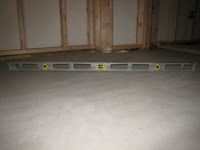
Due to the heating wire and cost constraints, we couldn’t meet #s 2-3 above, but we still decided to use LevelQuik ES for the job. We poured the SLU into the framed area and spread it out with a large squeegee. The results were good, but not perfect, with as much as 5/16†difference over a 4 foot area.
The next two pictures show a 3/16″ gap on the far left of the 4 ft. level. This is primarily caused by a crown in the floor near the middle/right of the level.
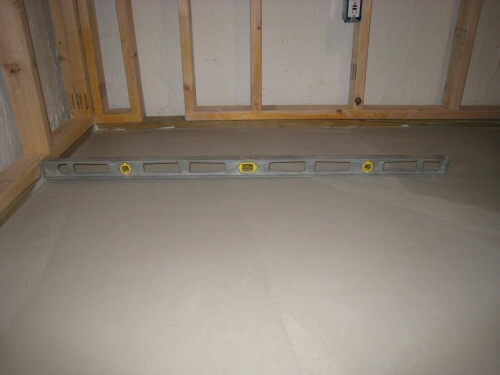
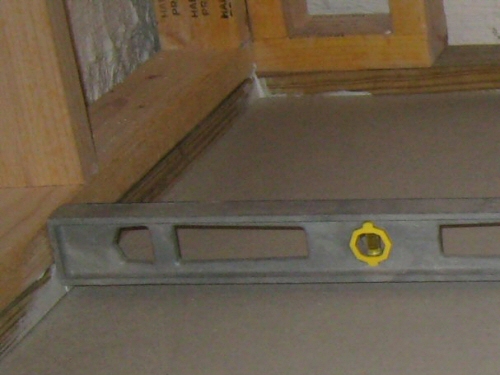
These two pictures show a 5/16″ gap in the middle of the level, caused by a depression near the middle of the level and a crown on the left side. Click on the pictures to see larger versions.


What do you think? Do you have any experience with self-leveling underlayments? Did you have better results?










Thanks! This was helpful. My wife and I are attempting to level our kitchen floor this weekend. I’ll try to post our results on our blog on Monday.
Bill-Thanks for stopping by. I’m glad this helped. If your kitchen isn’t on a slab and you’re using SLM, you’ll need to lay a metal lathe on the floor as well to ensure the SLM sticks. I am very impressed with the stuff and would be VERY interested in how well it works over plywood.
Thanks for your article. I am going to be putting down an electric floor heating system over a concrete slab as well. I think your suggestion of 1/2 inch thickness is a good one. What did you finally do?
There are four rooms with a combined area of some 334 SQFT. I think I best begin with the smaller rooms and gains some experience. So, a barrier at each door seems reasonable but wonder how difficult it will be to match heights.
If you have any further suggestions… I am all ears.
I was planning on using WarmlyYour but will do some research on the product you used.
Bryan, welcome to the site.
We did end up going with 1/2″ and were very happy with it. You can read a bunch of other articles on this site (just search for “self leveling” or “radiant” in the search bar and you’ll find more articles on our experience).
Dividing the rooms is good. Matching height it easy. Note that the toughest problem on this job is spreading the self leveler without damaging/pulling up the wires. You’re going to want to hot glue the wires to the slab (each loop must be glued – it takes time), then make a slotted squeegee (search “squeegee” and you’ll find our article) to drag over the leveler while you’re pouring.
We just finished the third area of leveler and everything is working fine (we’re doing about 1000 sq ft.)
Good luck.
Will self leveling concrete work in a bathroom that the backside of 4 1/4 to low from the front so it it’s actually zero to 4-1/4 off
You could certainly try it, but it would be an expensive way to go, since SLC’s much more expensive than general-purpose concrete; in addition, most SLCs aren’t recommended for single-layer applications much thicker than one inch or so. If it were my project, I’d “rough in” the floor using concrete and then after it cured would do a finishing coat of SLC. Some people are also artists with concrete, and could probably do an acceptable smoothing without further application of SLC.
Fred:
I am trying to level out a bathroom that is about 40 square feet and I am having a heck of a time with the levelquik RS that I found at HomeDepot. I have put on 2 layers and it seems worse than when I started. I think I may have spent too long mixing it. The instructions said mix for 2 minutes so I mixed for 2 minutes after I got all the powder in. The pour just did not flow very much. The second pour I used a notched board similar to your notched squeegee and that spread it out but it just did not flow that quickly. I even had tooling marks from the notched board. I could modify the board with stand off screws so it could be more like a gauged spreader, but I do not know if that would help. Any thoughts? Is the ES any better, did it flow well?
I noticed your mixing video you had several mixed buckets just waiting to be used. Did the wait in the buckets affect your flow? I think I will need 2 50 lb bags to get it level at this point so if I could use two buckets and mix them sequentially and pour them together I might be able to do the install in one pour without a re-prime. Or should I go with smaller pours and just do it in patch work so I make sure I do not need a lot of flow?
I am pretty sure my mix time had a lot to do with the results. My helper scooped the mix by hand while I mixed. It may have taken 2 minutes or more just to get the mix in. I noticed in your video that the mix was done keeping the paddle fully immersed with powder floating on the top. Did you just keep the paddle immersed or did you have to surface to get the powder fully mixed?
Any help would be appreciated. Also, since I only need 2 bags of the levelquik ES can you tell me where to find the stuff in the DC area? I am gonna try Sita tile but they may balk at such a small order even though I will pick the stuff up myself.
Thanks.
Steve G.
Hi Steve,
Thanks for the questions, I’ll do my best to answer:
1) I’m surprised the LQ RS gave you problems after 2 minutes of mixing, but it very well could have been because you were too slow in getting it all in the bucket. YOu definitely should just pour it in and leave the mixer running full speed. LevelQuik RS only claims 5 minutes of free flow time (with 10 minutes of work time). You really want as much free flow as possible, so mixing quick is imperative. Are you using a 1/2″ drill and mixing blade like the one I recommended?
2) Both LQ RS and ES will harden slower in the pot. ES has a full 10 minutes of free flow time with as much as 30 minutes of “bucket” time, which is more than adequate for most jobs. Yes, I used multiple buckets and that helps alot. If you use ES and you follow my mixing instructions, I’m sure it will work fast. Stop using a cup, though, and just pour in the whole bag.
3) My guess is that SitaTile will fill that type of order but you’ll need to pick it up rather than have it delivered. They can probably get it in on the truck for you. Home Depot can also order it, though I’m not sure if they’ll have a minimum order quantity.
Good luck and please let me know how it goes.
Fred,
We laid down the electrical infloor heating cable and hot glued it as you said. Then poured about a 1/4 inche of self leveling compound over it. Used the squeegee with notches in it and all when well. A little rocking on the five foot level but I believe it will be OK for laying tile on top.
Thanks for all the help on this… it looks great.
By the way, I ordered the infloor cable from Bulgaria of all places. I have also ordered the Carbon film infloor heating system for under engineered wood flooring. Will work on that over the next few weeks.
Bryan
Bryan,
Glad we could help! Our last two pours were much more level than the first, which experienced the problems in this post. The slotted squeegee made a HUGE difference. Congrats on your floor, and we’d love to hear about the film system for under engineered woods.
Maybe you’d be willing to take some shots and write a guest article? 🙂
Fred
I certainly will. I see some of the postings indicate the pour wasn’t that fluid. As mentioned it maybe the time taken to mix and that will likely be slowed down if you don’t just pour all the mix in as quickly as possible. My experience was there was a tendancy to slowly add the dry mix but when I realized I had 1 1/2 minutes to mix it… I just let her go. It seemed that the mix came to a pancake batter consistancy just at the 1 1/2 minute timeframe. I was worried because it appeared it might not get to that.
The other contributer to a stiff pour would be the amount of water in the bucket. Like cutting wood… measure twice mix once. 🙂
Again, I will chronical the laying of the Carbon Film Electrical infloor heating system under an engineered wood floor.
Bryan
Thanks for the response. I just ordered 2 bags of the LQ ES from the Depot and will wait on it. I probably have a week or two to plan things out. I wonder if the LQ RS I had might have been a little old and that sped things up a bit. I noticed from you video that your LQ ES flowed much faster than my stuff. How long do you think you have to use the spreader before the stuff cannot recover? My second pour and spread left tool marks in some places.
I wonder if I should divide and the room up. My bathroom is essentially 2 squares one small (3′ x 4′) where the shower floor will be placed, and one larger (4′ x 5′). I could put a barrier in between and level the 2 parts individually. Any thoughts? I think I can get away with half a bag in the shower area and the rest used on the remaining area. Just a thought.
Furthermore, the stuff I have already put down is cracking. The room has a 5/8″ plywood subfloor that I screwed 1/2″ wonderboard on top of. I patched the seams, primed and did the RS pours. Because all of my floorboards squeak I screwed down the subfloor as well as I could before the wonderboard was put in place. Does this cracking mean my tile is gonna come loose after a while?
Any help is appreciated. I wish I read this page before I made my first pour. Might be done by now. I guess it it is what you learn after you know it all that counts.
Thanks.
Steve G.
Fred,
Thanks for the great info. You mention the latex primer, was it applied before or after you installed the radiant heat mat?
Thanks,
Steve
Steven,
The latex primer is put down before the heating mat.
Good luck with your installation.
Fred
Well I have poured two sections of a basement to level out the floor. I used the notched out squeegee method and it worked well to distribute the concrete over the heating cables without disturbing the cables. But since I was only pouring say 3/8 of a inch it didn’t completely level the floor so I had to go back over it with leveling compound a day or so later.
The second pour was into areas that I measured and mapped out using a long level and chalk. I used a long board and raked it back and forth to help the concrete distribute and to ensure it leveled… That worked out very well. Just prior to it drying hard I took a trowel to the edges to both clean up and to feather the concrete out. It turned out very well.
I can see if you were to pour a thicker layer it would be easy to do and you wouldn’t have to do much as the pour is very fluid. In my case, I was just filling in hollows on the second pour and the surface tension tended to cause it not to flow completely out to the level of the rest of the floor. Therefore a towel was needed to get the correct feathering immediately after the pour and as mentioned above to clean up the edges.
Ok so i have a little project i am working on i bought a little project house and the subfloor in not level the house is built on piers and it was built in 1927. i started to pull up particle board (what they used) which was layed out on what looks like a hardwood floor. now there is nothing under the hardwood so may be it is a porch word or something. anyway it is about 1/4 to 1/2 inch off the boards are about 2.5 inches wide and the apeer to be tong and grove slats. the firs room i am doing is about 200 sq feet . can i use SLC or not? if i do rip it all up hoe do i make the whole floor level the joist are going to be off because of the house settling? i need some advice. let me know
Thanks
Mike
Here is a pic if it helps
http://www.gravatar.com/avatar/004897c8643a4b70313bbd08faba8d26?s=80
The helpful video you put up on youtube
http://www.youtube.com/watch?v=ACexRuifg18
showed how to mix and pour, but mentioned others to follow which would demonstrate how and when to apply a feather-edge. I cannot find the sequel videos. Are they available? If not, how long do you wait after the pour before
applying the feather-edge? I will be pouring only onto a low quadrant of the floor and want to feather the edge of the SLU so it’s flush with the uncovered section of the substrate (CBU).
Thanks
Tim,
Sorry that we never got up the sequel! We still have the footage but have been sidetracked.
You want to be working the feather edge immediately after the pour. LevelQuik ES starts setting up in about 10 minutes. it is at that point you want to begin to work the edge… If you are using LevelQuik RS, you’ll want to start at about 5 minutes.
Mike – very hard to say unless you provide additional details and give us more pictures (you could upload them to FLICKR.com and link here.
It sounds like you might have an older home with hardwood floors laid across joists, and they they laid an oriented strand board (OSB) subfloor over the hardwoods (perhaps they were sagging / not strong enough // or in the worst case, rotting.) All the SLCs I know can’t be used reliably on OSB, so its probably not an option.
If you have a settling foundation (or piers), it sounds like it would be a good idea to have a structural engineer look at the project and give you some ideas. Just my $0.02.
I have a small area in the master bathroom. I removed the contractor grade marble that was circa 1976 only to find a 3/4 inch Sand/cement mortor bed. Some of the mortor bed came up when tile was removed but not all. I have poured a SLM that was purchased from Big Ornage Box store. I dont have the bag anymore, not sure which one it was. I poured this over the existing mortor and filled in the spots that came up and it looked pretty good unitl I did the last bit. I think I did mot mix it well as it dried gray ang the other dried more white. Well after a day or two the grey started cracking. I have removed it back to the white portion.
Questions:
Should I just pour a new mix of SLM over the removed gray area and go from there?
Should I have removed everything down to the slab and started from scratch?
I an not sure which way to go on this. Thre area is only about 20 sq ft but it is the Master Bath and I want to do this job right the 1st time.
I have pics if that would help.
Thanks in advance~
Jonathan,
Sounds like you’ve got your hands full!
If the sand-cement mortar bed seemed pretty strong / not crumbling, I think it is fine to leave it intact. Did you prime it with a latex primer before pouring the leveler? If not, the underlayment could delaminate over time.
It sounds like the area that dried grey and pulled up quickly wasn’t well-mixed. If you’ve scraped away back to the white, suggest you prime the white section with the appropriate primer, and then re-pour the SLU in that spot, ensuring you throughly mixed it.
Here’s another article on the appropriate primer for LevelQuik ES / RS (RS is most commonly sold at Home Depot, and is likely the product you’re using). Even if it isn’t, this primer is a good bet….
http://www.oneprojectcloser.com/projects/prime-a-cement-slab-for-self-leveler-levelquik-es/
Good luck with your project!
Thanks Fred for your tip on the “Slotted Squeege”. I just poured two rooms of self leveler, one about 65 sq ft and the other was about 110 sq ft. My product of choice was Levelex from L&M. And it worked great. But the squeege made it so simple to lay.
Here’s what I did:
1. Prep – I had old glue lines to get rid of so I used a grinder with a 7″ grinding
cup with a dust shield hooked to a vac.
2. Applied bonding agent and waited for it to dry.
3. Mixed 6 bags of mix following the directions to the “t”. Just before pouring I
gave each bucket a “quick mix” to make sure it was not loosing fluidity
waiting. It was fine, no difference from the first mixed to the last.
4. Poured all 6 buckets onto 110 sq. ft. area and began dragging it around
with the slotted squeege. I pushed it into cornersand made sure floor was
completely covered and walked away. It looked great.
Only thing I would change is how big I cut the blades/slots in the squeege. I cut a 3″ blade-2.25″ slot 3″ blade 2.25″ slot and so on. It worked well but next time I will cut a 2″ blade 2″ slot or maybe 1″/1″. I found that if the blade was a little smaller the self leveler wouldn’t need to work so hard to close the gaps left from the blades. I hope that this is understandable.
Overall, the “Slotted Squeege” is the best tool I have used for self leveling underlayment and I owe it all to you. My Many thanks.
Damon, Thanks so much for your comments here and your experience. Your suggestion is very clear and I think that overall, smaller tabs and slots is a great way to go — it is much easier for the leveler to flow that way. Glad to hear your project worked out!
Hi Fred, Just happened upon your article via ‘Houseblogs’ and by following some links. I am currently building a small 5′ x 6′ washroom in my basement. The floor is currently painted with two coats of paint. Common sense would dictate removal of the paint prior to the pour. Just wanted to know if this was a necessity though.
BTW, very informative posts.
Fred, hope you don’t mind if I jump in and answer this question…
Dhiraj, definitely remove your paint first, the pour I wrote about wasn’t as successful the first time. There was just a tiny layer of old tile adhesive and it did not adhere at all. It came up easily but I learned my lesson well (and expensively). The phrase I stick to (no pun intended) is better safe than sorry. The fact that you are asking is reason enough to remove it. Concrete products are made to adhere to concrete and even a tiny layer of paint or glue can mess the whole thing up. I would also recommend a primer, it’s not expensive and well worth it. It sounds like you were going to remove it anyway, good decision.
Again Fred, I don’t want to step on any toes. And Dhiraj, good luck!
Damon, Jump in any time! I appreciate the help and insights from others!
Dhiraj, Damon’s absolutely right – you must remove the paint completely and prime. Latex paints, in particular, are designed for things NOT to stick to them (since this facilitates cleaning). You can check with the self-leveler manufacturer to be sure, but my guess is, you’ll end up wasting the entire pour if you don’t remove it.
Good luck!
Gentlemen, Thank you very much for the advise and insight. I will update later as the pour commences.
Regards
DD
Thanks again for the great tips, here is result.
http://foresthall.blogspot.com/2008/12/making-some-progress.html
Steve
Hi guys,
I want to level my concrete basement family room/bedroom to match the hight of the tiles I have in the hallway. I want to pour at once, but where would I stand as I level it with slotted squeegee? The room is aprox 12 by 10. Should I divide into squares and work that way? Besides I am hoping to stain it later and will not mind having markings (connection points that may show up do the division) instead of one big continue concrete floor look. What do you think?
How long do I have to wait before removing the barrier (2 by 4) to continue and pour the next area?
I will be using the RS (avaialbe at homedepot)
Thanks,
Henock
Hi Henock,
I will answer this from the standpoint of how I would tackle the project. I would pour a 10′ x 12′ area in a single pour, for a couple reasons:
1.) With this size area you have more than enough time to work with the mix
2.) You will be happier without the “seams” between the pours. It will just look
better. If you like the look of seams/joints, you can add decorative joints
after it dries.
As to the how to,start in the farthest end of the room work your way out (ie. dont “paint” yourself into a corner).
This process goes quick. Cleaning up will take longer than the pouring does.
Mix up your bags paying very close attention to water amount and mix time. Also use the correct mixing tool that the manufacture suggests.
Now with the mixing complete, pour about 1/2 of the mix onto the floor and spread with the slotted squeege. You will mostly be pulling while walking backwards (don’t be afraid to push into corners). Pour more as you need working your way out of the room.
Once you are done, you will say to yourself,”That was way easier than I thought it was going to be.” It is easy as 1,2,3.
1. Proper surface prep.
2. Proper mixing.
3. Proper spreading – the fun and easy part.
Henock, you can do it. Tell us how it goes. If I was to vague in anything write back with additional questions. And anyone else, if I overlooked anything, please correct me.
Thank you Damon.
I prepped the space by scraping loose areas and old paint as much as possible. I then mopped it using dish detergent and later moped it clean with clean water. I am letting it dry now.
My challenge is that the room is next to bathroom and I can see the hollow space under the tub below the baseboard, so I want to make sure the mix doesn’t pour there so I am planning in putting heavy duty plastic along that side of the wall to prevent that.
It sounds like I need someone to help me during the mixing (is that a must?) Also, can I mix 2 or 3 5 gallon buckets before start pouring?
I have a 1/2 inch drill, but it is rechargeable. Must I use the corded drill or can I use this. I have a spare battery back to swap if needed.
Also, how do you make sure you get a certain height? I mean if you start in the corner and spread it I would imagine it tries to cover more space so it becomes thinner than what I want it to be. If I pour more later then I won’t have an opportunity to level it since it will all be wet. How do you tackel that?
Thank you guys,
Henock
Still waiting for your direction guys…
Thanks you!
Henock, I use a rechargeable drill for small batches (10 pounds) of thinset all the time; but the higher mixing speed required for SL compounds, and the quantities involved lead me to recommend a corded drill; keep the battery-powered drill and some spare batteries alongside as your backup during the mixing process.
As for minimum height , you have to calculate the volume needed to cover the area to a minimum height, assuming you have a level but slightly bumpy floor. Now, if your floor *slopes* markedly, you have to calculate the volume in the same way you would do when figuring out how much water you would need to fill a swimming pool with a shallow end sloping down to a deep end. You have to calculate the area of the triangle and multiply that by the width of the room/pool to get the cubic volume.
Or you can mix more than you need and put a ledger marker and pour until you reach the mark.
Thank you Tim.
Is it then ok to mix several buckets prior to pouring?
Henock,
Yes, mix all the buckets before you pour. It’s better to have them all ready to go.
Thanks Damon,
My concern is that the LevelQuik RS instruction says to mix for 2 min. is that an indication that the bucket life is short ?
The 2 minutes is just how long to mix to make sure it is mixed thoroughtly (don’t know if that word is spelled correctly).
The bucket life is longer than two minutes but you don’t want to wait too long.
I imagine you will probibly using 3-4 buckets? If so, get the water measured out and into each bucket first. Then start pour the bag and mix the first bucket for the 2 minutes. Jump to the next one and so on.
What I do after mixing the last bucket is to give each bucket a quick mix (5-10 seconds) and then start the pour. Start pouring with the first bucket that you mixed.
Thanks Damon, that is exactly what I needed to know.
I will do the calculations as to how much I need and purchase everything tonight and perhaps pour by this weekend.
My plan is to stain it afterwords, anybody stained a recently poured self leveling concrete ?
Hello folks,
Over the weekend a poured 7 buckets (8 by 11 space) of the SL and it came out well. It was amazing to see it work. After it dried I level check and all was good. I then decided to mop it with clean water to remove any powdery substance befoer I could stain it, well, now it has some white areas. What is it and how do I remove it before I stain it?
BTW, aside from pouring, I did not touch it at all to level it so it had distinct terrain showing the varous pours, and the white areas apear along those lines.
Thanks in advance for your help
Fred, Thanks for all the info. Went thru all the comments and learned everything I needed to know. Hope my foyer leveling works out. I’ll let you know when I’m done. Oh yes, my husband is helping. Suzanne
Suzanne,
Thanks for reading! Good luck with the project… there are a lot of resources on this site that can help with this project in addition to this post… you can use the search box up on the right if you need more!
Good luck!
I’m debating the use of a self-leveling compound vs just using extra thinset mortar where I’m laying tile in our new master bath. (I took a year to demolish walls (this project is just part of my busy life) so that three small areas will become a truly “masterful” bathroom. The area of concern is only in front of the tub (about 3’x7′) and then the separate vanity area that is 5’x8′. (I hired a carpenter to build the raised floor of the toilet alcove, so that level issue is moot.) There are marked low spots in this 40-year-old concrete slab – it used to be a breezeway that connected the house to the garage; now, the garage and old breezeway comprise the “master wing” of our home – but most of the low spots (in corners) can be fudged by shims under cabinetry. (The carpenter built the tub deck accordingly, so the low corners were “covered” by the level deck.) I’ve been dry-fitting the 16″x16″ tile to determine any “rocking issue” between tiles. After reading these posts, I’m thinking that perhaps extra thin set mortar while laying the tiles would be the better way to go than pouring the self-leveling material. However, I do plan to install the heated floor mesh under the tile – hence, my questions about self leveling material vs thin set mortar. Any tho’ts?
On advice from the hardware store, I bought some level quik rs to level out the basement floor and cover up the old broken up tile and holes from where it peeled up.
I was planning on just painting it. I poured 2 sections yesterday and getting ready to do the other 2 today. It looks pretty good, real nice! 🙂
My concern is (after finding this website); Can Level Quik be painted over for a permanent surface. I bought some Quikrete Basement & Concrete Floor Paint to use at the same time, it has a urethane resin that is suppose to bind with the concrete. (http://www.quikretecoatings.com/basementConcreteFloorPaint.jsp).
I see that it says on the bag “Not meant for use as a wear surface”. The guy at the store said it can be painted over just fine.
Can I just use the Quikrete Paint over it and will it hold up with furniture and foot traffic on it?
I was also thinking about using the Rustoleum Basement Epoxy (http://www.rustoleum.com/CBGProduct.asp?pid=15). Would that be better?
I’m worried I was given the wrong information at the store.
If I can chime in here, a way to extend the working time of your SLC is to use ice-cold water to mix it up. SLC is primarily cement, which has an exothermic (heat-producing) reaction when mixed with water. The hotter the mix gets, the faster it sets up, so it’s a bit of a vicious cycle. Starting with ice water can allow for multiple sequential mixing in a single 5-gallon pail: mix, pour, mix again, pour again. Start with smaller pails of just the ice water (already measured and *without* any ice chips in it); then use each pre-mixed pail as a quick dump into the 5-gallon bucket you’re mixing the SLC up in. Even with ice water, it’s best to use two people for this job, one operating the mixer while the other one dumps the bag into the 5-gallon bucket of ice water. Then as you pour, make sure you’re always keeping a wet edge.
Now one thing *I’d* like to know — can you slightly “thin” SLC by adding a bit more water? In the case of Mapei’s Ultraplan 1 Plus, ferinstance, the recommended amount of water per 50 lb. bag of product is 5.68 litres (6 U.S. quarts). I was tempted to use exactly 6 litres, an additional 5.6% of water by volume. Does anyone know if you can “fiddle” like this, or will such a small change cause the pour to fail in some way? Some of the installers I’ve talked to in the past have recommended thinning the mix, but have been irritatingly vague when I asked how much to thin it.
Hello All,
My first pour “August 17th, 2009” still looks good. I haven’t stained it yet (been very busy). I do want to report that it has hairline cracks all over it. It doesn’t look bad and I don’t mind it, but I am assuming that when I stain and seal it the cracks will show, is that correct?
Also, I am planning in pouring the bigger space (basement living room area) this weekend. I will take pictures.
Hi Susan,
Good question. Levelquik definitely “wears” when it’s left unpainted/unstained. We haven’t painted/stained it, and don’t plan to. I would guess that a solid coat of cement paint might do the trick to hold everything together. I would suggest priming the surface first.
Quikrete is indeed stainable/paintable and can be used as a final surface.
If you get the answer (either from Custom Building Products, or from personal experience), please do come back and post in this thread. A lot of folks follow it.
Fred
Glad to hear how temperature affects the set time of cement. That explains alot! I live at a high altitude – and the temp’s drop into the 40’s after the sun goes down, so when I work in the evenings, I guess I’m extending the time I can work with the mortar.
Thanks for your reply Fred. I ended up using the Rustoleum Epoxy Shield Paint on it. It took 2 gallons (2 coats on 217 sq ft). I did add silica to it, for extra traction. It really soaked up the Epoxy well and went on nice and smooth, even seemed to smooth the Level Quik more. I guess the final outcome will be once I start dragging furniture across it, especially the heavy old Lazy Boy. If it can handle that, it should be strong enough. If not, I’ll be looking into tile…LOL! I am going to let the epoxy set up for a couple weeks or so first. I did talk to a friend who had used it on a garage bathroom with the Epoxy Paint and he is pretty happy with it, but in that situation it wouldn’t have to withstand the weight of the furniture. He thinks it will be just fine. I will keep everyone posted on how it works out.
Hi,
I am using Henry SLU and my first pour did not reach the necessary height of 3/4″….can I reprime and reapply a second layer of the SLU?
Thanks,
– Daniel
Hi Daniel,
You can apply another layer to reach your desired height. Some manufacturers recommend two applications to achieve thickness over 1/2″. Apply primer again as directed and happy pouring.
Hi guys…back in October I used the Level Quik on my basement floor, then primed it with Kilz and then used Rustoleum Floor Epoxy. It’s holding up great. Looks great and mighty durable. I guess the true test will be next Spring, when the rains come. I’m thinking after this long if its was going to bubble or peel it would of. We did have a pretty wet Fall too. I’ve dragged heavy furniture over it, dropped things on it, and it’s standing up to it. Only thing I wish I would of done different would be to of used two layers of Level Quik of it. It’s at about 1/8 of an inch, would of liked it built up more.
Susan, I’m in the process of leveling a garage floor and then intend to use the QuikCrete epoxy floor covering. My question: Did you use the primer that came with the Epoxy kit to etch the self leveling concrete? Or did you eliminate that step and instead primed with Kilz only before pitting down the epoxy? I’m concerned because I wondered if using the etching process, will it weaken the self-leveling concrete material and then perhaps crack when a car is parked on it. Anyone have any experience with this please chime in.
This thread is great.I am remodeling my basement and planning to lay tile and laminate. I have a floor drain in the center of one room, along with a clean-out. I am planning to raise the floor drain (cast iron) and clean-out using PVC. It’s not actively used as a drain, and the slop toward the drain/cleanout is too large to lay hard-surface floors (tile/laminate) and I don’t want carpet.
The floor has been painted (likely with some type of concrete paint. Is it absolutely necessary to remove the paint? Shouldn’t the primer eliminate the concern about delamination? How would I remove so much paint? The area is prob. 75 sq. feet. Any other advice?
Thanks!
Hey Carl, glad you like it!
A concrete primer aids in the bonding process between concrete and concrete. If there is a layer of paint (or adhesive) it probably won’t bond. I learned the hard way on this…I though the adhesive I took off was “good enough”. The whole pour peeled up. Definitely get the paint off first.
As far as how to remove it, what I did on this particular occasion was to buy a 7″ grinding cup for my angle grinder. The area I was working with was around the same square footage you have. This was a super dusty endeavor so I “rigged up” a dust collector and hooked it to my shop vac (they sell dust shields/collectors online). Do a lead test on the paint before doing this method. Bite off about 3-4 sq ft at a time and then move to the next section.
This process took me about 2- 3 hours. When you are done you will have the peace of mind that it won’t be coming up any time soo.
Let us know how it goes.
Damon
Carl:
You could try what my wife and I have been doing. She got the idea to loosen the paint on the concrete by laying a damp cloth/towel over the areas she wanted to scrape. After a few hours, the moisture goes through the paint and weakens it considerably, allowing it to be taken off by a variety of mechanical techniques. (No dust, either.)
When I saw how well that worked, I said to her “Your steamer would probably work on it too.” She got a light in her eyes and she was off to the races. 😉
And we did finally do a pour of SLC (Mapei) for our new basement bathroom — five bags at $50.00 CDN per bag, all mixed and poured in just under ten minutes. We were flying! It worked so well, when I went to level a cabinet I’d installed later, the side-to-side needed no leveling at all, while the front-to-back was out by a sixteenth of an inch. I leveled it front-to-back just for the Hell of it, but it’s unlikely that I even needed to. Certainly, the pro countertop installers we hired thought it was well within spec without leveling.
Thanks guys! I think I will try Garth’s approach first to determine whether it’s feasible or not. The previous flooring was the self-stick vinyl tiles and removal (completed since my last post) has left a slight coating of adhesive on the concrete. Not sure if the wet method will work or whether I’ll have to resort to the messier suggestion. I’m a little hesitant about using this self-leveler (fear of the unknown) but am confident all will turn out well. Complicating matters for me is that the drain area to be leveled is between two rooms that are separated by a large opening I created with framing. In one room I plan on installing laminate and need a very level surface. In the other, I am laying tile, so I have a little more flexibilty. I’ll figure out a way to make it work.
I’ll report back as soon as complete. Thanks again!
Hi all, this is definitely a helpful chat! But I am wondering…I read somewhere else online that I should use expansion tape around the perimeter of the room (basement bathroom) that I want to level to allow for expansion. Is this really necessary? Does it depend on what material the SLC will contact at the edges (for instance a concrete wall vs. drywall on studs)? Thanks in advance!
Steppenwulf:
Yeah, it’s a good idea. Not hard to do, either — I used a double layer of sill plate foam (y’know, that stuff on a roll that you’re supposed to put between the bottom plate of a stud wall and the concrete it’s resting on). I simply stapled it to the studs around the perimeter of the room and then used a thin bead of silicone caulk where it touched the concrete. Voila! You now have an expansion joint, about 1/4 of an inch thick, that also acts as a barrier to any of the SLC, keeping it from leaking away. (Bonus — it keeps your drywall from turning into mulch where the paper would have come into contact with the wet SLC.)
Once you’ve poured the SLC and let it dry, just go around the perimeter of the room with a utility knife and cut the excess away. Now drywall as usual (or, if drywall was already present, just start putting down your flooring and baseboards).
Hey all,
Just reporting back on my self-leveling work. Everything went successfully, although the prep work was very time-consuming. I had paint on the floor that needed to be removed. I rented two different pieces of equipment and both failed miserably. I ended up using my 4.5″ angle grinder with the diamond grinding cup to remove the paint. It was really messy.
I ended up putting down 6 bags of LevelQuick RS in three different pours to eliminate the dip that went to my unused basement floor drain. The dip tapered to about 3 inches at the drain. Figuring out how to raise the nearby drain cleanout was also a big chore, but solved through cutting various PVC pieces to accomplish the goal. Thanks much everyone for your help. It was worth the time and expense, in the end.
Carl,
Glad to hear everything went well for your pour… Did you use the multiple pours because you were building up to 3″ total?
Fred
Thanks Garth, sounds good! Didn’t think of caulking at the joint of cement and tape, but makes good sense. Went down and pulled up the 80’s sticky tiles on the basement bathroom floor today and found that I have a moisture problem (this was suspected since we found termites down there this past summer–treated in July). Now’s a good chance to mention I have a 1920’s row home. Any ideas about how to handle the moisture? I’m planning on ripping out the studs and drywall attached to the back (poured concrete) wall and painting with the waterproofing basement paint. Can I/should I do this on the floor too? Thanks so much for the advice!
Fred,
Yep. The specs on the stuff say it should only be poured 1″ thick at a time. You can wait until it’s totally dry for a subsequent coat or you can pour when it’s at a “walkable hardness” when the top is still somewhat wet but the compound is generally solid.
And a note to Steppenwulf, I have used Dry-lock paint to address weepage through my concrete block foundation. It does a good job, but I wouldn’t paint on your floors unless you have seepage there. Keep in mind, as I learned, you can’t tile over painted floors and have to mechanically remove the paint. I am tiling a portion of our wet bar area and had to use an angle grinder to remove the paint.
I would also recommend using metal studs to frame the walls to combat mold. If not, at least frame 1/2″ off the wall and use a pressure-treated toeplate.
There’s also a lot of debate regarding vapor barriers. I did not use one on my basement because I feel the plastic serves to trap the water in the wall and create further problems. Instead, I am planning to use a dehumidifer and I installed green board – the mold/moisture resistant drywall.
I’m not a fan of metal studs in basements, *particularly* if you’re aware of a pre-existing moisture problem — metal may not support mold/mildew growth, but man oh man can it rust. Your metal studs could easily fall apart in four to five years. (Although I think they’re a good idea for building bulkheads around HVAC components. Light, straight and strong.)
Better, in my opinion, to use pressure-treated wood — certainly for the sill plate (what Carl called the “toe-plate”); that’s what I’m doing in my basement reno, and if you’re concerned about the vertical studs, then for them too; although where I live (Alberta, Canada) it’s building code to keep all studs at least one-half inch away from the concrete wall of a basement, unless the entire wall up to grade has been treated with waterproofing paint (and even then, most of the contractors I’ve talked to still keep the studs away from the concrete). Also helps prevent your insulation (if you’re using fiberglass or rock wool) from wicking moisture. It should also be mentioned that, if you’re using treated lumber, you’re going to need proper fasteners (deck screws designed for pressure-treated lumber, ferinstance), otherwise the chemicals in the studs will eat the fasteners in a few years…
Steppenwulf, when you say “moisture problem,” what *exactly* do you mean? Is there standing water? Is the concrete simply cold and clammy feeling? If the latter, tape a piece of plastic down on that concrete for a day (a one-foot-square should be fine) and then come back and inspect it. Is there condensation? If so, that problem really REALLY needs to be addressed in some fashion before you proceed — otherwise, moisture will just wreck all your good work. It’s astounding how destructive moisture is. A good rule of thumb is: if the relative humidity next to the slab is above 40% or so, untreated wood will definitely start to get dry-rot or some other related problem within a few months or years. Below 40%, and you’re generally good to go. Consider using a product like Dricore, which helps to isolate the concrete floor and its humidity from the flooring above the Dricore (and will also, to a certain extent, provide channeling/isolation for small amounts of standing water should it happen to weep through your concrete floor). Here in Canada, Dricore’s available at Home Depot, and a competitive clone’s available at Rona.
My basement reno’s proceeding after five years of waiting because we finally managed to wrestle our moisture problems to the ground (spending around forty grand to fix it didn’t hurt, either). I wanted to go earlier, but the consulting engineers and general contractors we talked to who had experience with these problems simply said that, if I didn’t solve the moisture problem, I was going to be throwing my money away on a reno. They were right.
Good point about the fasteners. To install my sill plate, instead of using masonry nails, I used large bolt anchors. It’s more work, but far more solid since anchors drive far deeper than nails. Now that I think of it, however, I don’t know they’re meant for use with PT lumber. Oops!
Phew, the Red Head sleeve anchors I used are made of stainless steel, so no rusting…
To fasten pressure-treated sill plates to the floor, I used a Bosch hammer-drill with a 3/16″ masonry/concrete bit, and then screwed through the plate and into the concrete with hex-head Tapcon anchor screws, which are specially-coated to withstand moisture and the chemicals in pressure-treated lumber. (I think it’s Teflon, but I’m not sure.) Worked like a charm. Gonna use the same method with the Dricore when it goes down.
Oh yeah, almost forgot — you can also use PL400 to glue sill plates to the floor. This method assumes that you haven’t got any moisture issues. You have to get the positioning of the plates *exactly* right, ’cause there’s no second chances with PL400. But PL400’s solved several tricky issues for me in my basement.
I’m not sure if anyone is still following this thread, but I figure it won’t hurt to try for an answer… I just laid my first batch of LevelQuik last night. I have a small bathroom on a concrete slab that just had one area (about 3′ x 4′) that had some low spots. So, I mixed 1/2 a bag of LevelQuik RS with 1/2 the amount of water. I think I messed up the mix somehow because my mix was practically of water consistency. I read on here prior to my pour to look for a “pancake batter” consistency. When I was done mixing my batch (for more like 4 or 5 minutes) it was still pretty liquidy and I figured some people may just like their pancakes flat instead of fluffy.
So, it cured overnight and this morning it’s not near dry. I have spots (the low spots) where it’s still the color of the liquid mix and other spots that are semi-dried and have a white powder on top. Here are some pics:
http://picasaweb.google.com/williams.wes/LevelQuik#
Even the white parts are not dry. When I rub the surface the white layer comes off like powder and underneath is the dark grey/brown layer that itself rubs off like a dried pasty substance.
Did I just total screw this up? I’m in the DC area and temperatures are below 50 at night and this is on a basement slab. I wonder if it’s too cold? Mainly I think I just screwed up the mixing. What should I do at this point? Let it dry and hope? Scrap it up now, reprime, and do another layer?
I didn’t use a mixing paddle like the one in the video that Fred posted (didn’t see the video link until this morning) and I didn’t use a whole bag. I wonder if that was my problem? Please advise. Thanks!
Scrape it up now, and then use a new bag to pour the stuff. Mix the whole bag with the recommended amount of water — remember, the ingredients in the bag may not be thoroughly mixed in their dry state because of the method used to fill the bag (ingredients may have been dumped in in a sequence instead of thoroughly mixed from one big batcher). As well, the mixing paddle at my Home Depot was a massive ten bucks, and is a wise investment. If you can’t use the whole mixed bag in one spot, either leave it in the bucket to harden (and then dispose of it) or pre-plan to use it elsewhere where you may have some low spots you’ve always been meaning to fix, but never got around to. Once mixed, you’ve got about ten minutes max, and actually quite a bit less if you plan on getting gravity to do all the work.
Temperature isn’t a big deal — cementitious compounds create exothermic (heat-generating) reactions when mixed with water. There are operating temperature ranges for the pour that’ll be specified on the bag of mix, but it doesn’t sound like you went outside them.
Finally, don’t forget to prep the underlying surface as specified in the directions, otherwise your pour will eventually separate from that surface and start flaking (or chunking!) away.
Good luck.
Garth
Garth, thanks for the quick response, that is a HUGE help! One more question… here is the paddle I am using – is this not the right one?
http://www.homedepot.com/Flooring/h_d1/N-5yc1vZ1xh7Zaq7r/R-100390691/h_d2/ProductDisplay?langId=-1&storeId=10051&catalogId=10053
WAL-BOARD TOOLS Quick Mixer, 24 In. Length
Model # 43-001
Store SKU # 963178
Oh, and when you say prep I assume I need to re-prep the surface once I get the existing stuff up?
Thanks,
Wes
That doesn’t appear to be the correct mixer paddle — the one you linked to appears to have a “pitch” to the blades which could incorporate large amounts of air into the mix, because it acts like a propeller blade or a screw. Too many air bubbles in the mix can make the final cement weaker, just like adding too much water (though the flooring pros I’ve talked claim they routinely “overwater” their SLC compound by a couple of percent, to allow for easier leveling via gravity).
You need a mixing paddle more like the QEP Super Mixer, which looks like one of the two blades you normally see on a hand mixer for making mashed (whipped) potatoes (although much larger and sturdier, of course). It still incorporates some air, but much less, making the cement stronger. The one you linked to looks like the kind used to mix drywall joint compound. DO NOT OVERMIX — if the instructions say mix for two minutes, get your spouse or someone to actually time it while you’re mixing. It will start to set up even while you’re mixing it if you wait too long. You’re gonna need the extra minutes afterwards to get gravity to do its magic, so stop when the instructions say stop and get pouring. 😉
Once done, you should be able to walk on the surface within a couple of hours, even if it’s fairly cool. I waited overnight, but by next morning, it was quite solid. It continues to get stronger for about the next 30 days, but supposedly achieves most of its ultimate strength within 72 hours.
Finally, yes, you need to re-prep the surface. You don’t need to remove the old polymer coat — just put a new one right over top of it. It should still be slightly tacky when you pour the new SLC on top of it (though the directions claim it can be as old as 24 hours).
Garth
I used a concrete mixing paddle as described by Garth and got good results. I ended up pouring six bags.
As stated in previous posts, the temperature shouldn’t affect things too much. You could probably use half a bag if you dry mixed it before adding the water to alleviate any inconsistencies.
I suspect the lack of dry mixing is the cause of your problem, not the paddle. But it’s worth it to do it right the first time and eliminate any potential troubles.
As an aside, I also used the flat end of a trowel to smooth the edges and eliiminate ridges. That was important for me because half of what I leveled was for the tile, the remainder for laminate.
Good afternoon everyone,
Wow…what a great site. So much helpful information. I have a question I hope someone can help me with. I am putting in a heated floor but I am not using a mat. I placed strips down and weaved the heating element at 2″ intervals. The squeegee suggestion is going to work awesome here…great idea! The problem I have is that I did not prime the floor before I pt down the hearting element. I have not done the pour yet so I can still prime the floor. My qusetion is can I use a roller and prime over the heating elements or would it be better to use a paint brush and prime in between the elements.
Another question is would one person (me) have enough time to mix two buckets of SLC before it started to set in the bucket?
Last question…is there an easy way or appauratus that prevents the mortar from flowing into the heat register?
Thanks for any info you can provide. Ken Kipler
Hey there Ken!
I think you will be fine just using the roller to put down the primer. Faster and less walking on the elements.
On one guy mixing two buckets, you should be fine. I would mix bucket #1 as instructed, mix bucket #2 than a quick 5-10 second mix of bucket #1 again then pour away. However, ideally having someone help you pour the bags of concrete mix into the buckets slowly while you are mixing is better. Don’t just dump all the mix into the water at once.
As for stopping the concrete from filling your hot air register (which reminds me of a bad hangover story) , what I’ve done is to cut a piece of foam (the hard pink insulation type) to the size of the opening, slide it into the opening leaving 1/2″ above the old floor height (assuming you are pouring less than 1/2″ SLC. Then I caulked around it to make sure the concrete had no where to seep into. When dry it comes out nicely.
Happy pouring Ken, let us know how it goes.
Thanks for the help Damoni just finished putting on the primer. I will wait a couple of hours then it’s pour time! Kind of nervous though. My son is home so he is going to help me mix the SLC. That sould go pretty smooth. I will let you know how it comes out.
Would like to hear about the hangover story sometime.
Thanks again
I did my pour and it went pretty well. I used 6 bags for a 10×12 room. There are a few heating elements that are sticking up above the SLC. That should not be an issue. I have a plastic notched trowel I can use when laying the tiles. I do have an area about 2 x 6 feet that dips about a quarter inch. I am going to one more bag of SLC and let it level out.
The question I have is do I have to put a primer down on top of the recently poured SLC or can I just pour the new SLC over it? And how long do I have to let the SLC cure before I can start tiling?
The squeegee suggestion worked perfectly. I cut two-inch notches in the squeegee and it moved the SCL evenly.
Ken, the instructions should tell you (or you can go to the manufacturer’s website and download their white paper on installation), but usually you’re supposed to re-prime freshly-poured SLC if you’re pouring another layer, otherwise the topmost layer can “peel”/flake off. The bag directions should also give you some guidance on how long before you can tile, or again, the manufacturer’s website. Most SLC attains the vast majority of its compressive strength after 72 hours, but can continue to cure for 30 days and (like all cement) can get marginally stronger for many years. That’s why drilling through old concrete’s so much harder than drilling through young stuff. 😉
By the way, the second layer you’re pouring probably won’t level quite as well as the first (thicker) level you’ve just poured, so you’re gonna have to use a trowel (or similar) to feather it out around its edges. Work fast, and fight the temptation to overwork it. At most, you’ve got mebbe ten minutes. You can increase your working time a bit by using ice water in the mix.
Thanks for the info Garth. You are correct…the second pour did not go as smoothly as the first. I did have to trowel the edges a bit. When it dried, there were some high areas where the feathering did not go as planned. Also, there are tiny air bubbles in some of the areas They are in areas I did not trowel. I know air bubbles are not good but I do not have the time to break it up and start over. Is there a thin expoxy out there that I can pour over the areas to make them stronger? I definitely appreciate the help.
You *can* grind down the high spots, but it’s dusty, dirty work. I had to do it once on a small area. If you’re going to do the same, start sooner rather than later, as the SLC’s still relatively “soft” right now. (If it’s a really small area, you might even be able to do it by hand, which would cut down on the flying dust…)
As for the bubbles — I’d have to see ’em, but I suspect that if they’re relatively small and mostly at the surface, your thinset (when you lay down tile) will probably fill them and give them additional strength. I don’t think I’d worry about them too much.
Garth
Great site and advice.
Couple quick question for you guys.
1.Would it be easier to pour SLC first and then lay the heat element followed by thin set
2.I am building a house inside my 40×80 shop.It has a 4-6″ thick slab that has some cracks i am wondering if i should put some sort of Antifracture membrane down or would the SLC help with future cracks going through to the tile.
3.I put a 4’x6′ utility room in with a floor drain and since the slab was existing it is semi flat (i know it’s the whole point of this thread).But i intentionally want to make the room slope down toward the drain can.What would you guys suggest for this(mortar,thin set, Etc.)Sorry kind of off topic
Thanks in advance,
Todd
Fred:
Not sure this thread is still monitored – it’s been a while since the last post. Your video and comments (and the other comments posted) regarding SLUs were tremendously helpful but I have a project that is going to force me to break some of the rules (like going over existing tile) Project is a 10’x18’ concrete slab with a glass greenhouse room. The old room was leaking and had a non-functioning 6’x6’ hot tub. I took the room down, removed the tub and backfilled the hole with gravel topping it off with about 4†of concrete set in with rebar drilled into the existing slab. My plan was to then remove the old tile but I ran out of time (only have about 8’x9’ clean) before the glazers put up the new room. The rotary hammer is not an option now – flying shards of tile and glass don’t play well together…
Can I use an SLU/C to build up the half of the floor that is down to the concrete or am I better off using mortar/thin set? I only need about 1/4†to level up to the remaining tile. On the outside edge, can I use expansion tape to as a boundary? Unlike the basements or gutted bathrooms, etc where most folks here have sued this, I have a “finished†wall that I’d like to protect from free flowing SLU
Is it possible (I know it’s not recommended) to tile over the existing floor? Am I better off going with a second pour for a fresh base for all of the tile (in other words, is there any way to use the SLU over tile – will it adhere if I belt sand the finish off the old tile? I have about a 2†drop at the room threshold so any build-up would be fine (maybe even a bonus)
Hopefully you or Damon or anyone who stumbles across this has run into something similar and will have some advice –
Many thanks!
-Dave
I AM ABOUT READY TO ATTEMPT TO APPLY RS SELF LEVELING UNDERLAYMENT TO A CONCRETE SLAB, (APPROX) 155sq,ft) been reading all
the suggestions, so i was wandering if i could use a leaf rake, or a stiff tooth rake,?
i am thinking to make my mix a little thinner, useing ice cold water. also, since i will be glueing hardwood flooring, do i need to have it perfectly flat in all directions?
(north-south/ east west)???/ hoping to get a response as quickly as possable!!!
also… isthere anything that i could add to the mix that might extend its fluidity?
maybee some old school trick? tried to connect to the home improvement forum,
but couldn’t get it to connect. please rsvp asap.. thanks tony g…
You will want it as flat as possible..try using a floor squeegee attached to a broom handle to spread it out. you may want to.consider two pours to make sure its all flat. you can also use a straight 2×4 and rake it across to get it flat. if not flat in all directions you will have hollow areas.
Tony:
The packages usually suggest a range of water amounts to add to the SLC dry mix. Use the largest amount recommended on the package, but do NOT attempt to “water it down” some more. This ain’t drywall mud you’re playing with, and failure means chipping it all out and starting over again. Also, if you’ve been told to use a bonder on top of the old concrete floor, do so. Don’t skimp on the job.
Try and get a helper. If not, have multiple 5-gallon buckets with the right amount of water ready to go, and line up your packages of mix, already opened and ready to dump into the buckets, as well. (When my wife and I did it, we did this anyways — REALLY speeded up the mixing and pouring of each bag.) Wear a dust mask when mixing — it goes everywhere, and you don’t wanna breathe polymer-modified Portland cement.
The above poster (carl) suggested using a screed board as well to help level it. That works, but you have to work quickly. I used a thin-tined metal rake, but you’ll get very slight “rake marks” in the SLC (which probably won’t affect the quality of the finished flooring — I was laying lino, so it didn’t matter if I had a millimetre or two of ridging, since it was all bridged by the lino cement afterwards anyways).
Plan thoroughly, and good luck.
Easy question?: we have one coat of UltraPlan 1 Plus down (14 hours ago) and we need to follow up with another layer. Do we need to prime it before proceeding? Thanks for responses!!!
I believe you do — though the package which the SLC came in should give you the answer. If the directions say to do it, do it. Don’t assume you can get away without it.
Shouldn’t be too painful — only takes a couple of minutes with a roller.
Thanks for the reply Garth! The package doesn’t give any guidance and the Mepei tech line was hopeless. I finally found two other leveling product’s spec sheets online that suggested doing it so I did!!
I wouldn’t bother with MAPEI’s 800 help line — you can pluck various whitepapers of theirs directy off of their website, which go into mind-boggling detail about various aspects of using their SLC products. As far as I can recall, a subsequent pour always requires re-priming/bonding, but there might be exceptions…
Very helpful comments and advice. My question is a slightly different one.
I have a 12′ x 28′ basement room, concrete, unfinished. Using a laser level, I determined that the height of the floor—at the perimeter at least—had an overall variation in height of 1 inch. This difference in height was across the 12 ft shorter dimension, rather than the longer dimension. I went to the big box store and they suggested I use mortar or quikrete for a rough-in, and then followup with the SLC. Problem is with such a large area , I quickly lose sight of what is level away from the walls. I also know that a good part of the floor is an inch low, and the rise comes near to the highest point of the floor, so I would use a lot of SLC.
So my questions are:
1) Is there a way to use the quikrete/mortar as a first step? If so, how do I do this, considering that I will be transitioning from say 3/4″ to 0″?
2) If you recommend using just SLC, do I need to segment the room given its size? And then, how do I address the seams?
Clay –
When I did my basement (900 sq. ft.) I didn’t bother leveling most of it, because the change in elevation was gradual and I was putting down carpet on top of engineered subfloor (which also had its own leveling system). The only part of the floor I leveled was the bathroom area, for the obvious benefits of setting the toilet, laying down lino and getting the shower cubicle installed as level as possible (didn’t hurt with the vanity installation, either).
My point is this: what are you laying down on the floor? If it’s what I did for most of my basement, leveling may not be necessary. To answer your questions, using the amount of SLC you’d need to level the area (336 sq. ft., average depth of approx. 1/2 inch) would be a huge investment in time and money, and a real headache. Do you actually need to do this (i.e., you’re laying down laminate), or do you just want to do it?
If you need to do it, consider hiring a pro for that part of the job. If it’s just a want, consider changing the type of flooring you’re going to put in that area — you might not need to level the floor if you’re doing carpet, for instance. In fact, with a relatively forgiving engineered subfloor like Dricore, you can use it to “take up the slack” and lay most types of flooring down (except hardwood — you must build a raised subfloor using 3/4″ plywood to do that, because of the required fastening method). 336 sq. ft. of Dricore would run you about 600 bucks at present prices, which is probably cheaper (and certainly less of a PITA) than doing SLC over that area.
Using quikrete to go all the way to a feather edge is a bad idea — the stuff’s not designed to go that thin, and will simply flake away. (Plus, I’m not sure I’d want to use fast-setting concrete anyways…) If it’s not polymer-modified in some way, going to a knife-edge won’t work.
I dunno — a variation of 1 inch over 12 feet is 1 in 144 to me, that’s something I could live with, unless there’s a really abrupt transition somewhere. Mull it over perhaps you’re making work for yourself you don’t really need to do…
Garth
Fred,
Do you have to lay a barrier around the walls when applying the self-leveler?
Ryan
We are getting ready to pour Custom Building Products LevelQuik SE for our bathroom project. Including the linen closet, master closet, toilet room, and main bathroom, we are looking at approximately 180 sq ft. Using Custom’s literature on line, coverage is “45 ft2 per 50 lbs (4.65 M2/22.68 kg)
at a 1/8″ (3 mm) thickness.” If we want to pour 1/2″ thickness for this project, I figure we would need 16 bags. This sounds like a lot of bags! My questions are: (1) Are my calculations correct? (2) Is this job do-able with just my wife and I mixing and pouring? (4) Would we be better off pouring the closets and toilet room separately by damming off those areas with a 1″ x 2″? (5) How many buckets of product can one mix at a time prior to pouring. (6) My main reason for leveling the floor is because it is pitted like the craters on the moon after trying to remove the mastic on the floor from previous tile jobs, not to mention the floor is uneven. I chose 1/2″ of product because I read on this website that it is easier to work with 3/8″ or 1/2″ of product. We will be laying different sizes of Crossville tile (18″, 12″, and mosaics). Any suggestions and answers you could provide is much appreciated!
Mike
Mike:
I did 180′ sq with just my wife and I. I know that most of what you read does not suggest this as the best option but as is often the case, I had no other option. We did not need a 1/2″ so I only used 10 bags but I think if I had 12 bags I would have used them. My floor was less level than I thought. I was using the product to deal with some pocks as you are and also because I had two different materials (a hot tub was removed and back-filled. That slab was about 1/4″ off from the surrounding floor. All we did was mix all of the buckets (bags) at once – I premeasured the water and I poured the bags one at a time as my wife held the drill – went smoother than I anticipated. I also used a cordless drill which everyone says is a no-no. My corded hammer drill (which is ½â€) would not accept any of the paddles I tried. So I charged up 4 batteries and started…(never even finished the first battery but I would still make sure you have lots of back-ups if you go the cordless route b/c once you start you’re committed and the stuff isn’t cheap – wouldn’t want to waste it)
To spread it around I used my plastic leaf rake – upside down so I would not catch any of my heat wires – I also hot-glued the heat down – the duct-tape just wouldn’t hold once the cement started going down – at least that was my fear and those few areas around the thermostat where I was afraid to use the hot glue it peeled up – what a mess I would have had if I took the mfg’s advice and used tape….
One caution – if you do go with the “stages approach†be careful how you “dam†the intermediate transitions. I had an outside edge that had a drop-off and I tried using the tallest foam weather-stripping I could find. In a couple areas before it found its level it went over my dam. A couple of spots it also went under and I would imagine using a wood dam would create problems unless it was secured down and sealed along the bottom edge – otherwise the wood might float up and that would be a mess.
Final note- I did call the people that make level-quick (sp?) and there were very helpful in telling me the appropriate specs to calculate how many bags I needed – just, like I said, buy extra – especially if you get it from a HD or someplace where you can return extra. I planned to use 8 and ended up mixing all 10 and like I said, if I had 2-3 more, I would have used them. If I only had the 8 I would have been stuck trying another pour.
Good luck
Hi all:
My wife and I poured level quik in our masterbath over a radiant heating mat yesterday. I didn`t have enough to cover the area so I went to town and bought two more bags. We mixed up a second bag an hour later and poured it, That went well! I was still short so we mixed a half bag and finished the job with it. The half mixed bag is a darker gray but seems to have bonded well. The question is: How can I get rid of the ridges the last poor made and how do I feather the edges after it hardened?
Jerry
Jerry: Howdy! We just sanded the edges with course-grained and then fine-grained sandpaper. You have to wait until it thoroughly dries to do this (I’d give it at least 48 hours).
Has anybody had “success” in acid staining LevelQuick RS? I assumed it was stainable and have the floor poured with decent results (slight edges where the buckets met & a few whitish streaks). I went to our local decorative concrete store and they said that most Self-Leveling Concretes arent stainable after they have set-up.
He said their product (mepie sp.?) has to be stained within 6 hrs of the pour for the stain to take.
Help?
Fanley, I noticed nobody responded to your comment here and I had hoped someone might. Unfortunately, we don’t have any experience with this. One reader had successfully primed and painted (I believe with some type of epoxy coat) and used it as a wear surface. Quickrete’s leveling product actually notes that this is OK, but I’m fairly certain that LevelQuik doesn’t endorse the method.
Very informative article. I have enclosed my garage, the floor was poured at a gradual slant and a drop of 31/2″ at the entrance. the fall is from 1″ to 3 1/2″. What is the best way to level this floor?
Funny you should ask this because we were just remarking that our garage has a 3.5 inch fall in it as well. I’ve got to tell you, I think the right answer here if you want the floor flat is to do one of two things: either level the floor with a wood subfloor somehow, or have the entire thing dug up and re-poured. I would probably opt for the wood floor route if I were trying to convert a garage to a room. You’re going to want to do a lot of reading to make sure the solution is viable in the long run (e.g. you don’t have moisture problems) but I think if you get it right, a wood leveling structure might be the right answer.
Hi,
This is my first time tiling project.
I’m in the process of redoing my enterance way with cerimac tile. I removed the old tiles and found that the concrete slab was uneven in many spots. I figure I’ll need about a 1/8″ to 1/4″ fill over the area. (only a 6 ft x 6 ft. area). my problem is that most of the lower areas are by the walls. I figure I’ll have to put some sort of barrier against the wall and floor so the self leveling cement won’t flow off the edges and not build up to a level height. My question is, what should I use? I was thinking that duct tape might do the job but I’m not sure. Can any of you more experienced tilers help me out.
Thanks
Harvey,
Yes, duct tape will work (I just put a strip of wood across a doorway and taped it in place with Gorilla Tape lapped down onto the floor), but note some of the posts above that advise using 1/4″ thick foam tape around the perimeter as an expansion joint, which might also stop your gaps. If you have any other sort of gaps in whatever you’re pouring onto (like I do between the sheets of my non-tongue-and-groove subfloor), you’ll need to do something about them as well (like caulk).
Thanks for the tips–they were a big help.
TEC’s Smooth Start appears to be in the same time range as ES. It worked great for me, and specifically tells you to cover the WHOLE floor.
Definitely get help mixing (1 person mixes while the other pours), and have everything ready BEFORE you start mixing, since you still must move fast, even with 10-15 minutes. Buy EXTRA material and be ready to mix it–I found I needed the extra.
I took a hint from those talking about using golf shoes and build myself a “bed of nails” platform with a scrap of plywood and some drywall nails so I could stand in a spot that allowed me to get to all the floor.
My only spots with issues are where there were leaks, so I have to fill those with thinset by hand.
Hi,
I am helping my brother who is a partially disabled vietnam vet to move in to an older home. The kitchen floor is about half an inch off from being level in some spots. It has linoleum on the floor now which he wants to remove. We were considering putting hardi backer down to glue tile to but figured tile would crack if the floor was not level.Can I just use SLM to level the floor and then glue down the tile. Or should I use SLM and then screw down the hardi backer . I have never used SLM before so I sure would appreciate some input. Thank you
Dean,
If you use self leveler over wood, you’ll need to use a metal lath embedded in the SLU or it will crack when the floor flexes. Levelquik and other products will describe what needs to be done to use these products over plywood.
Leveling for tile is pretty complex… especially when you’ve got an inch of depth creating the problem. SLU may indeed be the right solution. An alternative solution to consider would be shingles under the hardiebacker, although I suspect that might end up creating other problems. Here’s the link to leveling a subfloor using shingles. Problem is that for tile you really need everything completed cinched up. Seems like the shingles could create a bigger problem.
http://www.oneprojectcloser.com/how-to-level-a-plywood-or-osb-subfloor-using-asphalt-shingles-construction-felt/
I’m about to use LevelQuik over an old mortar bed that is in reasonably good condition but needs to be smoothed out. I was noticing on their website that they suggest applying RedGard waterproofing over lightweight cement surfaces. I’m wondering if this is what I have. It’s an extra step of applying two coats of RedGard and then priming.
The bed does absorb water rapidly and I’ve read some stories about the LevelQuik drying too quickly. Any experience with this scenario?
I am not sure what you have, but I think you’d be safe doing the RedGard and then priming… and that should take care of the water absorption rate problem.
Guys .Thank you very much for the advise. I will update later as the pour commences.
Question: Can I use a self-leveling product lkes the ones discussed here to make a small platform less than 1 ” high and about 2 sqft so I can install a toilet in a basement bathroom (current floor is tile over 1940 concrete)? We installed a new 1 piece toilet about 10 months ago using JOhnny shims and it is now leaking like a sieve. I hope I can made a frame for the product that is slighty larger than the base of the toilet and then pour the product in the frame and then install the toilet over the new mini-slab. What do you think?
Cara, I sent you an answer via email. I think it’s worth a shot. Make sure to prime the tile and remove anything that isn’t well fixed to the ground. If it doesn’t work, you won’t have spent that much money and you should be able to tear it out and try something else. Normally I wouldn’t recommend this but it’s such a small area it might be worth a shot.
Thanks so much! I’ll let you know how it turns out.
I found the Henry prep liquid and the Henry self-leveling cement at Home Depot with no trouble. I also found a couple of 36″x 1.25″ flexible metal strips that I can use the form the edges/sides in the exact shape of the toilet base. My plan is to hook the form together with small bolts and washers and then duct tape the mental form to the floor on the outside so the duct tape can fill in any little side low spots from the grout lines so the cement does not run out the grout lines. I am also considering tinting the cement a dark blue to match the floor tile. I have done the tinting before using liquid food coloring in the water to mix the grey cement. The only cement tint I could find at the HD was orange.
Cara, looking forward to hearing how this one goes. Thanks for the thread.
Fred,
I know that some people have had a slab with paint on it and have opted to scrape the paint up, but i have a concrete slab that was painted with the concrete epoxy paint that doesnt really “scrape” up. Is there some sort of etching primer that can be used or maybe the self leveling primer would work? the area is about 200 sqft that i am working on leveling. If it just wont work, do you know of another product that might be better in this case? Thank you. Mike
Mike – I definitely get your concern and I’m just not sure on the answer. I would probably try giving the folks at Custom Building Products a call and see what they can recommend. In almost any circumstance, I think you’re going to void the warranty on the leveler’s performance, but that won’t be much of a concern if it works. I’m thinking that maybe roughing up the surface (think maybe a floor sander with fine grit paper), and then priming with a floor-primer for SLU might do the trick – but I just can’t be sure.
Fred,
Planning on pouring SLC for a basement bathroom with electric floor heating and I have a question:
Manufacturer instructions state I need to ‘roughen up’ the existing concrete surface if smooth, which it is [only 3 years old] to help with adhesion – any suggestions on how to do this? this requirement is on top of using primer.
Rick, My gut tells me that this is where and etching compound (similar to muriatic acid) might do the trick. You use the stuff to remove efflourescence from walls, but it also works to pit smoothed-over concrete. For what it’s worth, our floor was “finished” when we did the levelquik. It wasn’t shiny or anything, but the primer appeared to work well enough that we’ve never had any sort of bonding problems after 4 years. And we still haven’t finished this project and actually tiled over it. We’ve been distracted 🙂
I need a product that is lite weight (with spec’s to show for approval, around 2 1/2lbs per square foot) to cover a floor of 2800 square feet at 1/2 inch thick. A self leveler product that sets enough in a day or two to put carpeting and or tile over it. I am willing to drive to pick up anywhere in the NJ., DE., Pa. NY. area. Products that work are Ardex LP 65, or Prospeck LW 60 which no one seems to have. If you can advise me on anyone that has these products or of and equivlent I would be great full. I need this right away. Thanks
We’re attempting to pour RS level quick on a 12’x16′ concrete bedroom floor we’ve taken all the paint off using a grinder which left the floor in a bumby mess using a 6′ level it varies in height up to 1″ we’re planning on using a floating plywood floor then 3/4″ cherry wood my questions are would 24 bags be enough and would the level lite be better to use since the concrete is so old about 70 years half of the area covers a dungeon 8’x10′ I don’t have a moisture problem this website is definitely informative thanks
What?… A dungeon? more about that please 🙂
Hard to say the amount you’ll need exactly. It’s easy math though – if you need to fill 16×24, you’ve got 384 square feet. At 1″ deep every 12 square feet is a cubic foot, so you’d need 384/12 = 32 cu. feet. I believe each bag covers 1.5 cu. ft., so you would need 32 / 1.5 = 21 bags. If you have less than 1″ deep I believe you will be OK based on this math. (But double check how many cu. ft. each bag covers).
Glad to here you don’t have a moisture problem, but I would still be cautious installing hardwood flooring over concrete – if there is a significant delta in moisture from summer/winter you could have problems with expansion/contraction of the hardwoods. I would recommend installing an engineered or floating floor.
I have a commercial warehouse of about 8,000 square feet. The building is quite old
and the floors are cracked in some areas and have dropped in others. The floor settling seems to have stopped. We have a tenant that wants to run forklifts in the space and has asked us to renovate the floors. Is their a treatment that will stand up to heavy use other than cutting out the old concrete, installing gravel and re-bar then pouring new concrete? If so are there professional installers that work with the product.? Thank you, Howard
Homeowner here; I read through the comments on this article about self leveling compound and epoxy floor coating prior to doing the epoxy.
I found that with the self leveling compound YOU WILL NEED 2 COATS OF EPOXY.
Initially I had put down a self leveling compound in my basement a few years ago after pulling up some carpet people glued down. I sealed the compound with whatever seal they suggested, primed, and panted. maybe 2 years after that, we had extensive flooding in my area, including my basement. Afterwards, we found the paint, which was porch and floor paint, came up in giant sections. So we scraped all the paint off this year and epoxy’ed it with Rustoleum garage epoxy kit. We were hoping to just use 1 kit, but the compound, like I said, sucks the first coat up. We went through 3 kits epoxying a smallish basement. I wonder if priming the self-leveling compound would have helped, but we didn’t do that. Long project, that’s for sure!
Hi, I just gutted my basement back down to a complete large cement room. Among all the work being done down there to turn it into a livable basement I would like to level the concrete flooring. My question is, should all my stud walls be put up before self leveling the floor or should the whole basement be leveled before the walls are put up. Please email me with the answer or some suggestions. Thank you
Trying to think this through rationally, I would probably level first, then establish the stud walls. The reason? If you put the studs up first, you might find areas of your pour where the concrete/SLC may be so deep that it almost completely comes up to the level of the bottom sill plates(s) [or maybe even ends up *above* the top of the sill plate, if your floor was very uneven and needed lots of concrete/SLC]. If so, you’d then have to nail/screw in secondary lumber to extend the sill plates upwards enough so that, when you finally drywalled, you’d have a reasonable amount of sill plate above the floor to put in drywall screws, not to mention nailing in baseboard trim afterwards. Plus, if you ever for any reason have to remove the sill plates (say, after a flood), pulling them up out of an embedded position could be a real PITA.
Hope this helps.
We used Ez leveler on our basement floor and apparently some accidentally went down the drain. We thought we got it all but now the drain is plugged. This is the drain for the runoff from the furnace and air conditioner. Any help would be appreciated!
I’m trying to find a source for Levelquik ES here on Long Island with no success so far. I need to level 85 sq ft and need to give myself some extra time. any Idea where I might look?
Dal,
I’m trying to find it here in Westchester. Homedepot doesn’t order it and it doesn’t show up in local store’s order systems…
Please post here if you find it somewhere. I’ll do the same.
It can be ordered through Sears and Walmart. Masterpiece tile in New Rochelle will also order it for you.
Help! I have a half bath that had the old tile thin-set directly to plywood over the subfloor. Once the tile was removed, I attempted to remove the plywood by removing the screws but discovered it is also liquid-nailed to the subfloor. There is still some thinset on this plywood (that I have since re-screwed back in). floor is also slightly uneven in one corner. Advice from HD was to use self leveler over the plywood, then put backerboard on top of that. My issue is that yes, I can thinset backerboard down, if I use leveler UNDER the backerboard, I cant screw the backerboard down to floor. I primed the plywood for leveler, but Im just uneasy as to the next step. Someone has suggested I just use self leveler over the plywood and tile directly to that. As a result of the plywood, then leveler, then backerboard, THEN my tile, my small bathroom floor with be a bit higher than the abutting floor in the hallway. Just want to do it right, but not sure what the best fix is for my issue. Any help will be appreciated! Thanks so much, Amanda
I have a slab on grade ranch house and we’re doing a kitchen/ dining room/ living room renovation. we took the walls between the rooms out and vaulted the ceilings. in the process we needed to remove about 6oo sqft of the concrete floor. The new slab ended up falling away near the front wall and needs to be leveled before we can even think of installing new flooring. How do I work floor leveler when the area to be leveled tapers from 1″ down to 0″ and is probably 20′ across?
Can I use this over grace ht ice and water shield? I am using ice and water shield for waterproofing on a porch prior to decking with water proof deck product. I have a few small spots that I would like to level and the water shield has been installed.