


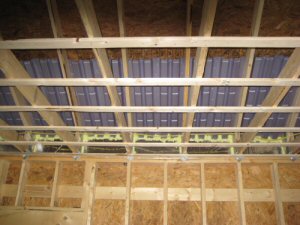
 Ceilings have a way of really showing defects when the drywall is not installed properly. While the visibility of ceiling defects can be reduced (e.g., through recessed lighting, flat paint, and other methods), the goal of every ceiling drywall installation should be to reduce or eliminate errors during construction. Everyone likes a clean-look drywall ceiling!
The first step in preparing the ceiling is to ensure there are no major issues with the sub-structure of the joists above, no plumbing or electrical issues to be addressed, and that, in general, you can live with a sealed ceiling. After that’s complete, the ceiling should be strapped to ease installation.
What is Ceiling Strapping?
Strapping a ceiling is the process of installing wood (or, in advanced installations, another material) perpendicular to the joists. The strapping serves as the nailing surface for the drywall. You should never install ceiling drywall fastened directly to the joists above. Why? There are several good reasons:
- If the ceiling has a floor above, the odds that the drywall will eventually crack and come away from the ceiling is greatly increased. Unlike wall installations where the studs never move, joists flex under the weight of foot traffic and furniture above, creating uneven stresses on the drywall.
- Installation is about 5x more difficult! Without strapping, you’d be attempting to nail the drywall joints on only half of a side of 2x lumber. While this can be done on wall installations, it’s not by any means desirable.
- You’ll end up with more seams. By strapping the ceiling, you ensure optimum nailing surface and spacings for drywall.
Strapping the ceiling also has the added benefit of reducing noise transfer from the floor above if you use an advanced material like resilient channel instead of 1×3 wood.
Purchasing Wood Straps
Ceilings are most often strapped with 1 x 3 uniform spruce lumber. Most home improvement stores will sell strapping in bundles, with sizes ranging from 8 feet to 16 feet. In general, you want to buy the longest strapping you can transport / install in the space.
Calculating the amount of strapping you need is simple. Measure the ceiling across parallel to the joists. Take the number of inches and divide by 16, then add 1. That gives you the number of straps to be installed. Measure the ceiling perpendicular to the joists. If this number is less than 16 feet, you can buy one strap for each length. If this number is greater, you’ll need to be additional straps to be installed on each length. Pick the best combination of strap lengths to achieve the ceiling.
How to Install Ceiling Strapping
Ceiling strapping should be installed every 16 inches on center, perpendicular to the joists above. Remember, a sheet of drywall is 4 feet, or 48 inches wide. 16 inch on-center spacing allows the drywall to be fastened four times across its width (one on each end, and two in the middle).  On-center installation is important, because every 48″ the strapping will be shared by two pieces of drywall. In other words, the center of the third piece of strapping from the wall should be 48″ away from the edge. This pattern should be followed all the way across the ceiling.
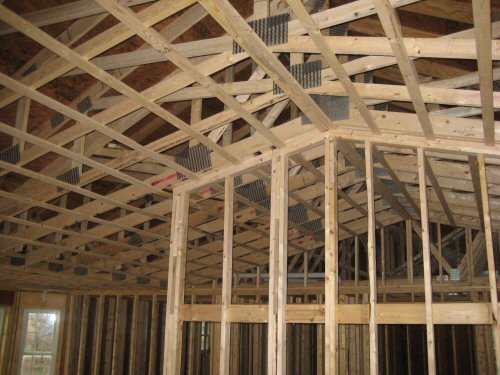
To keep the strapping perpendicular to the wall and in a straight line, you may want to snap a chalk line across the joists after making measurements, and before installing the strapping.
Use The Right Nails
10d nails are appropriate for ceiling strapping. You can use two nails at every intersection between a joist and the strapping. We highly recommend using a framing nailer to speed installation! (Otherwise, you’d be swinging a hammer upside down a few hundred times!)
Do not use finishing nails! Finishing nails will not provide sufficient hold in the ceiling above. Â Eventually, the strapping will pull away from the joists, and you’ll have a collapsed ceiling.
We recommend against screws only because of the unnecessary added installation time.
Summary & Credits
Installing ceiling strapping greatly eases drywall installation on the ceiling and ensures a smoother, even drywalling job. Â Special thanks to Todd over at Home Construction Improvement for helping us out with this article and for providing the two photos above.










Did I miss the announcement of who won the faucet giveaway?
We’re ready for our new bathroom faucet. 🙂
Carol – winner will be announced soon… and we’ve got another cool giveaway just in time to help you save money this Winter 🙂 Stay tuned.
Do you recommend strapping if the drywall is only serving as a thermal barrier for tongue and groove knotty-pine?
Rob – I don’t have experience in that use; but I would say that strapping still greatly eases drywall installation by providing even screwing surfaces… So yes, I’d probably still use a strapping.
I know this is a old post, but don’t you have parallel and perpendicular reversed in the purchase section?
Don, indeed we do, and I’m fixing it now. Thank you for the catch.
Suggestions: Typically you want to get a layer of 6 mil poly behind that strapping before you start. This is your one shot at keeping water vapor out of your insulation where it will re-condense to liquid and render your insulation ineffective.
Also, you may want to take the time to use the screws. The other primary function of strapping is to straighen out and adjust for defects in the joists before you hang board. With the screws you can back them off and get a shim in there, which you can’t do with a nail.
Ceiling. First poly then strapping then drywall? Is this the correct way?
In my basement i want to finish my celling in one of the room.
i have some joist strapping running all across the celling..i dont think i should remove them in order to put resiliant channel right ine the joist..seams like those strapping are the only thing joinning those joist.. can i put my resiliant chanel in the middle of those strapping? ( wich would result of them being parallele to the joist)…..?
With the entire world currently having some 7 billion people living in it,
finding ‘the one’ may seem like such a difficult, if not impossible, quest.
The free Greek dating sites provide the members
dating services devoid of any monthly membership.
When considering online dating, you must remember to be honest.
Ι am Greek and I have no idea what you’re talking about. As a matter of fact, I believe you don’t have either. Cheers!
I have a 12 x 16 shed, rafters are 2×4 spanning 6 feet can I hand drywall on the rafters, and do I need to install ceiling strapping.
1. 75 year old finishing basement. I have 3/8 drywall for a storage side of basement and my cheap builder has joists on 20″ centers. Is it safe to use the 3/8 if I strap and glue?
2. When strapping, I assume you start the first strap against the wall?
Good day,
I own a drywall company in Ontario I’ve been using 1×3 wood strapping on my ceilings for years . I use 2″ nails that are meant for griping into wood. Then I use a 2″ fine thread drywall screw when installing the drywall. I’ve never had an issue . I’m doing a job and the customer has told me that everything I’ve done isn’t right. . The wall framing wasn’t even securedo and told me that my door sizes were not correct, that the wall had to be 16 o/c and now that 1×2 strapping with only 2″1/4 screws was the proper way and to do it his way…. I’m the person responsible for injury if the cheap 1×2 strapping fails which I’ve seen all the time . The wood splits easy when using screws and is much harder to level the ceiling. Any suggestions
I know this is an old thread, but to install strapping to my basement ceiling joists, to receive the drywall, would it be OK to nail the strapping to the joist with a 2″ pneumatic nailer ?
Thomas, first of all, if the customer is insisting that you use 1x2s, and you still want to do the job, make him/her sign a waiver accepting responsibility in the event the 1x2s aren’t strong enough and cause a failure, especially of it results in injury.
To be extra safe, have the waiver drawn up by an attorney, and possibly signed in front of the attorney (if you’re lucky, this might change the customer’s mind to let you use the 2x3s).
Second, if you HAVE to use 1x2s, and plan on preceding, take the extra time to predrill every screw hole with a 1/16th inch bit. Then lubricate each screw before putting it in (even Vaseline will work to help prevent splitting).
Yeah, it’s extra work, but the (better) alternative is to quit the job because the customer is demanding that you perform an unsafe practice – personally, this would be my INITIAL choice.
I would resign in writing stating that you were resigning because the customer was requiring you to perform an unsafe action that you could not do in good conscience.
Hi Fred,
I have a project replacing a drop ceiling with drywall. Commercial space, clear 12′ X 26′ span, two feet beneath metal roof trusses.
1) Your pictures appear to have 2’X 4’s on 24″ centers.
2)Is it appropriate to run additional support to metal trusses?
Thanks,
Dave
Thomas – Fine thread screams are for metal studs and will eventually pop. Coarse thread screams are made for wood studs. Creepy.
Lol Screws…not screams….wth.
Can strapping be used to level a ceiling that slopes down 3 inches over 11 feet width?
Hi,
I’m looking to mount a suspension fitness system to my finished basement ceiling. I’m not sure of the construction and am using a stud-finder to find anchor points.
If I end up finding strapping, is it structurally sound to attach an anchor to it? Bodyweight is just under 200 lbs, maybe a little more rating for movement.
Thank you in advance!
Ryan
No. The strapping is not intended to hold anything other than drywall. You have to find the structural members if you want that kind of hanging weight. There is a good chance that your current ceiling, if you haven’t already confirmed this, does not have strapping. I would check on that but just let me repeat one more time that this kind of strapping especially on the ceiling, is not structural in any way and should not be used to hang anything heavier than maybe a small plant.
i have removed the old drywall from the ceiling, water damage etc. now I’ve checked the center line of the floor rafters and nothing is on 16center. if I do strapping it will be perpendicular to the original ceiling, will the drywall go back up paralell with the strapping or perpendicular to it? I think I’ve answered my own question but want to confirm. perpendicular??
House built in 1950 nailed to original rafter beems
Is metal 2 leg strapping better than using 1×3 strapping for a basement ceiling?