


Flooded basements are a very serious problem that can result in considerable damage to your property and possessions. It’s also a health concern as wet basements promote mold. It’s important to resolve poor drainage issues rather than clean up the aftermath year after year. Plus, flood insurance will only protect you for so long. If you’re looking for a DIY solution, French drains and drainage trenches are a great way to divert water away from your home.
How a French Drain Works
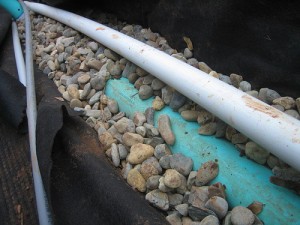
Water will follow the path of least resistance. A French drain provides an easy alternate route for water, allowing you to direct it away from your home. You accomplish this by using perforated pipe and gravel. Water would much rather flow through open pipe or around small rocks than through compact soil but there are some important things to keep in mind to ensure your drain works properly. Read on as we cover how to install a drainage trench.
How to Install a Hidden Drainage Trench
The overall idea is to dig a trench that slopes away from your house. Next, embed perforated pipe within gravel for water to flow through, and protect the whole setup with landscape fabric.
Plotting your locations: First, you need to decide where to install your drain. Examine the grade of your yard and determine sloping areas that direct water toward your house. Even gradual slopes can enable water to collect at your foundation. Ideally, you’ll cut off these pathways and redirect the water somewhere harmless. Storm sewers are the best endpoint for runoff, but it may be difficult to achieve that connection. The next best solution is to expose the drain end to daylight. Here are some considerations for where you direct the runoff.
- Neighbors – Sending water toward the neighbors is not a good idea. It may result in flooding problems and ultimately a law suit.
- Sidewalks – Sidewalks can become icy in winter or slippery in summer.
- Play area – You want to be able to enjoy your yard. Don’t create a soggy marsh that you can’t use.
Mark off the locations for your drains. Before breaking ground, check local code for any guidelines and call “Call Before You Dig” at 811. Call Before You Dig will get a local utility to come out and mark the utility lines on your property.
Digging your Drainage Trench: Trench widths can vary. I’ve seen them as small as 6 inches or as wide as 24 inches. Often, trench width is dictated by the equipment you are using and how much you want to dig. A backhoe makes it easy to dig a wide trench while shoveling is a lot of work. Wide trenches do afford several important advantages.
- They can collect more water.
- Working in a wide trench is easier.
- Wide trenches last longer because they will not clog as easily.
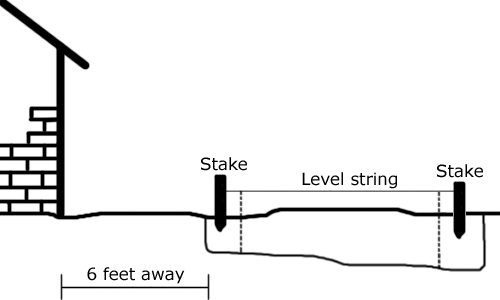
Drains should be at about 2-3 feet deep. Deeper soil is more compact and will better funnel water to your perforated pipe. Whatever depth you choose, remember to account for the downward slope. Also, place your drain about 6 feet away from the foundation, else it will pull water toward your house.
Sloping the trench: Your trench should maintain a 1% grade. That means a 1 foot drop for every 100 feet of length. A steeper slope is not a bad thing but 1% is the minimum. Use the 1/100 ratio to determine how far your trench should drop. Here’s an easy way to measure the grade as you work.
- Grab two stakes and place them next to the trench, along it’s entire length.
- Run a string between the two stakes. Adjust the string height until it’s perfectly level (using a level of some kind).
- Measure from the bottom of the trench to your string to determine the change in depth.
Fill with gravel: After digging out your trench, it’s time to fill. Begin by lining the trench with permeable landscaping material- fabric or plastic. Plastic landscape material can be easily damaged. I suggest using fabric landscape material.
This fabric will allow water to pass through while keep dirt and debris from clogging your drain, making it less effective. Be sure to overlap any seams and to allow extra for wrapping over top. Next, put down two inches of washed gravel taking care to maintain your slope. Be sure to select a large gravel that it won’t clog your pipe.
Many people use corrugated, flexible pipe in their drains however a rigid plastic pipe has some additional benefits.
- It’s easier to maintain the proper slope with a rigid pipe.
- Rigid pipes can be cleaned with a sewer snake, while flexible pipes would tear.
Place your perforated pipe on the gravel, holes facing downward. It may seem counter intuitive, but remember, the water pools from the bottom up. Placing the holes on the underside allows water to enter much sooner. Slowly fill the trench with gravel, taking care that the pipe stays in place. Fill the trench with gravel until you are 2 inches below ground and cover with the landscaping fabric. Add dirt with grass seed, or lay sod to conceal your drain.
Waterproof Your Basement Walls
Another important tactic to consider is waterproofing your basement walls. You can seal below grade concrete, brick, stone, or masonry walls to prevent moisture penetration. The best way to accomplish this is by applying a portland cement-based powder waterproofer. These waterproofers have chemicals that are activated by water and dry as a waterproof barrier.
What do you think? Ever install a French drain before?
Image courtesy of Jeff Tidwell










Several years ago, after two costly basement floods caused by poor drainage and the roof spill falling too close to our foundation, we installed french 4 drains around our house, and I’ve never regretted it. It was a big job and labor intensive, but made much easier by our son-in-law who could borrow a backhoe from work. The sacrifice in grass was worth it!
Another thing that we did to push run-off away from the house was to build raised gardens around the low side and back where most of the problem lay. We used 12-inch landscape stones to wall in the garden to 2-4 layers above ground. The underground pipes from downspouts to drainfield pass under the gardens and drain safely 6-20 feet out. So far, no more floods!
Chris, You mention a good point. Typically, multiple drains are required to divert enough water. And there are other measures like building up the grade around your home that can help too.
Ethan,
Great article! Best description of how to do it that I have seen yet, and I have been reading quite a few!
Thank you.
We just bought a house and 2 days later got an ncredible amount of rain. Needless to say, the whole basement flooded with about 3″ of water. I am uncertain about what method of waterproofing to go with. The indoor french drain w/sump pump or outside cutrain drain. I was told that the indoor drain detaches the basement wall from the floor so now you have a floating basement floor and affects the footings. I got a price of $6k to do the inside french drain w/pump. Whatever method we go with, we are do it yourselvers and would like to do the waterproofing ourselves. How much labor is involved with the exterior curtain drain?
@Julie, Sorry to hear about the flooding. That’s not what you hope for from a new purchase. I’ve never installed a french drain myself so it’s tough to compare. When I helped dig the drainage trenches, we used a backhoe. It took care of a lot of the heavy lifting, but your trench may not be as big- meaning less digging. Another thing to consider is laying the gravel.
I definitely think DIYers can handle the drainage trenches and that’s the choice I’d go with in your position. Good luck!
Is the idea similar for an indoor french drain? Our house already had an indoor drain installed when we moved in, and we have had no problems with water. Great explanation as usual. Does an outdoor drain work as well as an indoor drain?
I also suggest geotextile instead of landscape fabric, its more durable.
I really need to do this in my back yard, water pools in one part of my yard whenever I start having water troubles in the basement.
Great tip about the geotextile. Dirt getting past the landscape fabric can really negate the effectiveness of the drain so it seems like that might be a worthwhile upgrade.
Some of my thoughts, having built a few of these over the years:
Please do not direct your drain toward the storm drains… we don’t need more water in the storm drains. Better to direct it toward an area downstream of your home and allow the water to soak back into the the earth.
At the outlet, it’s a good idea to drill a horizontal hole through the pipe and insert a rod to prevent the larger critters from entering the pipe.
I once had a landscape designer tell be that black corrugated pipe is used to get the water to “swirl” and carry debris out. BS. Flexible pipe is a sure way to know you will be digging up your drain a few years down the road.
Don’t shop for “gravel” which often contains fine particles that will clog your system. Look instead for crushed stone, and don’t be afraid to rinse it with a garden hose before putting it into the trench. You will be surprised how much silt you can keep out of your system by taking this extra step. Larger stones create more air pockets for the water to flow toward the drain pipe.
A Ditch Witch is a great tool you can rent to dig a nice trench that is not too wide. Use a Sawzall with an Axe blade to cut back roots as you dig.
another great article. I just bought a house and it has a sump pump that looks to be as old as the house, 20 years. With no water or flooding issues, I till wonder about the sump pump and should a 20 year old one need replacing or is there any prevenative measures I should do. I know this is off the point somewhat but we are both wanting the same thing, no flooding problems.
My house has a sump, and I can’t remember the last time it came on. If I were you, I’d just test out the sump to see if it works. Since you haven’t had a problem in 20 years, it’s your call to replace the sump if it isn’t working.
I think you misunderstood. It works and runs several times a day usually. I just bought this house last year and was wondering if it might need replacing before it fails or what kind of life do they usually have.
I did misunderstand your other comment (obviously)… I don’t know what life expectancy sump pumps carry. However, running daily seems excessive. If it’s running in dry weather, I can only imagine how much it runs with a lot of rain.
this is a very relevant article for me as all of the snow melts here in minnesota… It is quite the task to prevent the basement from leaking in any house up here!
Perfect timing! We’re looking to put in a drainage system as soon as the snow melts- our sump pump discharge pipe comes maybe 4 inches out of the house, takes a 90° turn, and dumps the water right along the side of our house. Last month we got so much rain that the pump was running every 20-30 seconds, and while it was able to keep up, I did pick up a new pump just in case- it wouldn’t take long for our basement to start flooding. Now that our snow is melting (for real this time, I hope!), our pump is running quite frequently and while we’ve diverted the flow away from the house temporarily, we need a more permanent solution. This article will certainly come in handy as I plan our drainage system!
This is a great guide, and I think I will forward it to some of my customers next time they ask about drainage issues. I get many questions about basement water problems because I work in a field where we repair the water damage to the foundation. People are always curious to know how to stop the damage from happening in the first place. It’s nice to know I have a link handy, now.
Rebecca Lynn makes a great point. Though not cheap, having an extra pump ready in case needed might save a lot of trips to the curb ( or landfill) with ruined, wet possessions. I built up the grade next to the house. I also checked for holes/ leaky joints in the downspouts and gutters during a heavy rain & patched with silicone caulk.
To John’s response April 9,
What type of company do you work for? If I were to hire someone to do this……who would I call?
Thanks,
Mary
Our home is a 150′ ranch. Our crawl space is always wet. If we dug a trench around the house to prevent water draining in crawl space could we use old highway paving bricks instead of large gravel stones? The only reason I was wondering was due to the fact that we have a large amount of old highway paving bricks which we don’t have any use for anymore and I wondered if perhaps these could be used instead of gravel since due to the length of our house could get quite expensive. If we could get rid of the brick and save some money it would be great but I didn’t know if we could substitute. We could even break up the bricks if it would be better. I haven’t heard of this but was wondering if any possibility of it working? Thanks.
Hello. I have a house positioned at the bottom of a hill. Everytime it rains hard.. it floods the whole house. It has been as high as the top of the baseboards. The house lies directly in the waters path. Was given estimate of $2800.. told to dig a 3ft wide 6ft deep trench along the entire length of property out back at top of hill. To fill trench with rocks and that will solve problem. Does that sound about right? And should there also be a smaller trench closer to the house? What about the water coming down the hill in front of the trench at top of hill? I’m thinking that water will run towards the house also. By the way.. there’s a street with houses at the top of the hill. So it’s not like.. just a hill. Any input will be helpful. Thanks in advance.