

Should You Lay Hardwood Floors Parallel or Perpendicular to Floor Joists?
February 25, 2010 | by Fred (email) |
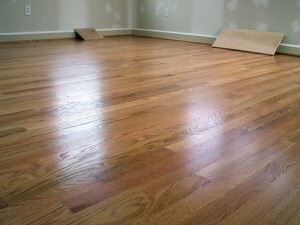 Reader question: I’m about to lay hardwoods in my house and I’ve heard that you should lay them perpendicular to the windows so the light doesn’t reflect off the gaps in the boards. A friend told me that I should lay the wood across the joists and that would mean running the wood parallel to the windows. What’s the right answer? — Lisa
Lisa, good question. In our opinion, it depends on what subfloor is already sitting on top of the joists, and specifically whether its plywood or OSB.
Plywood vs. OSB Subfloor
If your subfloor is 1/2″ plywood or less, we’d run the surface wood perpendicular to the joists. If it’s 5/8″ plywood or better, we’d be less concerned which direction the wood was running but would still be inclined to run the wood across the joists. With 5/8″ plywood or thicker, the plywood itself will grip the fasteners well enough to avoid the floor from pulling up, so hitting joists periodically throughout the installation is less of an issue.
If your subfloor is oriented strand board (OSB), we’d run the wood across the joists; however, that is mostly personal preference. You probably wouldn’t have a problem running the boards either way if the OSB is 5/8″ thick or better. Originally, OSB didn’t hold hardwood fasteners quite as well as plywood did; however, newer OSB has a holding capacity similar to that of same-width plywood. With 1/2″ OSB or less, just like with plywood we’d definitely run the wood perpendicular to the joists and we’d mark the joists with lines on the surface of the OSB and ensure we were driving fasteners down into the joists as often as possible to increase the strength of the floor.
Glue and Screw Additional Plywood
If you really want to run the hardwoods perpendicular to the windows, and your floor doesn’t meet our recommend specs, you could glue and screw a half inch of plywood to the existing sub-floor. Glue using liquid nails and screw the floor down every 10-12 inches square. This costs you 1/2″ of room height and extra materials, but it is a viable alternative. If you’re dealing with an unlevel subfloor, we recommend you check out our instructions for leveling a subfloor.
Prefinished vs. Unfinished Woods
I think a major question about whether the windows issue is a problem is how smooth your floor will be and whether you’ll lay prefinished or finish-in-place floors. Prefinished floors are more likely to show gaps between the boards than finish-in-place floors, because the latter is sanded flat prior to finishing.
No matter what you do, you should eliminate squeaks on the subfloor first by screwing the floor down through the sub-floor to the joists anywhere you can hear squeaking. You should also lay red rosin paper on the subfloor before you apply the wood to eliminate squeaks caused by the subfloor and hardwood rubbing together.
If you haven’t already purchased hardwood flooring tools, follow that link for the complete list of what you’ll need. Â You can also read our complete instructions for installing hardwood floors.
(photo: pdz_house)










Fred,
I’m going to disagree a bit here. The differences between plywood and OSB really are nill in my experience and also the flooring guys that work for us. The real question is the thickness/strength of the sub-floor. I agree that if you have less than 3/4″ of you should definitely run the flooring perpendicular to the joists (or at a 45 degree angle). However, if you have 3/4″ plywood or OSB you can change the direction.
Most flooring installers will lay the flooring parallel to the long length of the room to avoid the “ladder” affect.
OSB gets a bad rap when in fact it’s a good product so long as it doesn’t get wet. In fact, most all OSB products meet or exceed ratings that make it a structural rated panel. Today most new homes that we build use the AdvanTech OSB product and it works great under wood flooring.
Hi Fred,
I have a similar situation where I ripped out carpet in the bedrooms and am going to install floating click Time Honored Oak Tinted Natural 3/8 in. T x 7-1/4 in. W x Vary Length Engineered Hardwood Flooring. I was unable to find a direct match to the existing flooring in the hallway outside the rooms but have come close.
Here is the engineered hardwood:
https://www.homedepot.com/p/Bruce-Time-Honored-Oak-Tinted-Natural-3-8-in-T-x-7-1-4-in-W-x-Vary-Length-Engineered-Hardwood-Flooring-32-63sq-ft-case-EKHD73L21S/312605081
Facts:
– OSB in the bedroom running perpendicular to joists(unsure of thickness, will check today)
– Joists are 24″ apart
– If I run the wood the same direction as hallway it will be parallel to joists and perpendicular to both the longest wall in the master and the windows
– Floor feels stable, no creaking
– Using a 4mm underlayment
Questions:
– Can/Should I run the engineered hardwood parallel to the 24″ separated joists?
– Is engineered hardwood more or less susceptible to sagging if I run parallel to joists in comparison to hardwood?
Thank you!
I have tried in vane to find out if when a builder puts in an addition and runs the joyce boards so that your new flooring cannot be run perpendicular to the floor joyces? My house the wood floors were installed and run perpendicular but the addition was put in so the floor joyce will not allow me to run the new wood flooring perpendicular? Should I install another sub floor?
Todd, interesting to hear another perspective. This is information I received when I installed floors in my first house from a hardwood installer online.
The information I’ve found online today is varied, esp. in terms of what NWFA will support. As I understand the guidance, they want wood floor always installed 90deg. to the joists, even on a 3/4″ nailing surface. They do say that 3/4″ OSB is an OK subfloor for nailing 3/4″ hardwoods.
So, another factor to consider here is whether our reader is laying 3/4 hardwoods or thinner, in which case guidance might change.
Thanks for the great information. We will certainly consider it when we lay our new floors.
If you have an older house, with a shiplap floor, the shiplap is perpendicular to the joists, so the flooring is parallel to the joists. Some houses have the shiplap on a 45. I guess you wouldn’t have to lay it parallel, but the shiplap has a lot more movement then plywood or osb.
I have a two rooms in a open concept front part of my house. The joists in both of there room are in two directions. So picking which way to run the hardwood is difficult.
Another thing there are stairs as well, so to add 1/2″ underlayment will bring my floor high over the nosing and railing nosing.
My sub-floor is 5/8″ plywood, is it OK to just go ahead and install the floor knowing it will be parallel and perpendicular to the joists?
I know 45 deg would solve the problem as well, but I think that might be too much for me.
Brent, in this circumstance, I would lay it whichever direction you want. I think you’ll be fine with 5/8″ plywood. It’s not as ideal as 3/4″, but the alternative is no good, either.
My question is after having a tile layer taking our money and removing the OSB Particle Board, I have 5/8†plywood in great condition sitting on 16†center 2X8 joists, Can I lay a vinyl plank flooring on it?
Regards,
Frank
I want to put hardwood floors throughout my upstair home. I have a basement. The front of my house the floor joist run one direction but right in the middle of my home they go the opposite direction. So if I am to run the hardwood flooring perpendicular to the floor joist and it changes direction between the dinning room and the living room which the middle of the house, then what???
Kristy, Definitely a good question… It illustrates exactly why this is a difficult decision. What’s the subfloor today? If it’s 5/8″ plywood or better, I think you can lay the wood either direction with absolutely no concerns. Even if it’s less (say, 1/2inch), you can still lay the hardwoods and it might work out just fine. The only problem is that if you lay them parallel to the joists, you can end up with more unevenness in the boards (they could dip between the joists). However, I wouldn’t lose sleep over it. It’s not like the floor will collapse over this decision.
My house is 30 years old. The subfloor is 3/4 inch plywood. Most of the joists are on 16 inch centers. Some are on 8 inch centers. I want to run my 3/4 inch solid wood floor paralell to the joints. Do you think I will be okay? Most things I have read on line say absolutely must run perpendicular to the joints. Half the installers I have spoken to say one thing and half say the other. I am so confused. Help.
I think with 3/4″ plywood on 16″ centers you’ll be fine running a parallel floor. Make sure the rest of the installation is to spec and you should have no problems.
I am replacing the flooring in a 50 year old house with 1 1/2″ tongue and grove sub-floor. The floor joists are large beams on 4′ centers. The sub-floor is laid perpendicular to the beams, and the current flooring is laid perpendicular to the sub-floor. Because of the wide beam spacing there is noticeable movement of the floor, and the current floor squeaks in many places. I would like to place the new floor parallel to the sub-floor and perpendicular to the beams. This would also be parallel to the hallway coming off of the room (it will get the new floor as well). Will this work OK? I want the new floor running the long way in the hall.
John, I have little experience with this type of installation, but my gut is that a perpendicular installation may run into problems with fasteners given that the tongue and groove subfloor is running parallel underneath it. I’m not certain this would be a problem though, and from a structural standpoint I see no reason why you can’t run the boards perpendicular to the beams and parallel to the subfloor.
I have a 80 year old home. The flooring is 3/4″ t&g nailed directly to the floor joist. The floor joist are rough cut 2×8 spaced 24″ oc with a 8′ span. I have added 7/16″ osb to the t&g and plan on putting 2×8 blocking every 24″. will this support new 3/4 t&g running parallel to floor joist?
Hey Team,
Do the warranty. I’ve crawled over 1 million square feet now (unfortunately) and I can promise you I’ve never come across a hardwood, exotic or domestic that didn’t require a perpendicular install. It might read “manufacturers suggestion†and that might make it sound like an aesthetic option to the home owner or installer, but it isn’t. If you install a hardwood floor parallel, you waive basically your insurance on your floor, meaning that if your floor buckles, crowns or crest because the maker didn’t kiln dry the product properly, they will blame you for improper installation. And its not without reasons; it strengthens the floor and diffuses the psi-think basket weave. A parallel floor can become a rolling phenomenon.
As for laying a floor along the longest wall that applies to an unsecured floor, what’s known as a floating floor:laminate,LVP, LVT,etc. Some hardwoods can be floated however by glueing the tongues to the groove. You can also install a floor diagonally, however you will have more waste.
You can do floors in a lot of different ways but I would advise anyone to read closely those little sheets in the box that will basically tell you how to keep your floor with it’s 20 year or 100 year warranty(yes they’re out there).
1) Keep expansion gaps around the wall-1/2 inch is usually safe(Bamboo requires up to 1 inch!).
2)Use T-transitions in doorways. Many manufactures now require them between doors under 48 inches.
3)Level floor; some require a floor no more than 1/8 inch difference over a 6 foot span
4) Shoot A LOT of staples or cleat nails. Many require a staple or cleat every 8 inches
5) Lay Perpendicular
There are more warranty rules, but these are the most common ones overlooked that waive the warranty.
[…] image source : google.com […]
I had no option for laying the floor perpendicular to the joists. The long hallway from the front door to the kitchen/dining area dictated the direction. Knowing that that is not ideal, I screwed 2×4 blocks between the joists about every 16†(tried to create something like a grid of support vs. joists alone). Now roughly 29 years later, I have some pretty squeaky spots in the floor.
Question – would it be beneficial to remove the 2×4’s and screw them back in the with glue, this time?