

Plywood vs. OSB (Oriented Strand Board) | Differences & Applications
July 3, 2009 | by Fred (email) |
Reader Question: What is the difference between plywood and oriented strand board (OSB)? What are the appropriate uses for each? Is one better than the other for new home construction? — John
John, those are great questions. Here’s the basic rundown on each material and suitable applications.
Plywood
Plywood is made by cutting thin layers of a tree all the way around its circumference. These boards are then laminated together using a hot press (basically a giant iron that fuses wood and glue together under heat). The first piece of wood is placed so that it rolls “up” while each subsequent layer is laid 90 degrees to the one below it, and upside-down. The result is that the tendency for the boards to warp into their original shape is diminished as each board is pressed against the other layers. As a result, thicker plywood (say, 5/8″ and above, which is made from 5 or more plies) is much less likely to warp than thinner plywood, such as 1/4″ or 3/8″.
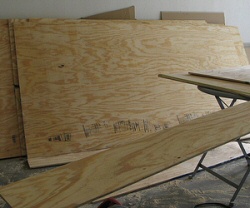
All plywood will still have some warp, especially because some layers have greater warp tendency than others (for instance, layers derived closer to the center of the tree). Obviously, these forces are easily overcome by fasteners when the plywood is attached to studs or joists.
When exposed to water, over time plywood will delaminate. It is important to avoid an extensive amount of water exposure during construction. (Some water, however, will not damage the boards). We’ve had a number of readers ask about water exposure. The reality is that water and plywood don’t mix well, especially over time. If you leave plywood exposed to water, it will eventually rot and must be replaced.
Plywood is sold in nominal thicknesses, such as 3/4″. However, finished plywood is actually 1/32″ thinner than its nominal rating. For example, 3/4″ plywood is actually 23/32″ thick. The nominal length of plywood is true to its actual length (4′ x 8′ sheets are usually 4′ x 8′); however, even length and width can vary slightly due to imprecise cutting.
Oriented Strand Board (OSB)
OSB is built by pressing smallers strands of wood together with glue and wax in a hot press. OSB looks a lot like a collage of different wood chips. Unlike it’s plywood counterpart, OSB lacks the forces that tend the wood to warp, and so is easier to get perfect dimensions and avoid warping tendencies.
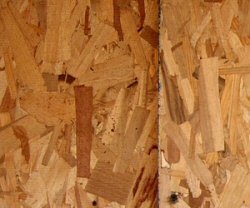
The one major disadvantage of OSB is its propensity to expand with moisture. The edges of OSB will dramatically expand (>15%) when wet, and takes much longer to return to normal size. If the moisture is allowed to remain in the OSB for some time, the boards may never return to their original dimensions. The effects of water on OSB are much worse than plywood, although in both cases water and moisture should be avoided.
Applications for Plywood vs. OSB
Subflooring
When used as a subfloor, either product will work for many flooring surfaces, especially carpet where there will be no noticeable difference. For hardwoods, plywood is desirable because it holds nails slightly better than OSB. Also, since the entire floor will be built with the same product, some care should be taken in deciding whether its worth it to risk potential moisture in bathrooms and kitchens that could cause OSB sub- flooring to buckle and rise at the joints. For ceramic and stone tiles, either can be used as long as the product meets the deflection requirements of the installation.
Here’s an article using plywood and shingles to level a subfloor that may be of interest.
Roofing
For roofs, plywood is preferable and required by code in many states. Since roofing wood will be exposure to moisture, OSB will have a tendency to expand and warp which will both weaken the roof and may pry up the shingles, making any leak problem worse. However, for exterior buildings, such as sheds, OSB is an appropriate product.
Here’s an example of building a shed that uses OSB and Advantech, a material mentioned in the comments section below.
Sheathing
For wall sheating, OSB or plywood is acceptable, but again, plywood is preferable unless extreme cost savings is a concern.
Cost Savings for OSB vs. Plywood
The cost savings of OSB over plywood will be less than 2% of the total cost of most homes. If we were building a new home, we’d choose plywood given only these two choices. That said, Plywood and OSB aren’t your only options. Our buddy Todd over at Home Construction Improvement swears by Advantech Sheathing, a next-generation surface that resists moisture much better than either plywood or OSB. He built his whole house with it!
(Photos: nieve44/laluz, hryck)









Fred,
Couple things worth pointing out. The layers of plywood are oriented with the grain 90 degrees from the previous layer for another really important reason. Plywood panels give floors, walls and roofs substantial shear strength to counter wind and other horizontal forces such as earthquakes. By orienting the grain in two directions you create a much stronger “panel”. The same theory applies to OSB and that’s why the wafers are allowed to be dispersed in many different directions.
Also, most all OSB products are now approved for construction of walls, floors and roofs. All of these products have made significant improvements when it comes to strength with fasteners. OSB also happens to be quite earth friendly as it can be manufactured with new growth wood instead of old growth.
Great post Fred! Some of us take for granted the differences between these products.
Todd, great additions… always appreciated.
I’m still skeptical on OSB applications where water is involved. I have seen that stuff swell to a ridiculous degree (must more than 15%). Would like to see some demonstrations where OSB is subjected to a lot of moisture over several years, or where a leak develops on the edges.
We built a gorgeous timberframe home in northern VT ten years ago. When our builder came to replace a cracked clapboard, he discovered that the OSB on theentire south and west exposures of our home was wet and rotten. The apparent cause was a buildup of moisture beneath the Typar (due to condensation???). We are having to scrape off the OSB surface of the stress skin panels (manufactured by Foard in Brattleboro, VT) and re-glue a new surface to the panels prior to putting on a siding. We are very discouraged as this is a $70K problem covered by only 10K of “mold and wet/dry rot” insurance. Also, we do not want to have a repeat of the same problem. Solution??
We had a snow and ice storm last Jan. 2011. It caused an ice dam on the roof. We replaced the roof that was damaged. Insurance wouldn’t cover it. Now 1 year later we have mold inside the house on the wall. We took off the vinyl siding on the outside of where the mold was. The osb was wet and rotten. We think this is from the ice dam one year earlier. How long does it take wood to rot? Where we took the siding off there is no sunlight.
Wood can start to rot in as little as a few weeks if exposed to constant moisture. OSB, particularly will delaminate in these conditions. From what you describe, you’ve got a problem that is several months in the making.
It sounds like the problem you are having is related to moisture infiltration rather than the 1 year old ice dam problem. If your vinyl siding is not properly installed (proper vapor retarder – Tyvek, and proper flashing and waterproofing practices) it will allow water to reach the substrate. This is not a problem of what your wall is sheathed with, it is a problem of poor installation of your siding. All siding leaks. Could also have to do with improper roof flashings.
Unfortunately it’s to late and I’m sorry, but my guess is all of your problems are coming from you’re eaves and rakes. To allow for proper shedding of water and soffit to ridge ventilation you need at least a 12″ overhang on your eaves and at least 6″ on you’re rakes, I say 12″ all around, looks better anyways. In addition the plumb cut of your rafters needs to exceed what’s even possible from a 2×8 rafter in order to get the full r-38 value of insulation to the outside of the exterior wall with a baffle above it to allow for air flow. There are ways around that, but at you stage, I’d recommend getting a good contractor in there to check the ventilation between your soffit and ridge, make sure there are baffels, soffit vents, ridge vents, the proper amount of insulation, and that there are not any obstructions, plumbing vents or hvac vents within 4′ of the soffit, and no skylights within three feet of an exterior wall.
Then if you don’t want to have a problem with you’re siding again I recommend getting a siding system that incudes a breathable moisture barrier that adheres to the osb, with during strips over that to create Chanel’s for moisture to escape and not rot, and then siding. It’s a more modern method designed for homes in flood areas so the moisture can escape but since I’m afraid that you are going to have continued problems it might be your best choice even though the price is much greater
I have 5/8th inch plywood subfloor in my house that I am laying 3/4 inch hardwood flooring over. I have to build up my family room with 1/4 inch luan to match the level of my kitchen. Am considering using 1/4 inch OSB due to cost, but don’t want to sacrifice quality. Anybody have an opinion about the appropriateness of OSB for this application?
I think it’s perfectly fine for you to use OSB in the application you describe. This article may also be of some interest to you:
https://www.oneprojectcloser.com/how-to-level-a-plywood-or-osb-subfloor-using-asphalt-shingles-construction-felt/
Fred
In my kitchen is 3/4″plywood floor.Can I use 1/2″ OSB boards over 3/4″ plywood to build subfloor for ceramic tiles?
I have osb as sub floor and I want to put solid hard wood flooring and nailed is this posible
Roberto, yes this is possible, but a lot of factors should be considered: how thick is the OSB? Are you laying the hardwoods perpendicular or parallel to the joists? What type of hardwood do you plan to lay?
Hi, I have a new garage and I have moisture proof sheetrock on the walls. I like the finished look of OSB board. Can I install OSB board over the sheetrock? Is this a good idea? Thanks Steve
Steve, I’m confused. You want the walls to look like OSB rather than drywall? That’s pretty unusual…. Why would you want that?
My husband decided to store some leftover OSB in the barn stacked against a wall.
We have two young geldings and they have eaten the OSB on a regular basis and seem to do pretty good on it. One horse has really gained weight on it.
It started with the feeder my husband built out of the OSB. This was not intentional on our part, but what is in that stuff that makes a horse eat it wood chips and all? They get hay and grain everyday but if there is a board in there, they eat that too!! Would plywood be better? Maybe they would not eat that??
Jean, I can honestly say I have no idea!
I’m getting vinyl in one of my rooms at this ment and though they were supposed to get the 1/4 inch luan what they are applying is actually more like 3/16 and am being told that’s what’s called 1/4 in construction terms. Is that true?
Actually, 1/4″ luan is normally finished to 7/32, but it could be easily mistaken for 3/16 if you’re thinking that it should be exactly 1/4. I think they are telling you the truth.
May OSB boards (panels) be use for open (no awning, canopy or roof above it) outdoor deck ? Deck eventually will be covered by outdoor carpet.
If yes, what kind of OSB should be use ?
Andrew
i have osb used as a facia / decorative band around an outdoors deck. the problem is that the edge of the osb has been exposed to the elements for seven years. the edge was painted, but have deteriorated.
any suggestions on preventing further deterioration.
another unrelated question: how well do screws work on osb?
I am working on a old complex apartment with subfroors and on the kitchen and restroom iam installing 1 1/8 OSB
I’m a Code Enforcement officer for the City of Holland, MI 49423. One of my duties it to enforce the Minimum Housing-Property Maintenance Code for rentals. Recently I have called the removal and replacement of floor covering in certain rooms in a rental dwelling. The LL/owner has removed the floor covering and in many cases has laid down OSB Board sheets. He has his maintenance people glue and secure it down with fasteners. Instead of placing carperting, tiles or linoleum down they stain then OSB floor boards, seal it with a lacquer finish and call it done. The question is is this an approved method and application and use of OSB boards as a finished floor. They do not use the OSB in kitchens or bathroom but every other room when called on. One of my co-workers thinks that this is not an approved method and use of OSB. I think if the OSB board is properly secured to the existing floor, proerly sealed at all joints and sealed with a hard durable lacquer finish it is acceptable. What are your thoughts and recommendations.
Sincerely,
Juan J. Mascorro
I am having a house built. The builder left the osb out in the winter for three months. He is now using it on the floor, walls and roof. I paid extra for plywood. Should I be concerned that the wood was left uncovered in the winter for three months in the snow?
I would be more concerned if you paid extra for plywood and he’s installing OSB! There’s no problem with the wood if it hasn’t absorbed moisture. You should be able to tell pretty easily whether the wood has been damaged. I assume that the OSB was at least covered, in a stack?
Snow isn’t the same as water, I’ll leave osb out in the snow for the duration of a job, even if it went through the spring the snow melts and runs off of it, the bottom should be on cleats so it can’t sit in water, and a good tip is to leave the top sheet on the stack bottom up, because osb sheathing has a waxy underside that sheds moisture better than the abrasive marked side.
We are having pull down attic stairs installed to utilize the attic as storage space. Our contractor was going to lay down some OSB instead of plywood as the flooring. Do you think one material would be preferential over the other in this case?
Hey, I’m building a spring floor for my martial arts studio I’m opening. I’m trying to keep to a budget, but I’m not sure whether OSB will be the correct wood. The floor is going to be 42′ by 22′ it will consist of either 1/2 inch OSB or ply wood placed on top of high density foam blocks. Another 1/2 inch layer of wood will then be placed on top perpendicular to the originals. My main worry with OSB is whether it will be strong enough to support the impact of falls over time. I’m also slightly worried about the moisture problem OSB has. I’m going to have puzzle mats on top of the spring floor, but there is still a risk of a little sweat getting on the boards. One last note is the floor will be on top of concrete. Any help is greatly appreciated. Thank you!
IM BUILDING A 4 X 8 MODEL TRAIN SET LAYOUT IN THE BASEMENT AND WONDERING IF 1/2 OR 3/4 INCH OSB BOARD WOULD BE AS GOOD AS USING PLYWOOD TO USE AS THE BASEBOARD,,
I think you might want to consider cabinet grade plywood so you have a smooth finish. The OSB will certainly be strong enough but depending on what you plan to do with the surface it might change the material you use.
FRED, THANKS FIR THE REPLY.
WHAT WOULD THE WEIGHT OF A 3/4 4 X 8 OSB BOARD BE…
TRAIN TRACKS WILL BE ON THE SURFACE AND I MOST LIKELY WILL BE PAINTING IT FIRST, MY MAIN CONCERN IS MOISTURE AS I WILL BE BUILDING TUNNELS AND MOUNTAINS WHICH WATER WOULD BE PART OF THE PROCESS OF BUILDING THOSE…
Hello
I’m currently building my house. I have 3/4 Edge Gold OSB over 16″ on center I-joists. I’m thinking about adding another half inch plywood over the OSB after my walls are framed. I’m thinking this will allow me some future flexibility particularly in bathrooms when I want to change tile or other types of flooring. I can’t find any 1/2″ T&G. Is there a such thing? If not, I assume I just butt up all the 1/2″ with approximately an 1/8″ gap?
Also, am I going to have a noticeable height difference where my carpet and pad butt up to 3/4″ hardwood flooring? I know back in the day they added 1/2″ particle board too butt up against other flooring…After adding 1/2″ everywhere would I have to go back and put 1/2″ particle board on all the carpeted areas?
Thanks
I won’t use plywood on roofs for the reason you mentioned about plywood, while working on two different subdivision built by two different builders, I was hired to go back to, id say a dozen houses with plywood roofs no more than five years old because at the time they were built they sat to long with out being weather protected and I’m guessing installed with out the proper expansion joint, but instead of swelling evenly like osb would have the plywood delaminated at each butt joint so the roofs actually looked like ripples in the water. Those builders and myself will not use plywood on anything that is unseen. And the products we use today are even better. Also osb subfloor no longer has the issues with nails that it used to.
I love the advantech subfloor, and have seen this done on t.v. I don’t like it because they have to sand it down to remove the markings, making it weaker, and if someone try’s to “refinish” it to repair scratches, fading or to achieve a better look what do you have left? It does look pretty cool though maybe sugest to lay down a second layer inside the room that is not part of the structure of the house?
i am roofer for about 20 years and whatever you put on the roof ply or osb is ok if you have problem with wet sheating thats because of the roof is not done right, which is also include not proper ventilation also i have seen several time that ply after couple years buckles even with not leaking roof and with proper ventilation, never seen that on osb, so i have put osb on my house on the walls and roof and floors and so far no problems after 15 years so i sincerely would use osb anywhere
typo in below, ‘exposure’ should be ‘exposed’
Roofing
For roofs, plywood is preferable and required by code in many states. Since roofing wood will be exposure to moisture, OSB will have a tendency to expand and warp which will both weaken the roof