


Crabgrass is one of the most common annual grass weeds in North America–and one that is particularly common here in our little subdivision of Baltimore County, MD. Crabgrass grows from a single seed and shoots out wide blades of grass in the shape of a star. The plant grows very rapidly, moving from seedling to full plant in 14 days. OK State University has a great picture of crabgrass here if you’re looking to identify it.
The term annual grass weeds refers to the whole set of weeds that occur annually in lawns. These weeds germinate in the soil in early Spring/Summer, grow, spread, and drop seeds during hot Summer weather, and die off in the frosts of early Winter. Each year, no living crabgrass remains in the lawn, only ungerminated seeds lying on the surface and just beneath the surface of the soil.
How to Control Crabgrass
Nature gives us a short window to stop crabgrass before it starts. In early Spring, before the new seeds germinate, a preemergent herbicide can be applied to the soil. Preemergent herbicides (called preemergents for short) prevent crabgrass seeds from germinating into the full plants. The result: less crabgrass grows during the season. And, since less crabgrass grows, there are fewer plants dropping seeds for the next cycle. With consistent application of preemergents, along with other grass care, crabgrass can be virtually eliminated from a lawn. This gives way for the healthy, rich turf we all dream of.
When to Apply Crabgrass Preventer
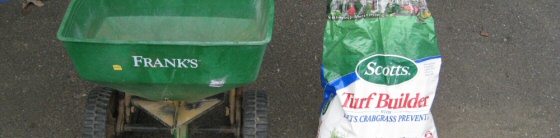
Crabgrass seeds germinate in the early Spring when the temperature of the surface soil rises into the 50s and 60s. Once the seeds germinate, the opportunity for prevention is passed. So, applying the preemergent early is key. Scotts Turfbuilder with Halts Crabgrass Preventer (our preemergent of choice this year because that’s what was available at the big box) recommends spreading the preemergent before the days are regularly in the 80s. We think that’s much too late. Once the days are regularly in the 60s and 70s, the seeds will be germinating and sprouting small plants. Instead, apply preemergents very early in the season, while the temperatures are still in the 50s. In Baltimore County, MD, this means spreading the preventer before April 1.
Scotts crabgrass preventer can be applied only twice per year, once in the early Spring and again in the late Summer if desired. The limitation has more to do with the Turfbuilder nutrients in the product rather than the crabgrass preventer. A product that only contains the herbicide could be applied more frequently. That said, we think it makes sense to spread preemergent only in the early Spring, while focusing on building up the cultured turf for the rest of the year.
Don’t Plant Grass Seed | Avoid Garden Areas
Because preemergents prevent seed germination, they should be carefully applied so as to avoid garden and other new growth areas. You should also avoid planting any type of grass seed within 3-6 months after applying preemergent. In other words, plan to plant new turf only in the Autumn.
Other Considerations / Instructions
- Always follow instructions on the crabgrass preventer you choose.
- Watering your lawn after applying crabgrass preventer will help form a protective barrier.
- Don’t aerate or heavily rake the lawn after applying pre-emergent. (This will degrade the barrier). Wait for the Fall to aerate your lawn and to spread seed.
- Wait 2 months before applying other chemicals like weed and feed unless you are following instructions or consulting with a professional.
More Info
This article covers the application of preemergent herbicide. If you’d like to learn more about lawn care, consider further reading like our review of Scott’s Turfbuilder with PLUS 2 Weed Control, and this detailed guide about weed control and how to target specific weeds.
What do you think? Do you spread crabgrass preemergent each year? Tell us about your results in the comments…










Great post Fred! Very timely, I live in the North East and was just thinking how I need to get ready to apply a Crab Grass pre-emergent as well. Last year my lawn looked good and hopefully there will not be much Crab Grass again this year. I have been working very hard over the last few years to really keep my lawn in tip top shape and cannot overemphasize the importance of eliminating Crab Grass before it germinates.
Also, I am very interested in seeing how you do with the Scotts product. I have been using the Jonathan Green.
Excellent information, Thanks!
Hi, My experience with Scott’s is this..
And just so you know, My property is in the southern most area of NYC.
I had really let my yard go for a few years, had NO time for it whatsoever outside of the weekly quick mowing!, Between work, kids, friends, family, life, I did not have even one day a week to care for it, it looked terrible, so I re-leveled & reseeded my entire 770sq ft yard four springs ago (March 2012) with Scotts products,
I used their “Sun & Shade Mix”, I’d say maybe 40% of the entire 5000sq ft bag took and started growing, what was growing was looking great by mid April, but, by the 4th or 5th cutting I still had a lot of bare spots and many weeds and Dandelions.
So I than tried a bag of Scotts Weed & Feed with Dandelion preventer/killer to clear that issue up first and than waited four more weeks and filled those bare spots in with a bag of Scotts overpriced “Patchmaster” garbage!, And again, maybe 40% of THAT, at most, began to grow, the bag was mostly some sort of paper/fiber filler that never did do anything, and also, the grass from the Patchmaster that did grow was completely different from the Sun & Shade mix!
It was very thin, very weak and very light green!
And by late June all the Patchmaster areas turned yellow and died off!
I than waited till after another four cuttings and sparingly used a bag of Scotts food for new lawns, it was a bit of hoping the grass that WAS there would get strong and healthy and take over the yard! SO much for hoping!, but, than came the dreaded Crabgrass in mid/late June, lots of it, and it took over fast!
Less than ONE week!
It was already too late to do anything about it (without spending a fortune on $25 bottles of watered down, half empty CG killer, that typically just burns spots in the lawn and doesn’t kill the CG!), The CG totally covered my entire yard. It ended up choking out my nice new lawn and killed it by mid July!
When September came, the CG started dying off, within a week new grass started emerging, I was shocked! It was actually looking nice!
I than waited for that Fall season and overseeded, and again going with Scotts Sun & Shade mix, waited till after the 4th cut and applied the Scotts winter weed & feed stuff, and also read a ton of stuff on lawn care products over that winter and learned where some of my mistakes were.
So the following March (2013) I applied the Scotts with Haltz CG preventer while the lawn was still very short, it did only help green up the lawn slightly but, it DID prevent 90% of the crabgrass from re-emerging that June, and I was able to spot treat the small spots of CG that sprouted by mid July, but, than by late July/early August my yard was once again covered and taken over by CG.
So than I waited for the fall, once again, and overseeded, again!
Winter came quickly that year, so I didn’t get to throw anything down before the first snow hit!
Than, in the beginning of July (2014) came, I quickly applied a bag of Scotts weed & feed with Haltz CG preventer, and my lawn began to look nice till June, than it began to turn yellow in a couple very small spots, I went and asked a local expert who said I should check for grubs, I went home, pulled a few spots up, and BLAM! There were the biggest, fattest, hungriest Grubs I ever saw in my life everywhere! I’d say there were at least 40-50 in one small spade scoop!,
And there MY luck with my lawn once again going south!!
So I ran to the store and bough a bag of Beyer’s 24 hour Grub Killer, as that was what the guy in the store recommended and claimed HE personally used. I applied, following the directions very carefully, and it didn’t kill anything but the rest of my lawn! Within one week my entire yard was yellow and dying, after two weeks it was all dead!
So once again I was forced to wait for Fall, and I reseed all over yet again!
Once again I reseeded with Scoots Sun & Shade mix, maybe 20% of that bag started growing, after roughly 4 weeks!
I had many bare, unsightly spots, and it only grew a couple inches, than started looking sick, yellow and started dying off on me, I had my soil tested, they said pH was OK, just a bit acidic and to just add a small amount of lime, and they didn’t know why it died like it did, they said the acidic level wasn’t high enough to kill the grass.
So, I did apply a light dusting of lime, watered that in daily, waited a week and threw down a thin layer of Scotts Grub Ex, I wasn’t going with Beyer’s non working garbage again!, I watered that in and waited while we lived with an awful lawn for 2015!
How awful was you you might ask?
Well, I had a back third of my yard filled with half grown splotchy Sun & Shade grass, another third where the much finer, softer and darker Patchmaster took, and one last third where half of it was pretty barren and/or spotty and the other half was a very thick, lush, dark green grass that didn’t match ANY of the other grass in the yard!
What an unsightly, sloppy looking MESS it all was! LOL
So I waited for Fall 2015 and applied Vigor’s Sun & Shade mix, I have given up on Scotts garbage seeds!
I would say that 85% of that bag of Vigoro took across my entire yard and looked great, nice and dark green, soft, strong and healthy, it seemed like a very resilient lawn for once, finally!
I waited till after it’s 4th cut and lightly applied a bag of Scotts Winter weed & feed, and that actually burned a lot of it, so I just kept watering hoping it would come back!
Within one week it looked as if it was coming back and greening up again, than one short week later Winter hit, so I didn’t get to cut it as short as I normally would have, and even though it was cold out, it was actually still growing till late November and really looked like it needed a good mowing! My yard has NEVER needed a cutting in Nov.!
So far, this March (2016), it already looks like the yard has all the same type of grass growing across it, with a small clump or patch of a non matching type here and there, and it looks a bit long for this time of year, and with some/few small yellow spots, and a lot of Clover, Chickweed, a couple of Dandelions (which I have NOT had in about 4 years!) around just the edges of the yard, but, mostly, it looks pretty green for it still being winter and temp’s still being in the 40’s & 50’s (with the exception of the two days last week that were in the high 70’s/low 80’s).
In a day or two (weather permitting) from this reply, I am going to mow, rake and apply a bag of Vigoro weed & feed with CG preventive that I picked up a couple days ago, so that I (hopefully) won’t have another CG issue this year!
I will than wait till after the 4th weekly cut (mid to late April) and put down a Grub preventative, so that (hopefully) I won’t have any Grub issues this year either!,
Than in 4 weeks from then I will also throw down something to prevent and or kill Dandelions and other weeds!
I swear, I WILL have a nice lawn one day, even if it kills me!
But I will NOT waste one since cent on another Scotts product as long as I own this property!
Oh, BTW, forget their “No questions asked, Money back guarantee if your unsatisfied”! When you call the Scotts clowns, all they will offer you are some lousy “Coupons” for more of their GARBAGE!
Why would I ever want coupons for a brand I will NEVER even buy ever again!?
And one poster here said that Scotts makes Vigoro, that I did NOT know!, but I did know that Scotts owns Ortho, or is owned by Ortho! And THAT is why Scotts & Ortho products NEVER work and ARE very over priced!
I know I typed a lot to read, but since you asked, I thought you should know exactly how Scotts garbage really is!
Hope YOU have better luck with YOUR yard than what I have had and get a lawn you can be proud of and enjoy!
Best of luck to you!
DJ
Have you performed a simple mason jar soil test? Too much clay or sand can be a problem. I had a spot in my yard that was more composed of sand and sun which required a lot of watering, where as a few spots with more clay grew moss and had poor drainage. New seed is tough, dirt needs to stay moist and not dry out. Organic manure mixed with grass seed in a bucket or wheel barrel and rake it over the bare spots works perfect for me here in Massachusetts.
You wasted a lot of effort. That’s my conclusion.
Very interesting. You are a lot more dedicated than I am. Hope you finally get the lawn you want.
scotts products are WAY overpriced , read any other bag’s ingredients , it is exactly the same mixture
Does anyone know when I should apply crabgrass preventer in upstate NY? I wanted to try Greenview seedstarter and crabgrass preventer as it lets you overseed and helps prevent crabgrass. Should I wait till temps are in the mid 50 to 60’s before I apply? Thanks.
when the snow gone it’s time
From all my exp and everything I’ve read, you should apply CG preventatives while the ground temps are in the 50’s, I’m also in NY, on Staten Island, I would get mine down this week here, being a little more north, you should get your’s down by next weekend. Best of luck to you!
David, I wouldn’t wait that long … once the temperatures are out of the freezing zone and Spring is approaching, I would apply the preventer. Likely no later than 4/15 (which would be too late by MD standards).
I’m surprised that a crabgrass preventer encourages overseeding, as most pre-emergents would prevent new grass seed from germinating.
Both Greenview as well as Scotts has starter fertilizer with crab grass preventer. They are expensive and they don’t last as long as the typical crab grass preventers but if you have bare spots you have to pick your poison. Do you think if I seeded in a couple weeks the seed would die before the temperatures raised enough for germination to take place? I’ve heard the seed will rot if you plant it too soon? I’m not sure what too soon is in central NY?
Hi Fred, thanks for your post on this topic – I just recently spread the same on my lawn — unfortunately I didn’t read carefully the package and also spread on top soil which I hope to put new seed on in the coming weeks (i.e. within 1 month of putting the pre-emergence down). Any ideas about what I can do? This is over 3,000 sqft on our front and back lawn! Would agitating the soil a lot (scooping and flipping with a shovel, raking) help? It already rained and the fertilizer is not recoverable. I would like to seed v. sod, but would sod be an option in your opinion? I’m in NY State (90 min north of NYC) looking to put Tall Fiscue (90%+) with some Rye and Kentuck Blue (10%). Thanks for any thoughts!
Dave, Unfortunately, I’ve not run into this situation. The crabgrass preventer won’t have a negative impact on sod (as its already got a mature root system). As for whether you can turn the soil enough to eliminate the pre-emergent, I’m not sure. If you must do it, I would suggest turning the dirt and watering it a few times to try to get the chemical to seep further down. Worst case scenario is you get some bare spots and you work to fill them in over the Summer / Fall / next year. Seed is going to be significantly cheaper than sod, so I understand the appeal.
Fred – Thanks for your thoughts. We may sod certain sections and be patient with the rest!!
As a follow up for anyone interested – I called the phone number on the bag (the Scott’s fertilizer bag Fred highlighted) and the representative suggested that we made the right choice b/c crabgrass would have likely choked growth of new grass. I was advised to wait 6 weeks (from the time of application) for the crabgrass preventer to be absorbed and flushed through the soil. After this time, they recommended we seed the top soil and over seed the rest of the lawn (as desired) and then to apply the yellow bag (plus 2 weed control) to the whole yard after the new grass has been mowed 3-4 times (at least another 4 weeks).
Hi,
I was wondering what is the best way to control crabgrass after it has emerged? I have some new beds which are now empty except for crabgrass. I also have a large area (where a magnolia tree used to be) that I am trying to get zoysia to take. I planted some plugs that are doing OK however they are being swamped by the crabgrass too. Can I spray the crabgrass now and then put in my plants (and more zoysia) in the fall? Thanks for any help!
Charles
CP-Good question.
You can pull up the crabgrass by the roots and then spread a pre-emergent to prevent further seed germination, but any roots that aren’t completely removed may sprout new leaves and spread, and the zoysia will not germinate new seeds.
I’m not too familiar with zoysia plugs but I would assume they aren’t seeds, but rather zoysia with roots already growing – so the preemergent probably wouldn’t affect them but may take care of your crabgrass preventer.
I don’t know where you live, but my late dad had me install Zoysia plugs on the family property way way back when I was around 12 years old (I’m now 47 LOL).
It’s now my home and in NYC.
The plugs NEVER really spread out much at all here, but, they did grow back each and every year, even when other seeds were applied the plugs still grew through, till I finally redid the entire yard 4 years ago and pulled all the plugs up.
I hear Zoysia does much better in more southern states, so if your further south, Zoysia should work for you. Also, on the question about what to do with CG once it’s emerged, only two things, expensive spray chemical CG killers, or pull by hand.
Good luck to you!
I live on the Cumberland Plateau in TN, one hr south of KY. My question is can I top dress my yard and reseed this fall and then spread Crabgrass preventive in the spring and not have it effect the new grass seed?
Based on where I reside when would be the proper time to apply the Crabgrass preventive in the spring?
Thanks,
Dennis
What are the requirements when you apply crabgrass preventer for the following?
1) Temperature – at the time and for next 24 hours
2) Before and after application weather condition – 24 hours
3) Before and after water application to the lawn. – Whether lawn should be watered before or when after application
4) Best time of the day to apply. The morning when there is dew or any time
Thanks
I always water my lawn at least 2-3 days before applying scotts with halts.. The last thing you want to do is drop heavy duty nitrogen to dry stressed grass. The day of fertilizing I make sure the grass is not wet, it’s not good getting this kind of fertilizer on the blades. Some say wait 2-3 days to water, I think it’s jibberish. Hopefully it rains the next day or as soon as you finish dropping it down. If you don’t get rain water it right away to get it off grass and into the soil to activate. Morning time after a dew dries up it the best time, as your grass is not as stressed from a long day in the sun. If you see any forsythia bushes with the yellow flowers blooming you better hurry and get the stuff on your lawn. They will always bloom before crabgrass germinates. With the weird weather I been getting here in Massachusetts, I look to nature to tell me when the right time is to do the job.
I am in line with omt above. I would like the same questions answered as well as I am in Central New York, and it was extremely warmer than usual the past couple weeks, with 2 days hitting the 80’s. Presently though, it is 59 degrees, and it should remain so, for the next couple weeks. Can you tell me if I should bother with crabgrass pre-emergent? I don’t want to waste my money if those 80 days gave possibilities to the germination of crabgrass. Thank you……Fran
I am having a very difficult time getting rid of crabgrass in my lawn and garden. Every year it gets worse. I apply preemergent crabgrass preventer just as forsythia breaks into bloom, before the flowers are fully in bloom. Obviously this is not working, I have been relucent to apply too early so as not to disturb the barrier. With this info, any suggestions? I live in northern Balto. Co.
Thanks,
Bill
Bill, you’re real close to us!
Have you ever tested your soil? That’s the first place to start. If I had to guess, I’d bet that with where you’re located, you’ve got acidic soil. That is likely preventing the good grass from taking root and its allowing the suns rays to get down to crabgrass seeds. Pre-emergent only works over the long run if the natural grass can fill in the spots.
Get the soil test kit. If it is indeed acidic soil, you’ll want to spread a yard lime and probably aerate. Get the soil to a good PH, then try the pre-emergent again once you’ve gotten that fixed.
Would I have a crabgrass problem if I laid the pre-emergent too early in the season? I live in Long Island, NY and I just put it down Mid-March. Would I need to lay a second coating down and if so when should this be done.
Thanks
Hello, I live in central Ohio. I have a close to one year old yard. We hydro-seeded our new yard with fescue, rye and KY Blue Grass in mid May before the dry summer. Most took well except the south side of the house and in the back facing the east. We watered throughout the summer. We also got hit hard with crabgrass. Because of the clay soil we did put another application of top soil and over seeded again in Aug and late September. Some of the Aug seed took, none of the September seed. Here it is early spring, temps avg. 45-55 degrees in the days. My delimma is to use Turf Builder now with Halt to prevent crabgrass and wait 6 weeks to plant more seed or seed now and skip the crabgrass preventer? Also if I do any of the above crabgrass preventer and or plant seed, is it ok to areate this spring? Thanks for the advise.
Dana
Dana,
Tough call… the best defense against crabgrass is a strong, healthy lawn. My gut tells me to aerate and seed now, water it so you get germination, and then potentially apply the crabgrass preventer 3-4 weeks later to try to grab some of the crabgrass ahead of the full late Spring, early Summer growing season.
Fred
I’m in Asbury Park, NJ on the Jersey Shore. My lawn is made up of approximately 80% crabgrass and I have to admit, I’ve done nothing to stop it this year because money has been tight. Now I want to get started again. From the articles that I’m reading here, i should forget about the crabgrass that is there now but once it dies off for the season, I should aerate, add lime, seed, and water. The next thing to to is to make sure I get the crabgrass preemergent down on time next spring. After a few seasons, I should start to see less and less crabgrass and more and more “good” grass. How am I doing so far? Also, does anyone recommend one fertilizer over another? How about pre-emergents? Thanks for everyone’s help.
Ben, you’re right on. We’ve used Halts crabgrass preemergent successfully, and have been happy with the Scotts line of fertilizing products… But we could be swayed, it’s just worked for us here in MD.
Our most annoying lawn weed is creeping Charlie. Any tips on getting rid of that?
Fall is your best time to attack CC. It is weakest right now. If you hit it now you will have much less in the spring and then hit it again. Depending on how much you have it might take a couple seasons.
Great article , i have a relative who lives in Baltimore County , he always complains of this Crabgrass , i will send him this article , it will be so useful. Thanks for sharing
We have two circles of “grass” that are in our front lawn they grow way faster then the real grass. Is this crab grass? Is it known to grow in circular patches? I was thinking of cutting it out and removing it with the roots and just reseeding the lawn there.
Could be… can you send a picture over? There are other kinds of lawn grass weeds that also grow quicker. If you search our site for “grass weeds” you’ll find an article helping you to identify it!
I will have to take a picture in the spring/summer when the grass is parched, now that the lawn is green from all the rain colder weather it will be hard to show 🙁 I’ll search your site though thank you Fred.
Though I’m sure my hubby knows all this, he’s been to greenskeeper school and used to run a 27 hole golf course, I found it all very interesting. I should pay more attention to what he does to our lawn in the future. Thanks for such good and easy to understand information for an average person. I appreciate it.
I appreciate this informative article! I’ve saved it for review again this coming Spring. I’ve never really understood about all the different applications that can be made to our yard, which is why it looks so bad. lol I appreciate the explanations. I’m looking forward to doing something about it. Crabgrass is really hard to get rid of, maybe now I can. Thanks!
I have heard that here in Oklahoma that the preemergence applied last year in combination with our record cold & heat done a number on the bermuda grass, that this year do not apply an preemergence. apply a post-emergence after the bermuda grass comes back good. I heard the preemergence done something to the root system. Any truth to this?
Could be… Depends on how Bermuda grass repopulates… Does it drop seeds or just go dormant? Pre-emergent stops seeds from germinating, but it normally shouldn’t kill regular grass (that I know of).
Will Scotts Super Turf Builder with Halts Crabgrass Preventer prevent germination of other weed seeds – particularly spurge?
Lois, I’m not sure if effectiveness on this type of weed. I will say that I’m fairly certain this product prevents all seed germination.
I fought a losing battle with spotted spurge for several years – it got worse every year in spite of trying various ways to control it. Last year I finally found a pre-emergent that was virtually 100% effective at preventing it: Green Light Portrait Broadleaf Weed Preventer. It specifically lists spurge as a controlled weed and performs as advertised. If you have a long growing season you need to re-apply after 4-months because there will be seeds just waiting for it to lose its effectiveness! Although their website listed several distributers here in Phoenix I went to all of them and they didn’t have it and sold me something else that simply did not work (eventually ordered it and had it sent from a distributer in Texas). Good luck!
I live in Northern VA, have worked on my lawn to stop the weeds and crabgrass, but it seems nothing is working. I now have about 80% of my lawn covered with crabgrass, and no good grass left in those areas. I just spread Scotts with crabgrass preemergent preventer last week on 2/16, and plan to overseed in April. What would be the best way to bring my lawn back to life ? I will very much appreciate your advice. Thanks !
Hi Narinnee,
I can understand your frustration. Here’s some thoughts:
1) I think you’re just a tad early applying pre-emergent. I usually like to wait until the first week of spring. It has been warmer here, tho, so it’s hard to be sure.
2) If the pre-emergent is doing its job well, over-seeding in April should really not work. The pre-emergent should be preventing germination. I usually advise aerating and seeding in the Fall.
3) In really bad situations, I would recommend pre-emergent twice. Once in the spring (done for you) and again in the June time-frame, as some of it will have washed away. Read directions on your pre-emergent bag, tho, so you don’t over-apply the chemical.
Good luck. Getting rid of crab grass is a long process, unfortunately.
Hi Fred,
Thank you for your thoughts and recommendations. I just hope the pre-emergent I spread in February will work because of the warm weather in the 50-60’s we have had lately.
I will try the pre-emergent and the weeds control again in June, and do the overseeding in Fall as you recommended. I saw a new product at Lowe’s, Spectracide for crab grass pre-emergent and weeds, that I think about trying. It’s pretty expansive though. But I am concerned that crab grass and weeds will keep coming up in the bare areas.
Lots of good information to process
I have reestablished my 401-K drought stricken turf last fall & this spring foregoing any crabgrass premergence, Can I use my previously purchased Scotts spring premergence this Fall inlieu of the recommended Scotts Halts Fall product & expect favorable results ?
Crabgrass needs a soil temp of 57-64 f for 3 days to germinate.Every year is different so to give a date is not wise.If applied to early and with plenty of rain you will not be happy with the results.The best way to determine when to apply a pre emergent is to look for the forsythia to bloom.Forsythia need 55 degree soil temps to germinate no matter where you live.Beyond that you could use a thermometer.
My landscaper used a pre emergent UNDER Bermuda sod before it was installed. What can I expect? Will growth of sod be reduced?
I just bought weed n feed but now after reading your info I cant use weed n feed and crabgrass during the same time… any suggestions?
It’s August 4th and I just bought the Scott’s Crabbgrass preventer. I can’t handle the crabgrass spreading along my flowerbed edging . I’ve been pulling them out making a narrow bares spot edge around the pavers to make mowing easier without weed eating and blowing it out of the beds. Where it’s bare now, can I sprinkle some on ? Will it prevent any new growing?
I have read that you CAN apply the Scotts weed & feed with haltz CG preventer at the same time as lime (though I never have done both at the same time). Have also read that you can apply other brands of weed & feeds that don’t have any CG preventative in them along with CG preventives at the same time. I just wouldn’t waste putting down any grass seeds 4 to 6 weeks before applying or without waiting 8 weeks after applying. I do apply weed & feed with CG preventatives each spring and wait at least 6 weeks minimum before adding any seed to fill bare spots, some years the grass seed grows, some years it doesn’t grow until the fall. I have applied seed in the fall that didn’t rot and grew the following spring. Guess it depends upon temps, how much rain or snow occurs over the winter & where you are, I’m in NYC. Best of luck to you
Depending upon where you live, August is most likely not the right time for applying any CG preventatives, by July/August it’s too late, CG is already in full bloom! Applying right after it dies out is no good either, since the pre-emergent will be gone by the next spring which is when you will need it the most.
Early to mid spring, after the last chance of any more frost, is the correct time to do it so that it can get down into your soil to the pre-emerged June/July CG seeds long before they start to ever grow.
CG preventatives also do NOT kill the seeds!
From all that I’ve read, NOTHING kills CG seeds, you can only prevent them from emerging each year until they finally do rot or dry and die out, some say that it takes 3 years, some say 4 or 5, I have applied CG preventatives each year for the last 4 (this will be 5) springs and I still had some small patches of CG here and there every July/August and I either pull them by hand, spray them with CG killers (you CAN kill an already grown CG plant), but by early September all emerged CG always died off…
Weeds ARE plants, they are just unwanted plants!
Best of luck to you!
My lawn will be mowed in 3 days. Should I apply Scott crabgrass preventer after the lawn has been mowed or can I do it 1-2 days before? Thank you
Can Scotts Halts pre-emergent be dissolved in water and applied with a sprayer? It would reduce the separate operations of spreading and watering to a single step.
Had a chuckle reading the anti-Scotts remarks. I’ve tried other products, looking to save a dollar or two, over 50 years, and always found Scotts to give the best results. When moving into a new home in a retirement community, simply applying Scotts lawncare products turned a lawn which was not much more than a weed patch into a lush green lawn with no crabgrass, in a couple years. I apply Halts Plus during the first two weeks of April (SE PA) and have found it to be very effective. I follow that with two applications of Turfbuilder, Summerguard and Winterguard for the balance of the season. Don’t skimp on the spreader settings. Not mowing to less than a height of 2 1/2 – 3 in. is crucial during the summer. The difference from neighbors who ‘skin’ theirs to 1 – 1 1/5 in. is very noticeable. Use that extra length to protect roots from drying out.
I just put my crab grass preventer down this morning.
I already have weeds and dandelions are starting to come up, so I need to do a weed and feed.
To that end, your post confuses me because if we are to do crab grass prevention in early spring, we will always be applying weed and feed long after the yards are full of weeds, dandelions, etc….
What would happen if the crabgrass prevention and weed & feed were done at the same time?
I have the same question as Martin. I put Scotts Halts down the first week of April and want to put down the next weed and feed step.
Scotts suggests 6 weeks after the Halts.
We are surrounded by neighbors lawns with armies of dandelions just waiting to invade our lawn !
How soon can I put down the weed and feed after the Halts ?
And does the Halts provide any protection against the dandelions ?
I live in Sarasota Florida, last year applied Scotts Halts for the first time, first application was Feb 1, 2nd application was April 1st, by end of June crabgrass was everywhere. The product seemed to work after each of the first 2 applications but apparently after the 2nd application wore off seeds germinated. This year I’ve done the same thing, and so far NO crabgrass, Scotts says limit of 2 applications but if last year is a an indication I’d need a 3rd one, what would happen if I do apply the Halts for a third time now in mid June, will it hurt the lawn or is there another reason for a limit of 2 applications per year?
Hi:
I have a bad case of crabgrass, but my wife and I are just NOW about to take care of it (today is Sept. 10). We bought SCOTT’S TURF BUILDER CRABGRASS PREVENTER ($50 bucks!) but it clearly states to only put it in early Spring. Your website states early spring, and sometime in the summer, but like I said, it’s already September and where I live (Auburn, NY) it’s already getting cold. I don’t want to waste $50 bucks so could you tell me if it’s any good if I put it in the grass now?