


Weed & feed is the generic name for a broad range of lawn chemical products designed to strengthen existing grass and kill off certain weeds in a single application. It generally improves your lawn’s ability to absorb water and food, and adds necessary nutrients which promote healthy growth. A healthy lawn, in turn, discourages weed propagation, enabling the use of a reduced amount of the product over time.
The “weed” portion of weed and feed is one of a variety of broad leaf-targeted herbicides (usually Dicamba, 2,4-D, and/or MCPP) that attacks dandelions, dollarweed, and most other green leafy weeds. Not to be confused with pre-emergent, the chemical is usually sold in granules that are applied to and subsequently absorbed by the leaves of the weed. The granules will not sit on grass blades, which is why weed and feed generally doesn’t kill regular grass unless it is incorrectly applied (over-saturating, especially, can cause grass death). There are also liquid forms of weed and feed that are generally applied with a foaming sprayer. The same concept applies for the foams: they sit on and are absorbed by large weeds, while they run off of grasses.
The “feed” portion of weed & feed is a fertilizer that contains some combination of nitrogen, phosphorous, and/or potassium to green up your lawn. The exact blend of fertilizer ingredients varies by brand, but all products will contain some percentage of nitrogen. Some products also include additional benefits, such as timed-released nitrogen for extended feeding.
When to Apply Weed & Feed
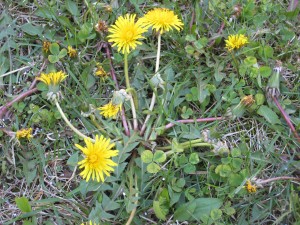 It’s important to apply weed & feed when weeds are actively growing. Applying weed & feed during the winter will have absolutely no effect on the lawn in the following spring and summer. You should spread weed & feed on damp/wet grass (use a sprinkler or apply just after rain) so that the granules stick better to the leafy portions of the weeds.
You should also pick a time when no additional rain is expected for two days, and you should avoid watering your lawn over this period. This allows time for the herbicide to absorb into the leaves. If it does rain or the lawn gets drenched, it will wash the granules off the leaves. In this case, however, you cannot re-apply the chemical immediately because you will over-feed the lawn and potentially cause a chemical scorch.
How to Spread Weed & Feed
There are a few important details to remember when spreading weed & feed. Keep all of these in mind when planning the job to achieve the best results. Note that these tips are not intended to replace manufacturers instructions, though you will find most manufacturers will recommend some variation of these tips.
- Make sure your lawn is a normal height (not too tall, not too short) – approximately 3-5 inches is good.
- Wait 2-4 days after mowing before applying. This protects your grass and helps ensure the weeds are actively growing. It also allows some of the leaves on the weeds to grow that may have been cut during mowing.
- Don’t water the lawn for two-four days after application. (Which means you shouldn’t apply the granules during a dry / hot spell). This is another important difference between broadleaf weed control and applying crabgrass preventer.
- Be careful not to apply too much product as this will scorch your lawn. Check the manufacturer’s guidelines. Scorching occurs when you over-saturate the soil with the feeding chemical.
- Only apply weed & feed twice per year. Over-application can result in run off that is harmful to the local environment, such as nearby rivers, bays, or lakes/ponds. The feed portion of the chemical is actually more dangerous in these areas as it can encourage algae blooms which choke out fish and native plants.
- Be sure to spread the herbicide uniformly across the lawn for best results. You may choose to use a broadcast spreader and make two passes at half-application strength, rather than trying to spread at full strength in the first pass.
- Avoid spreading granules onto flowers, vegetables, and ornamental shrubbery. It will kill most broad leaf plants, regardless of whether you consider them weeds. If you must spread near a garden, either use a drop spreader or consider laying plastic temporarily over the area near where you will be spreading.
Planting Grass or Aerating after Weed & Feed
Weed & Feed prevents seed germination, so you should avoid planting new grass or aerating your lawn for at least four weeks. We recommend waiting longer, though. If you weed & feed in the spring and summer, spread grass seed and aerate in the fall each year.
Reasons Weed & Feed Didn’t Work
Here are some common reasons that weed & feed was ineffective:
- Weed & feed targets broadleaf weeds like dandelions, and dollarweeds. It does nothing for crabgrass and other grassy weeds. For these, you should use a crabgrass preventer in early spring. Make sure your weeds are on the list that the chemical targets.
- Mature weeds are not actively growing, so the product wasn’t as effective. Weed & feed should be applied early in the growing season and a couple days after mowing.
- Rain and sprinklers can wash away the granules. Make sure there is no rain in the forecast and avoid watering for two days after applying.
What if You Apply Too Much Weed & Feed?
The best way to avoid damaging your lawn is the flush out the weed & feed. Water your lawn with 1 to 2 inches of water for about 4 days. Don’t apply any other weed & feed until the following year.
Unfortunately, over watering like this can create run-off in certain drainage situations, so try to avoid the situation in the first place.
Safety Considerations & Pets
Like every lawn chemical, standard precautions should be followed before applying weed and feed or any herbicide to your lawn. These safety instructions are NO substitute for manufacturers guidelines. Be sure to read the safety instructions on the bag and follow them.
- Wear long pants and long sleeves and gloves during application. Herbicides like Dicamba, 2,4-D, and MCPP can cause serious skin irritation.
- Avoid contact with eyes. If you get the dust of the product in your eyes, flush them for 15 minutes with water.
- Never ingest the product, leave the product where a child could ingest it, or leave it open for pets. Weed and feed chemicals can be harmful or fatal if swallowed. If swallowed, you should call 911 or a poison control center immediately.
- Keep pets and children off the lawn until after the first drenching rain after application. Visually inspect the lawn to ensure the granules are completely dissolved.
Professional Lawn Service
Professional lawn care services will provide experienced and knowledgeable staff that will manage every aspect of your lawn. They will address pH imbalances, conduct soil test, proper watering and spur new grass growth. You can find a local expert through services like ServiceMagic, or you could contact TruGreen or another service near you.
What do you think? Do you put down weed & feed?










how do you rate scotts 4 step program
jimr
Scotts 4 step program is good : Weed & Feed( Turf Building/2x yr., Seperate Crabgrass treatment and other additional weeds that the W&F doesn’t Kill..
Creeping Charlie is another Issue, I use Ortho-Weed-B-Gone Concentrate in the Fall for my CC..in a 1 qtr Spray Bottle . If have alot? Use a 1 Gal Sprayer.. It may take a couple of YRS to get rid of most if not all of it..
FYI- I use Weed and Feed 2x a yr.. Early Spring for the 1st wave of Dandeliens and again in July for the 2nd wave.. I time it when its going to rain.. . If have any left over? I spread a Lite treatment in late Fall..
Around Bushes, Veggies, Flowers? Simple 50% Vinegar and Water spray!
Gravel Driveway? Spry with Weed B-Gone In early Spring and again in Mid Summer…. Don’t wait till the weeds come up in the driveway.. If you do? Kill them and then have to Rake them up ..If Have alot of Weeds In Driveway? Hire someone to Grade it and then Spray it afterwards. and Every Month thereafter 1st Year..
Can use 50/50 Vinegar and Water and 1oz. of soap Detergant in 1 gal Sprayer… .Is more Enviormentally safer if On Well Water But will take More Treaments..
I also Use Weed & Feed on my neighbors Lawns if they don’t do it? I have summer Home owners and they do very little to their lawns.. I treat them in the Fall ( after they leave for the season) …to Reduce my getting their Weeds blowing over into my yard..in the Spring.. Cost me $10 in extra W&F & 5 min for each lawn, but worth it. to me.. They, In turn will Mow my Lawn for me 2x a yr.., when we go away on camping trips..
Hope some of this helps others !
Outstanding commentary- THANK YOU!
I have a dilemma: Instructions say to apply weed and feed a couple of days before rainfall, and then to not let your pets on the lawn until after the first drenching rain. How am I supposed to keep my dogs off the lawn for 2+ days?
Did you really ask that question? Would you go sit in the middle of your yard after weed and feed? How would you stay out of the yard? Use some common sense.
Maybe you could divide your lawn into 2 different areas i.e. front and back and do them at different times. If the “drenching rain†is taking too long to come then use the sprinkler instead. Or alternatively plan a camping trip with your dogs right after doing your lawn.
Thanks for the tips. I always thought I had to water the lawn as soon as I was done applying the weed and feed.
Yeah, that us what my neighbor thought, too, who has been doing mine a and never killing any weeds. I did it once, the right way, and the died out so well that I was able to take a heavy metal take and take out huge chunks of dead weeds. It looked good sheng the lawn filled in, but then gets windy in Sacramento and back come the dandy lions. He is very nice to help me as I just had surgery, but he mowed, put out the weed and feed and stuck the sprinkler on. It won’t kill the weeds and hopefully it will feed something! I ALWAYS READ directions, even if I think I know.
I didn’t realize that mature weeds aren’t effected by weed killer. That’s good to know.
Is it too late to use weed and feed? How can I kill grassburrs?
Hi Joyce,
Weed & Feed will target specific broadlead weeds and should be applied during the active growing cycle. Check the bag to see what weeds it will target.
Grassburrs are a grassy weed (not broadleaf) and you should apply pre-emergent to help get rid of them. Put down pre-emergent when the soil temp reaches about 50 degress. There are post-emergent herbicides (MSMA or DSMA) and these work best on immature grassburr plants.
Good luck!
I had a young man spread weed and feed yesterday on my backyard. He said I should use my sprinkler system in the everning which I did. ‘
Also I have a dog and he said not to let the dog out. I forgot to ask him how long that should be. I used the sprinkler yesterday and I let the dog out this morning.
Since then she is acting differently…laying around and hiding, wimpering. Is it possible that she’s been poisoned? If so, what should I do, short of taking her to a vet. It’s Sunday and I’m not sure I can get hold of the Vet.
Please answer quickly.
Lou, We are far from qualified to give you advise about your dog. I would definitely call a vet. Get a list of the active and inactive ingredients as both can be harmful. Hope your dog is OK!
Your dog is acting funny cuz he thinks you are acting funny.
Minimum 72 hours personally I would wait a full week 7 days before I would put any kind of domestic pet out their .
Ethan this is for you as well
I had a baby Yorkie that walked on the neighbors freshly fertilized lawn and it was dead the next day. Please be careful with pets.
Same thing happened to my grand daughter …. bloody weed and feed!!!
Clint, surely you have better things to do than troll people on this thread. Please grow up and go away.
Thanks… and what about my pets with this product?
I recently had a man to seed my yard now the weeds is taking over the grass that is coming up. What should i do my yard looks a mess.
But a new house
Clint, surely you have better things to do than troll people on this thread. Please grow up and go away.
Anna, thank you for addressing the problem of trolling. This is the most constructive response I’ve yet seen anywhere.
I would like an answer to this question. Fescue seeds planted two weeks ago and weeds are growing along with grass. When is it safe on grass and seedlings to use a weed and feed?
I am planning to apply weed and feed to my lawn, but the lawn appears to have a good bit of thatch. Is it OK to de-thatch the lawn before I apply the weed and feed? Thanks!
@Jerrad, Some thatch is a good thing. It helps prevent weeds from taking hold and locks in moisture. With that said, you want less than 1/2″ of thatch. If you have more, you should aerate your lawn. There’s no reason to wait in between aerating and applying weed and feed.
Can you use Weed n Feed on vegetables?
Hi Donna, Weed & Feed will kill vegetables. Don’t use it on your garden or flowers.
If used in your vegetable garden, how long shoud you wait before re-planting?
i just resod my lawn 5/1/11. When should I use weed and feed on new lawn or should it be used at all?
Hi Tonya, A newly sodded lawn is still very “fragile” and applying W&F before it has established roots is a bad idea. In my opinion, wait till the fall at the earliest.
Will the weed and feed help repair the grass that has been destroyed by my female dog’s urine?
No you have to clean it out and start over
Cheap beer poured onto those burned spots should also help. My mom would only let my dog off the deck which resulted in a large burn spot. I added some Pabst Blue Ribbon beer threw down seeds and it grew back nice. Less work.
OMG – don’t waste beer!!!!
Probably the best use of PBR to be honest
I can’t speak for refilling the space, maybe rake it up amd replant with starter seed, but for the dog, add ketchup to their food, regularly, it will change the pH of their urine, and not burn up your grass nearly as much!
Ralph, how much ketchup? I have 4 large German Shepherds and this is an ongoing problem with the grass in our backyard. They range in weight from 70 lbs. to 115 lbs.
Hi Marsha, forget the ketchup, you cant safely change the ph of a dog’s pee by altering its diet. The grass gets burned by the high nitrogen content in urine. A little nitrogen is a good fertilizer, too much nitrogen burns. Best fix is to pour a gallon or more of plain water on it when your dog pees. This will dilute the urine enough so it won’t burn your lawn. I know that’s not the answer anyone wants, but it is safe and will work. Don’t feed your dog ketchup… it has a ton of sugar in it… if everyone keeps feeding their dog stuff with sugar in it, our dogs will be the next species succumbing to diabetes. Check the ingredients in dog treats… SUGAR!
i may have overseeded a little on my lawn…maybe an overlap in a few places….should I just keep watering??
Watering those areas is a good idea. If the grass doesn’t look burnt in a few days you may have lucked out. Another good idea is to mow you lawn and bag the clippings to try and remove some of the product.
My newly(5-1-ll) seeded lawn is looking good where the grass is coming up(70% of intended area). unfortunately, weeds are taking over elsewhere. I’ve had a bag of weed n feed waiting to apply. Too fragile at this time(6-20-11) for the new grass sprouts to weed’n’feed? I’ve cut the lawn twice, bagging the weeds and grass. Another part of the situation is that I put down Schultz 10-10-10 fertilizer with the seed 5-1-11. Too early for the 25-0-08 Estate/Viper for that reason, too? This is a remake of a formerly uncared-for(15 years) 9000 square foot backyard which I cleared by hand over the winter and spring, then ‘Roundup-ed’ 4-10-11 before the 5-1-11 seeding/fertilizer.
How do I get rid of brown spots?
Hi Jesse, We’ve got an extensive article on watering your lawn. That might be a good place to start.
I have the same problem with brown spots. My wife just washes my underwear in hot water, tide, and a little bleach. My recurrent problem with brown spots eventually led me to changing to boxer briefs. Good luck!
You are f’ing weird, John
I put down weed and feed yesterday with no rain in forcast a 16-4-8 with Atrazine. It raind 9 hours later. Where do I go from here? Thanks ahead of time for for any help or suggstions.
wish I would have read this first. just applied wee&Feed Your advice is very helpful I will definetly bookmark it.
Very good tips and discussion. This will help me a lot as I try to reclaim our yard for the grass this spring!
Some good info here.
I actually opted to put down weed and feed first instead of the crabgrass killer since there does not seem to be much, if any crabgrass action on my lawn. Also, I misread the bag for the spreader settings and actually set it to about half of what it was supposed to be (I set it at 3 when it was supposed to be 5 3/4). Is it alright if I do another run through my yard with a lower setting since I didn’t really put down the full amount to begin with? It was about a week ago.
Thanks!
Hey Sean,
If the weed-n-feed is being effective, you’ll start to seed broadleaf weeds (like dandelions) turn brown in a few days. If that happens, I’d hold off on another application. You don’t want to over-apply and scorch your lawn. If you don’t see any improvement, I’d suggest a regular strength application in about a week.
Remember, I’m not a professional, so these tips are just coming from another homeowner (who wants a sweet looking lawn too). We’re getting ready to start a new series about a lawn service, and hopefully we can address questions like these.
Thanks for your quick reply and information. I’ll take note and go from there.
What happens if you put weed & feed on bermuda grass, and wanted to use up all the bag so you went back over places again? I see some of the broadleaf weeds starting to die. Some of the grass in some places may be turning brown. Bermuda usually revives itself doesn’t it if it is scorched right?
Should I spread weed and feed when there’s still dew on the leaves or should I wait until the lawn is totally dry?
Drew apply when wet either morning dew or wet the lawn manually
First timer and having no clue. I have watered my lawn two days in a row after I have applied weed & feed. Am I done for the year or what can I do?
Well, you’re probably in pretty good shape for the near term. You can apply Scotts weed and feed twice per year, I think (see the bag for directions). Hopefully you let the granules sit on the weeds for 24 hours before watering. That’s how weed and feed works (absorbed through the leaves).
What will weed and feed do to clover.
It will kill it…2-4d, dicamba, all those types of weed killers that are in weed and feeds also kill clover.
Will 18-0-9 weed and feed kill lespedzia which is a japanese clover. I love Lesco fertilizer as i use the 15-0-15 every season. I also would like to know is it safe on my centipede grass. THANK YOU
do you have to water after you use weed and feed?
No. In fact, you shouldn’t water for at least 48 hours. See watering instructions above. You should actually water immediately before weed and feed application, and then hold off for 48 hours afterwards. The granules have to sit on the leaves of the weeds to be an effective weed killer.
I just seeded my lawn, how long should I wait to weed and feed it??
Wait about 6 weeks after seeding. Water the seed/grass daily and make sure it gets reasonably strong before treating it with any type of fertilizer. Don’t overdo it. It’s easy to scorch new grass.
Can I distribute weed n feed over my lawn using a dust pan (& wearing gloves)? I dont have a seed spreader. I have a small yard. Thanks.
No, because you won’t get it even and you may end up burning areas of the lawn. Get a spreader, or borrow one?
I also have a small lawn. Ive been hand sowing mine for over 15 years, and i have a nice looking lawn. I don’t use anything except my hands.
Hand sowing allows me to drop extra granules directly on those tough dandelion weeds.
Same here. It is like feeding chickens. I could never walk fast enough with a spreader to do it right anyway. The older age thing.
how long should i wait between weed and feed applications?
Yes, I get many weeds, spurge, which I hate, burr weeds and of course dandelions. Then there are tons of what I can only describe as swamp looking grass. Uia more and a few days later there are all these things sticking up about 8″long with tips that look like a row of seed pods. The actual weed is round and flat. I killed them all once spraying every one with round up and applying weed and feed to the whole lawn. They pulled out nicelyafter that but came back with a vengeance the next year. How do I get rid of em?
How long to wait after spreading weed and feed, before you water it in???
You said hopefully 24 hours in your april 2nd reply, and 48 hours in your april 16th reply… Which is best? I spread mine yesterday, so I need to know now.
I applied Weed and feed 5 days ago, watered it on day 4, now it is suppose to rain for a week, should I mow now or wait until after the rain ( a week more?) also, should I mulch or mow?
I put down crabgrass preventer on Friday and want to put weed and feed down on the next Sunday, 9 days later. Is that okay?
@ Debbie- Make sure the crabgrass preventer didn’t contain fertilizer, or you might ” burn ” the grass. Anyone out there have proven suggestions for getting rid of Creeping Charlie in the spring or summer WITHOUT killing grass?
I always learn something new from you guys. Thanks and keep up the great work!
I just mowed the lawn and then spread weed n feed and then soaked the grass hand watering the entire lawn. I was told to do this! Now I’m laying in bed looked this up and I now found out I’ve done it all wrong! What should I do?? Weed n feed it again tomorrow since I soaked the grass??
I used weed and feed in the front lawn and in the back. Reading how it is not safe for pets I was concerned.I never used it before so am nervous about my dog going out there. It’s been like 20 hrs since I applied it. Let my dog out this morning and immediately washed her off in a small tub to be sure there was no chemical on her. Then thought that I was to spray the back lawn so the w and feed would soak in. Did I do the wrong thing soaking it in?
I did that too…. now the bastard weeds are growing like they have been injected with a growth hormone!!!
Can liquid be put on right after cutting lawn?
weed n feed that is.
There are so many different variations of weed & feed, example (28-0-04). What do the numbers stand for and what is your recommended variation?
My spreader gadget has its valves stuck open, so I had a few piles of weed & feed spilled on my lawn. I scooped and scraped and kicked and wiped, using hands and a rake and stuff. Not good enough! I exchanged my weeds for a few big brown spots! I could have watered it but that’d have spread and diluted the product, so maybe I should have brought out the shop vac! 😉
It soon rained hard for days, but I guess it was too late. The stuff works but it’s no joke!
I worked as a landscape contractor for quite a few years and I’d like to suggest the following.
First, set your mower as high as it will go. The grass plant will be healthier and will generally shade out lower growing weeds. The grass plant will grow more slowly and thus require less mowing. Cutting short will cause the plant to grow faster (its trying to eat – photosynthesis requires leaf surface to happen). Lower height encourages weed growth as it allows sunlight to reach the weeds. As a rule, never remove more that 1/3 of the grass plant – 1/2 if its really out of control.
To treat for broad-leaf weeds, set the mower lower (don’t scalp it!) for one cut, cut the grass, then the next morning while the dew is still on the leaves, apply the dry granular weed control. Allow the grass to return to it’s normal height. The broad-leaf weeds should melt off.
For grass weeds such as crab grass, goose grass, etc. You need to apply a control product that prevents weed seed from germinating – usually referred to as a per-emergent. These are usually sold as part of a fertilizer mix (such as weed and feed) and that is not the way you want to go. Find one that does not include fertilizer and apply per directions. These control products have to go down before the seeds germinate! Don’t expect to be able to apply them in June and have the work – they won’t. Timing is everything. Read the directions and follow them.
Fertilizer should always be a separate application and should be tailored to the grass type and geographic area. Here in the transition zone the grass is usually Fescue. Fescues are low fertility grasses that should generally not be fertilized in the spring. There are exceptions but, they should be driven by soil tests, not commercials. Fescue lawns should usually receive no fertilizers in the spring and about half what is recommended on fertilizer bags in the fall to push root growth. On the other hand, blue grass is a high fertility lawn and requires quite a bit more fertilizer to do well.
Finally – use your local Cooperative Extension Service. Google it as in: “Maryland Cooperative Extension Service”. These guys are the experts and they will provide you – the home owner – with an incredible level of service for free or next to free that is specific to your area. Use them if you really want to grow something whether it’s a lawn or a garden.
Tim…
Ditto- Tim-For sharing oyur Experience
But, most Want ot Cut their Grass Short because they’re LAXY- LIke getting a Short Hair Cut to save Money having to cut it so often ( Ave $15-$20 per HC)
A Trimming method is they way to go of Have both your hair and Lawn look nice and Healthy and igve it that Professional Manicured look
I Mo my lanw/Trim it ave 6x a month in Spring and 2x mo in Summer
And let it grow Thick for the Summer and keep it that way
When I do Mow_ I carry a Hand Spade to dig up weeds and put in a reg. Grocery Plastic Bag I carry with me….I watch others taht are just plain Lazy and just cut it short and fast and they wonder why its full of Weeds, Creeping Charlie etc..
Be Nice if Landscapers would Let you hire them ot cut your grass EOW- Every Other Week and Also Dig up Andy weeds with a hand spade at the same time -but they won’t.. They want a Full 30 wk contract to make More $.. even offering them to pay them 50% more to cut it EOW.. Won’t do it ! So I tell them Screw U and tell them to Leave ! and Go Con someone else !
I just aerated my lawn. I usually weed and feed in fall and spring. Your instructions say wait 4 weeks before aeration after application. Should I wait 4 weeks before I use weed and feed since I just aerated?
Just applied weed and feed this morning. I set my spreader at the recommended number. The bag was to go 15000 square feet, but did not go nearly that amount. I’m afraid the spreader was spreading too much. I may end up scorching the lawn if too much was applied. What is your recommendation if there may be too much applied. I don’t want to waste the product either if I start watering the heck out of it . On the other hand, I may end up with a damaged lawn.
I bought the weed and feed…….but i cant find my spreader recommendation setting on the bag…..i have an Earthway rotary spreader…….the bag had a rotary spreader setting listed on it but it was 3.5……my spreader doesnt have that setting….first setting is a 5………..
What do I do. My husband spread the weed and feed all over my floor beds.
Many plants are looking like they will die. What can I do?
Nothing start over you have to be extremely careful with any kind of chemicals
I had a yard guy that started doing that to my flowers(he got successful after a few years and started rushing/cutting corners)… upon the advice of a local garden center, I’d water the flowers when ever I suspected my yard guy had gotten them with the weed spray. I was able to save 75% of my flowers from him before I had to say adios after 5 years.
If you can get the flowers soon enough the killer will have less impact – it’s easier to try to water it out then buy all new perennials. If the yard is such that you need to use weed killer I’d recommend put covers on the plants – I use painting drop clothes or my frost plant covers
Will bio weed and feed 9-0-0 hurt the trees, or can I spread close to them or on them?
Will weed and feed effect the paint on the car?
It killed my plants and the yucca are dead! The weeds are growing great!! What’s wrong with this?
We have St Augustine grass that is now getting a lot of weeds. What weed killer is best for St Augustine grass and can it be applied in August?
Hi,
Ive got heaps of clover on my lawn and I bought a feed n weed. My question is, do I need to mow the lawn first , then apply the feed n weed? Or do I have to wait a few days after I mow the lawn then apply the feed n weed,?
Thanks..
Will weed and feed kill monkey/mondo grass?
We put Weed and Feed down yesterday. However we also have crabgrass when should we put down crabgrass preventer?
Do I have to keep my dogs off the lawn for two days after I put down some weed and feed? I know I have to wait a day or so before I can water it
If dandelions are actively flowering is it best to pick flowers before applying weed and feed?
It’s my luck that I weed and feed every year. I try all the advice. You know how to spread, when to water, right time of season… I think everytime I go get a new bag it says feed the weeds. I think I am ready to give up . If I finally get it right it’ll kill all the weeds and I won’t have a blade of grass. I guess maybe I don’t have a green thumb.
How long after applying weed & feed do I wait to mow? Thank you
I put down weed and feed just after dawn about a week and half ago. It seemed to have killed some weeds, but not all. Can I apply again sometime this week?
I just used a 17-17-17 fertilizer on newly planted grass been cut 5 times. I have alot of weeds but grass looks pretty good. Can I still apply weed and feed although I just fertilized? I really want those weeds gone and there the type that weed and feed would kill. Or should I wait or is there another option . It’s quite a large lawn by the way. Thanks!
So after application on wet grass, it has not rained for 5 days and I am ready to mow. Should I water it in before I mow to avoid the risk of the granuals being sucked up off of the lawn?
This schedule works for me
Day 1 – Mow lawn like normal
Day 2 – Water lawn if it has been dry
Day 3 – Apply to wet grass – no rain in forecast
Day 4 – See dand. and plantain wilt
Day 5 – See clover wilt
Day 6 – Water deep
Day 7 – Re-apply to spots that were missed
hi, I would like to know that my grass is only 6weak old and had lots weed in there so can I use weed and feed or it’s to early because grass is not too old?
How much feed and weed do i add per litre? I
Is it ok to put down fescue and fertilizer on the same day and water them in?
I put down weed n feed 7 days ago. I did not realize my sprinklers are not turning on…needed a new pump and am still waiting for the electrician to finish the job. Is the weed n feed still going to work? It has not rained, I’m in FL and it’s been in the 80’s. Thanks for any info!
I have some actually lots of blue violet weeds, will the weed and feed kill them if I apply them now. I know I am a little late as it is already spring. Or should I get a specialist to come in and do it.
I am in NY and keen to get some guidance.
Rgds
Do you have a resource for identifying weeds? We are new to the state of MO and the region and I’ve got a tall, single blade grass with crazy active rhizomes. I’ve tried digging them up, I know, those optimists! Any thoughts on what it could be?
I don’t mow my lawn for the grass, but for weeds as do all of my neighbors.
It’s the second week of June, HOT and MUGGY. is it too late to apply weed & feed? should it be done in the morning after a watering or when would be the best time?
Is raking before/after recommended or does it even come into play?
I am not using weed killer from this point. I feel that it stays in the soil for much longer than we know, thus preventing premium grass growth. I will just feed the lawn well before seeding. My aim is to crowd out the weeds with healthy grass, putting time in each week to manually keep ahead of the weeds.
The only grass I have is where my dog does her potty business. I work, so she has to be able to get to it while I’m gone. Do I need to board her for the two days after I apply the Weed and Feed, before I water, then bring her home?
Bought 30 0 3 have crab grass and clover in Wisconsin think I should apply now do to white clover and crabgrass??? Well established lawn
Hi`i`m in Florida, can i use weed and feed for Lawns in my Vegetable Garden
Good lord, no. Unless all.you want in your garden is grass……
Weed and feed is a broadcast weed KILLER. Meaning generally, anything with a leaf unlike grass is fair game.
You don’t want toxins like “weed control” in your garden.
Fertilizer only and corn meal based pre-emergant is the only thing that should even come close to your garden.
And the pre-emergant can ONLY be used AFTER your vegie seeds themselves have germinated.
For fertilizer, I use a bulk granular that dissolves in water. I have a designated 40 gallon plastic trash can I mix up and drench the rows and the plants using a 5 gallon pail and/or a large coffee can.
You can side dress plants with granular as well.
Mulch, landscape fabric, new paper, grass clippings, straw…..etc can be used to keep aisles and around plants weed free.(with in reason) but gardening is a hobby, experimenting is half the fun. See what works for you!
The directions on my bag of Bonus S weed and feed state that it should be applied when lawn is dry and that you should water the product in after application. Did they change the product? Any thoughts on why the manufacturers rec is so different. Thanks. ch
What time of day do you apply weed and feed
My sister gave me a ziplock bag of weed and feed. Sheesh. Wish I’d read this first. So I sprinkled weed n feed on my yard by hand. So far it’s just dirt and weeds. I haven’t planted grass as of yet. So my dirt was dry upon application. And still is dry. Should I just rake it all again and try to scrap the weed n feed? I can still see all the granules. I really want to plant grass soon. Any tips for planting grass? Thank you for your great advice. Much appreciated!!