


Welcome back to our Pro-Follow with professional contractor Steve Wartman as he and his crew remodel a master bathroom. Last time we left off, the guys had just finished gutting the bathroom, removing the old vanity, toilet, tile and tub. If you missed it, here’s coverage from Day 1:
- Day 1: Bathroom Demolition
We’re always working to bring you more Pro-Follows, and other high-quality tutorials. If you enjoy home improvement and learning from professional contractors, take a moment and become an email or RSS subscriber.
As I catch up with Steve and his crew, the plumber and electrician have been through and completed their rough-in work. Here’s how the bathroom looked at the end of Day 1.
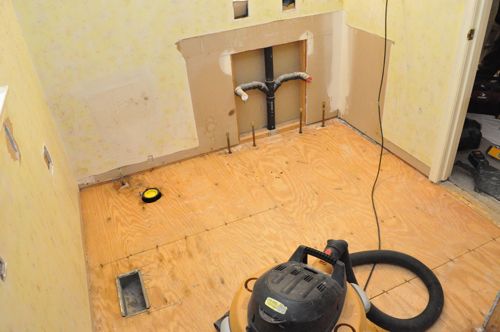
Step 8: Plumbing Rough-in
The previous vanity had a double sink, and the homeowners have decided to go with a single sink. Therefore, the plumber eliminated one set (hot, cold, drain) and centered the other set.
Pro-Tip: Most sink drains are roughed-in at 19″ off the floor.
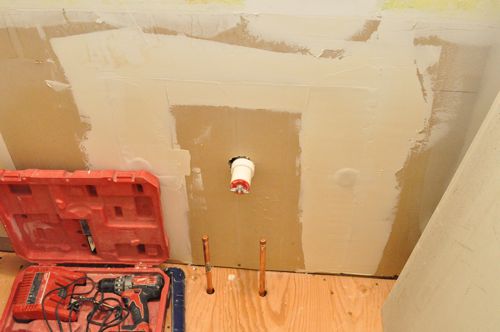
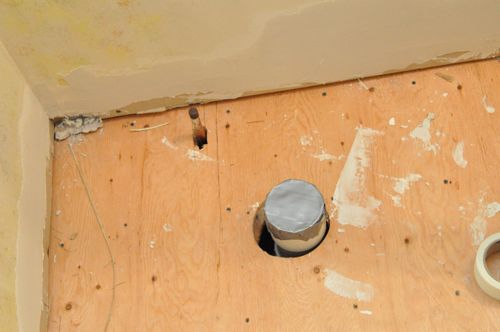
The plumber also removed the old toilet flange and extended the sewer line. After the new floor is installed, the plumber will add a new flange. You can also see he removed the SharkBite end caps in favor of soldered end caps.
Tip: If you’re looking for more information on soldering copper pipe, check out Fred’s tutorial available at that link.
The guys will be installing grab bars 33 – 36″ off the floor so they’ve added blocking in between the studs.
Pro-Tip: The ADA provides specific requirements for grab bars including the size, location and spacing. To read all the specifications on grab bars, read section 609 from the 2005 standards for buildings and facilities.
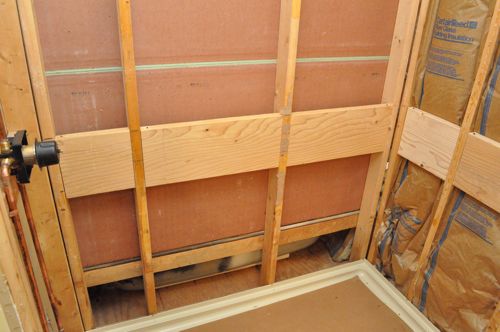
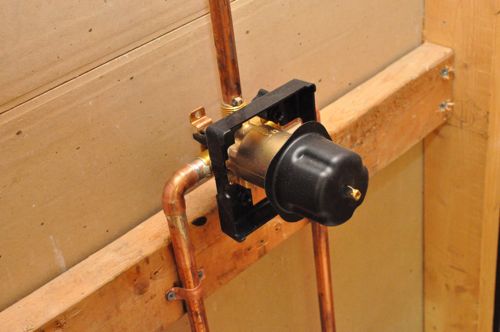
Here’s the rough-in for the shower controls. The plumber was able to preserve the shut-off valves for the hot and cold supply, and he replaced the shower-head line.
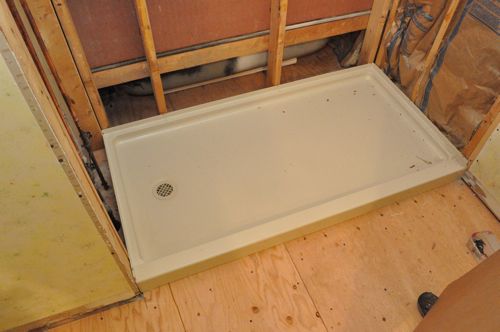
The plumber installed a new shower pan, modifying the drain line to keep everything aligned.

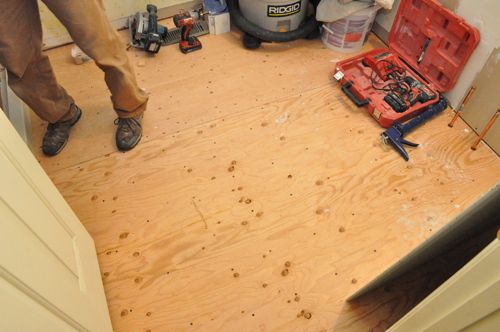
If you recall from Day 1, Steve targets at least a 1″ subfloor to reduce deflection and provide a stable surface for tile. To achieve that thickness, the guys installed 3/8″ Fir CDX plywood over the existing 1/2″ subfloor, gluing and screwing it in place. They used Fir plywood because it features better water resistance and is less likely to swell or warp.
Pro-Tip: The letters “CDX” indicate the grade of plywood with “A” being the highest level (without knots, holes or defects). “C” and “D” refer to the front-side and back-side grade. “X” stands for exposure and indicates that the glues and adhesives used are water resistant. Even so, this plywood isn’t intended to withstand direct exposure over long periods of time.
Tip: You can Build Your Own Basic Plumber’s Tool Kit with tools available at most big box stores.
Step 9: Electric Rough-in
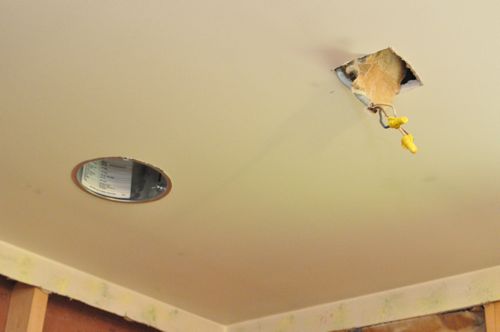
Steve and his crew are also moving the bathroom vent. Originally it was over the toilet and not pulling very much moisture from the room. To make the vent more effective, they’re repositioning it closer to the shower.
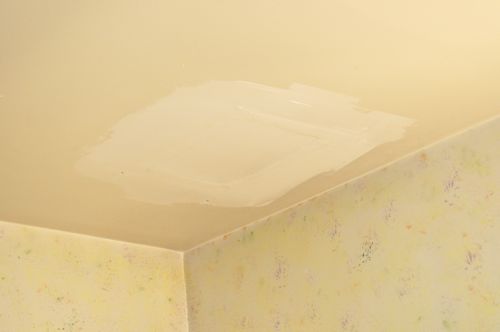
The electrician was able to re-route the existing power supply to the new location. He also installed a recessed light over the shower area.
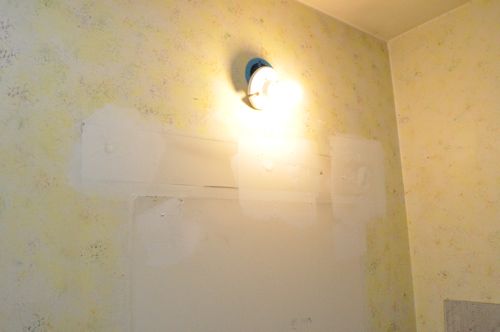
Lastly, the electrician removed the old light fixture and installed a new box higher up.
Step 10: Install Concrete Board
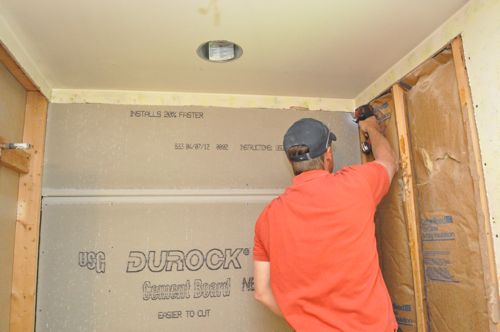
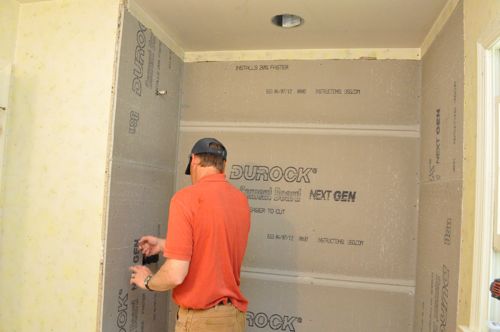
For the shower walls, Steve installed Durock concrete board which is moisture and mold resistant.  It also does not deteriorate in the presence of water, and that’s important because tile is not a complete waterproof barrier. Durock is preferable to regular concrete board because it’s much lighter making it easier to work with.
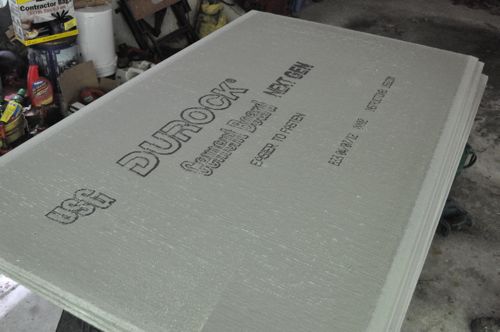
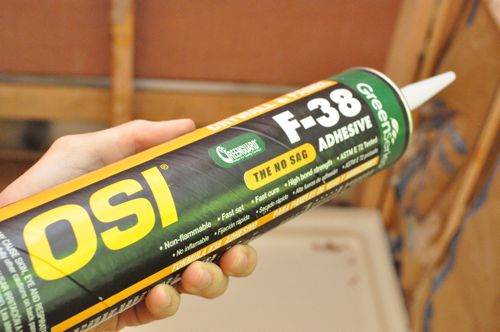
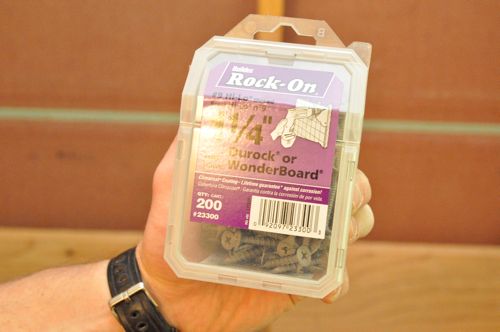
To secure the concrete board, Steve used 1-1/4″ concrete board screws and OSI adhesive.
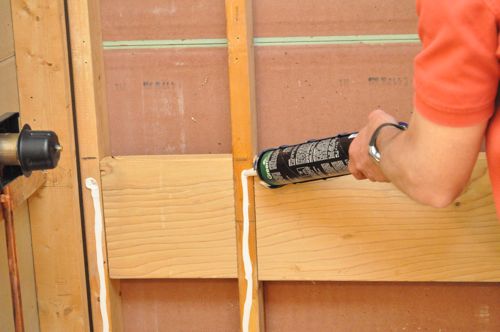
The Durock is commonly available in sizes 32″ x 5′ and 36″ x 5′. As you can see, they fit nicely across the width.
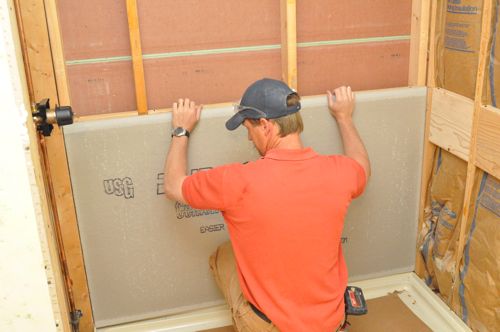
The bottom of the Durock is positioned so that it just meets the lip of the shower pan.


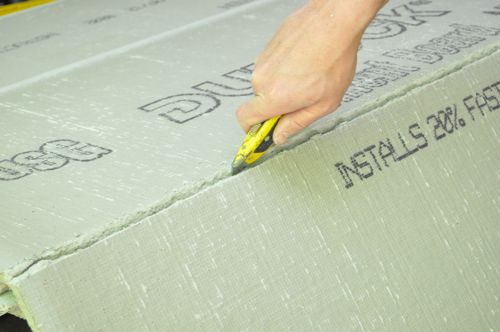
Cutting Durock is much like cutting drywall, and Steve started by scoring the Durock along a straightedge. With a little pressure, the board cracked along the cut.
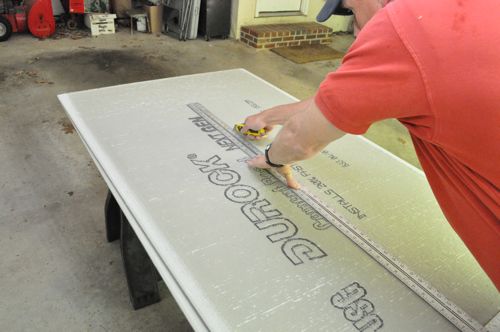
Next, he finished the cut, and used a rasp to clean the edge.

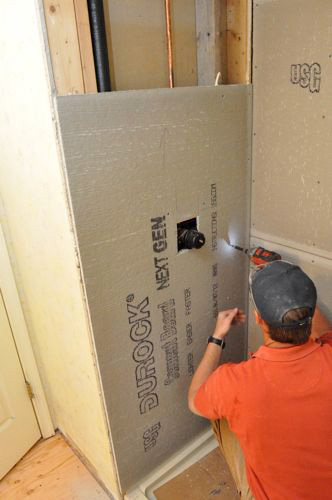
For the shower controls, Steve used a drywall saw to cut make the necessary cutout.

Steve paired all the factory edges together, putting the cut edges at the joint with the drywall.
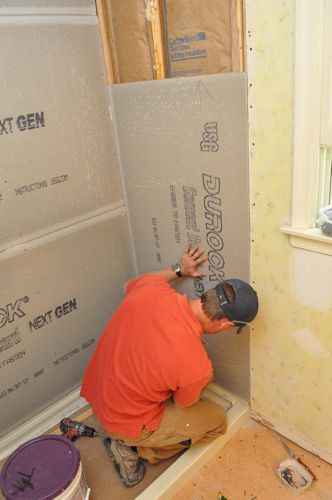
These joints will later be taped and covered with mortar.
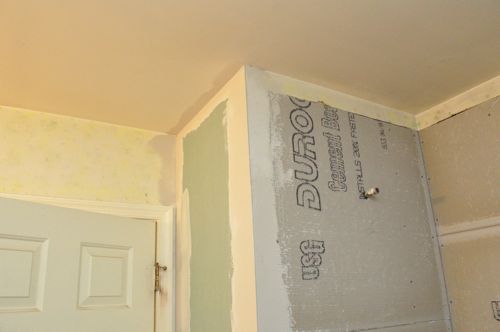
To give himself a better edge and to make it easier to tile the corner adjacent to the shower pan, Steve added a piece of greenboard. Greenboard has a water-resistant (not waterproof) paper covering, making it a better choice than drywall for moisture-rich environments like a bathroom. However, it should not be used in lieu of concrete board in the shower.
That’s it for today’s update. Look for details about moving the bathroom vent fan, and tiling the shower in the near future.










Is there any need for a membrane on the walls, or is the combination of concrete board and tile sufficiently water resistant?
Properly done concrete board and tile is all that you’ll need. I did a waterproof membrane in my bathroom as an added precaution. When I asked Steve about it, he said they have done waterproof membranes in the past. However, it’s not something they typically include.
Really?! He sees not waterproofing a shower OK? The wettest location in the house doesn’t deserve $15 worth of waterproofing to save the homeowner from having hidden mold issues in 15 years? A sheet of plastic or some tar paper is not expensive or hard to install under the cement board.
Cement board is NOT waterproof. The grout he used is NOT waterproof. What is behind the non-waterproof shower? Wood and paper covered drywall in a dark location…a perfect location for mold to grow!
I used that same delta universal rough-in in both of my recent bath renos. Takes a lot of heat to sweat that in but is a great product.
The only thing I do differently than Steve is to use my garage floor as the rasp. I’m sure he wouldn’t do that at a customers house but its a fast way to knock down all the high spots and make everything even.
This stopped being a DYI project when i saw this:
“Steve targets at least a 1″ subfloor to reduce deflection and provide a stable surface for tile. To achieve that thickness, the guys installed 3/8″ Fir CDX plywood over the existing 1/2″ subfloor, gluing and screwing it in place. ”
Too intimidating for me.
The nice thing about the subfloor is that it doesn’t have to be pretty. It really isn’t bad. I think the subfloor was the easiest and fastest step for me when I just went through this. Measure the space, cut plywood on the tablesaw, test fit. If it fits, put a little glue down and screw the crap out of it. It doesn’t need to fit tight. I left a quarter inch gap all the way around.
I can’t wait to see the before and after shots with this. The bathroom is looking good so far
Great this answered a lot of questions I had. We need to redo a bathroom here and having step by step info like this are great. I was thrilled when I seen you were doing a Bathroom remodel post.
Not really a question about doing these parts of the remodel but don’t know where else to put it on this site. Having trouble deciding on which toilet to buy and wondering if anybody can point me to good detailed reviews to check beyond Consumer Reports? Thanks…