


Walls and floors get all the attention, don’t they? We spend hours debating the color and finish of wall paint, whether we should lay ceramic tile or settle for carpet, and how to make sure our walls and floors complement our furniture to achieve the perfect look.  The result? Ceilings pretty much get ignored. Slap a coat of ceiling white on them and they’ll pretty much go with anything…
…unless the ceiling has flaws (perhaps because the ceiling strapping is incorrect or non-existant). Then we’ve got to think about it. A ceiling with a few imperfections can really detract from a room. No matter how perfect the design, a bad ceiling will draw the eye up and ruin the effect.
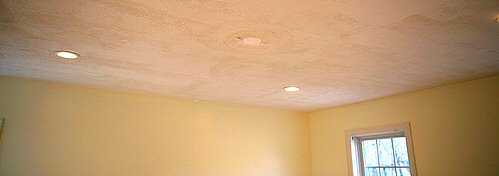
Fortunately, there are a few things you can do to take care of that ceiling and finish off your design.  Of course, as with any home improvement, the options range from very simple to are-you-sure-you-shouldn’t-hire-someone-for-this difficult. Here’s a few ideas to get you started on fixing that flawed ceiling to make the overall look fantastic.
Paint the Ceiling with a Flat White Ceiling Paint
Flat paint will go a long way to hide minor imperfections on a ceiling. Flat paints don’t reflect as much light as their glossier counterparts.  Since the eye sees imperfections in the ceiling because of the light reflected off of them, and flat paint reduces overall reflection, this dramatically reduces the visibility of small flaws.
Many paint manufacturers sell a ceiling paint as part of their line. “Ceiling” on the front of a paint can is a paint company code word for “cheap.” Ceiling paints tend to be thin and cover poorly (see our review of Walmart’s Colorplace Ceiling Paint).  They are manufactured with less pigment, and are usually sold at a discount. Most of the time, ceiling paint is ok for a typical application.  If a ceiling is already mostly white, a thin coat of flat ceiling paint will cover fine. If your ceiling is a non-white color, we suggest going with a regular flat wall paint to achieve the best coverage at a good price.
Install Recessed Lighting (Can Fixtures)
Recessed light fixtures sit above the plain of the ceiling. As a result, no direct light shines on the ceiling itself. Light reflected from the floor, walls, and furnishings in a room will still hit the ceiling, but the light will be diffused and widely distributed, eliminating shadows (and thus hiding imperfections).
Recessed lighting also has the visual effect of raising the ceiling because no physical fixture sits in the upper space of the room, drawing eyes to the walls and furniture instead of the ceiling. Recessed lighting can use CFLs to save energy; and, as an added bonus, recessed lighting is highly desirable in newer homes, and will likely pay for itself at the sale of your home.
Add Beams, a Medalion, Crown Molding and other Accents
Adding decorative beams to a room can hide flaws if the ceiling is sufficiently tall to accomodate these. Solid wood beams can be fastened to the ceiling at even intervals, or in another creative pattern. This breaks up the plain of the ceiling and reduces the visibility of flaws.
If the imperfection is isolated to an area around a lamp (for instance, an electrical fan box was installed in an unprofessional manner), a medalion could be a viable solution. In general, medalions should be sized just slightly larger than the diameter of the lamp that hangs below them, and painted with either the same flat paint as the ceiling, or a slightly off white accent color.
Crown molding and other accents offer another solution for some ceiling problems. If the imperfections are close to the corner of the wall and ceiling, crown molding is a perfect solution. Be careful choosing crown molding if the ceiling has imperfections that wouldn’t be covered by the crown itself. Crown molding will draw the eyes up to the ceiling, where any unhidden flaws will be quickly spotted.
Texture the Ceiling
While ceiling textures have fallen out of favor in modern design, one solution to a very bad drywall job is to stipple the ceiling with a drywall compound. Texture should be applied as subtely as possible, and should be coupled with other solutions in this article, particularly recessed lighting. Texture the ceiling only if you aren’t willing to do a complete ceiling replacement.
Replace the Ceiling Altogether
Obviously the most difficult option, replacing the ceiling is necessary when the flaws are so bad that they cannot be addressed by any other method. If you decide to replace the ceiling, be sure none of the products used to install the original ceiling contained asbestos. Many ceiling textures and some drywall compounds used between 1950-1980 contained asbestos.  Especially if you have a textured ceiling, it’s best to have the material tested before you tear it out and replace it.
What do you think? Have you used any of these methods to hide flaws in your ceiling? What other methods have you used to address ceiling imperfections?
Photo originally by juhansonin and cropped for use here.










Excellent advice on ceilings. Another approach if a ceiling is really bad is applying a layer of 3/8″ drywall over the existing ceiling. That way you don’t have to remove the old material and you can start with a fresh layer.
Another suggestion, on the higher cost and higher skill level set, is to put a tin ceiling up. This would work especially well in a kitchen, or in a historic house.
These are both great ideas. Thanks for contributing to the post — I’m going to update it with your ideas.
Good post – I can really relate being I have a lot of ceiling experience in my off line end of the business. An upstairs flood always seems to affect the ceiling and spare the walls. I wish that it was the other way around because the ceiling is the most difficult part of a room to work on – you are always fighting gravity. I do not recommend that the DIY homeowner attempt complete replacement unless they are very skilled. The compound dust from sheet rock especially from the ceiling can be very bad along with the difficulty of working overhead. One other technique that also takes some skill and I don’t recommend for a beginner is to have the ceiling skim coated. If the ceiling is strong enough to hold it, this is another option, but as I said takes some practice. Thanks for the post!
Sitting in our added- on family room, it’s easy to see that the builders in the past used the can lights and textured ceiling for a purpose! The crown molding suggestion for hiding imperfections looks to be a great idea, and would add character to this room. Add another project………
Thanks for the great advice. Our family room and living room ceilings show crack lines no matter how many time we have repaired them. In our case, it’s probably time to bring in a professional.
I recently had a skylight taken out, I hired a drywall man to put mud over the drywall wall the guy who took the skylight out put up. It is in my living room. He did a terrible job try to match the patter of the original ceiling. So, I hired another man that said he could do it, he said the pattern was called “chicken scratch” and he tried to blend the new with the old, well– he couldn’t, so I got up there with a bucket of water and a sanding sponge and and tried to smooth some of it out, and it doesn’t look that bad anymore. Now I am going to paint it with a flat off white paint. Would a light color paint, say blue or green work better than white?
I think flat white looks the best on ceilings having seen a few different options. I would say stick with the flat white.
I’m with Fred on this one. I had 3 skylights removed and had 2 drywallers try and fix the area. They both failed. On 2 area’s they are smooth and you can see the outline of the skylight and the 3rd is in my living room with a textured ceiling and it looks terrible cause neither one could match the texture. I have even tried a flat white paint, but it still looks bad. I am on a tight budget-any other suggestions that I can do my self? would be greatly appreciated.
How much would cost and who can I call to install drywall over my existing very bad ceiling?’
The room is huge because it has kitchen, Dining room and family room . I tried with different kind of paint, but I just wasted a lot of money.
I tried Patching a calcimine ceiling, I’m fairly skilled at general home repairs but this was a nightmare. After bubbling , peeling sanding , dust and swearing & waiting I finally had what I thought was a mirror finish. Painted with a flat calcimine “high hide†Benjamin Moore spec 300 white paint………I cringed . Even after it completely dried it looked like a goddamn roadmap. I want to die. Never ever attempt this. Get out the phone book. Call 50 to 100 people who do this for a living. Have them screw up 3/8 Sheetrock/ blue board and hire a plasterer. Only other way out is a textured finish.
Use a flexi pole sandpaper and get the ceiling reasonably good. Most people entering a room will hardly keep looking up at a ceiling; it’s only you will observe the blemishes , besides I think it’s a home first and all these little marks etc add character .
At least , this is my take and yes go for a matt finish.
A good idea though is to apply a sealer if some of the old paint that may contain the old distemper paint or other products that may cause the new paint to flake.