


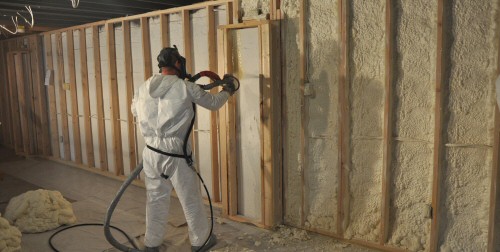
 Several years ago we wrote a whole series on installing spray foam insulation in our basement. As part of the research for that project, we compared a variety of basement insulation options, including closed cell spray foam, rigid foam board insulation, cellulose, and the staple of most homes — fiberglass batts.
Insulation options are generally compared by “R-value”, which is a measure of heat transfer. R-value is always proportional to the thickness of the insulation, usually as described in inches. For example, most closed cell spray foams provide between R6-R7 per inch. Traditional fiberglass offers R3.5-R4 per inch (and hence, why the traditional 3.5 inch batts installed in walls are R13).
The problem with R-value is that it measures heat transfer in a perfect installation. This perfect scenario would provide no way for air (or heat) to move around the insulation to penetrate the conditioned space.
Obviously, the problem with measuring heat transfer in a perfect installation is that it ignores the reality that heat can move around the insulation in an imperfect installation. This can create a huge difference in performance, especially for a material like fiberglass which is extremely porous and therefore difficult to completely air seal. If a fairly heavy draft is coming through an exterior wall, it is likely it will find a way to get around fiberglass.
Closed cell foam, on the other hand, completely shuts off air transfer, which eliminates drafts moving through the insulation. For heat to move around in closed cell foam, it literally has to move from one sealed “cell” to the next – an extremely inefficient process. And when it comes to insulation, you want heat transfer to be as inefficient as possible.
Our experience with closed cell foam is that it insulates so well, you would have to install 1.5x – 2x the amount of fiberglass to achieve the same “real” insulating properties as the foam. In other words, R13 of closed cell foam performs similarly to R20-26 of fiberglass. This isn’t going to be universally true, especially if the fiberglass is installed properly.
However, it’s not completely fallacious either. Take the example of insulating a rim joist. In this situation, you have many difficult angles that must be completely sealed from air penetration. Air flow is a particularly acute problem in the rim joist, especially for a first floor, because the joist is often sitting on top of a sill plate which is on top of (imperfect) masonry work. The air penetration at this point can be a substantial factor in heat loss.
The same situation applies in an attic when comparing rolled-out fiberglass batts to additional blow-in insulation. Blow-in insulation is better at covering the floor, which eliminates spots that foster convection. If you want an even better performance improvement, closed cell foam in an attic prevents heat radiating from the ceiling of the house from creating air flows in the insulation, a problem that exists with fiberglass or cellulose installations.
As you can see, R-values can be very deceiving, so it is worth investigating further and asking your insulation installer a lot of questions about how radiant and convective heat transfer will be minimized in the installation.










If money is a factor, one can always put down closed cell and then fill the rest of the wall cavity with unfaced batting. It would be cheaper than filling the whole cavity with foam.
Jeff – you raise a good point and this is becoming more popular. Folks need to remember, though, that if you are relying on the closed cell foam for its vapor barrier properties, many foams require at least 1.5 inches to be considered a sufficient vapor barrier. If you have 2×6 studs, you can do 1.5 inches of closed cell and put R13 batts behind it for an extremely good envelope.
First, I must state you guys have put together a great set of articles.As an FYI, the R-Value actually does account all three types of Heat transfer. Now granted it is in a sealed container in a lab, and it is based on a perfect install, which is nearly impossible to reach in the field and can easily lead one to believe that it isn’t accounted for.
As another quick item for the pitfalls of certain insulations, convective air currents can actually develop inside blown in insulation & certain batts which will also cut down on their actual performance.
Jeff, one issue with that system is that the sprayed in insulation isn’t smooth & that leaves one with either pockets between the two layers (not good) or compressed area’s (really not good as it reduces the FG’s R-Value)
Sean, you made me go and do some more research and you are correct. I’ve updated the post to get the core of my message across, without making that error. I wanted to say that exterior drafts have a way of penetrating traditional fiberglass installations and are therefore far less efficient than the R-value would have you believe. This is especially true in areas like rim joists where many small pieces of fiberglass insulation are installed.
I installed the R13 batts in our upstairs walls and under the roof, being careful to seal the batts by stapling to the studs. I would have liked to have done closed cell, but the cost was prohibitive. So many older homes lack proper insulation.
closed cell foam insulation seems like a good investment, based on my research… It certainly seems worth the cost in the long run.
I had always assumed this to be true but hadn’t given it the thought it deserved. The catch 22 is that for most builders it would seem in their interest to use batting rather than closed cell in order to keep costs down. Their horse in the race is always to get the job done while saving money. Plus, batting is what most of us have come to expect with houses. Spray insulation doesn’t seem like a sexy feature that builders could flaunt for potential buyers very easily. I wonder what percent of general contractors are spraying on new construction, or even renos. Maybe I am too cynical 🙂
Sorry I don’t have that percentages for you but I do have a few interesting points for you…
The #9 biggest production builder is all about foam & they found a way to make it look sexy – the company is Meritage Homes & they do ENERGY STAR & Challenge America Homes (you ought to check out some of their videos on how they do it)
#10 Habitat, many of the affiliates have switched to foam & pursue LEED, ES, and other programs because it not only makes a better house but because if they have lower utility bills, that helps ensure the can make their mortgage, etc…
As I recall almost 1/3 of the new homes were rated (HERS Rating) last year for numerous reasons – 1/8 or slightly over 100k+ as I recall were ES (not all use foam) and maybe another 1/8 (bringing total to approx. 25% were part of another building program (LEED, NAHB, regional) Granted the use of foam is not required, but the elimination or reduction of the air leakage which hurts fiberglass & other materials is part of all those certs.
Hmm interesting stats. I didn’t know that. Even still, I’d think the naive homebuyer might not understand why the extra money was spent. When I bought my first home that was not a question I asked about.
I think if you plan to stay put long term, then spend the bucks now and be comfortable and save money long term. Anyone heard of gas or electric bills going down.
What about just building with ICF in the first place? I hear it offers an incredible return on energy savings
My dad and I were having this discussion just last weekend. We built my brothers house with ICF (2 stories) but were discussing how much cheaper it would be to set traditional forms and then use rigid sheet insulation after the fact. Granted it’s only cheaper if you have the forms already. While our conversation diverged from your original question pretty fast, the idea of having a continuous layer of exterior foam is great. It minimizes thermal bridges and the air/vapor barrier is a lot easier to do if it’s on the outside verses having to mess with all the interior wall partitions and anything else that might perforate it.