


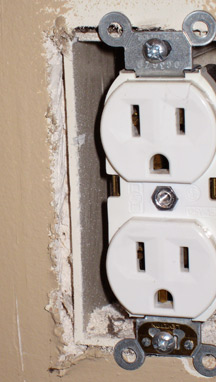
 Many homes feature fiberglass batt insulation that creates small gaps around electrical outlets and light switches. Along exterior walls, these gaps are prime places for air leaks that lessen the energy efficiency of your home. You can fill these gaps with small bits of fiberglass or a foam pad, but the best way to eliminate these air leaks is by spraying a foam insulator. This post will share how I insulated some electrical receptacles in my home.
Foam Insulation
Insulating outlets and switches is not that different from insulating a basement. You want to achieve a continuous envelope that prevents air leaks. Foam pads and fiberglass are better than nothing, but can’t compete with spray foam insulation. Foam has the advantage of expanding to fill all the gaps around adjacent objects.
We have some great posts about spray foam. Check out our basement insulation video and spray foam R-values to learn more.
Seal Air Leaks with DAPtex Plus
For this project, DAPtex Plus is exactly what you want to use. It can be used around windows, doors, ducts, pipes, and more. This latex foam comes in a pressurized can with a straw that attaches to the nozzle. The straw enables you to foam tight spaces like the outside perimeter of electrical receptacles. DAP was kind enough to send me a sample to better insulate my home.
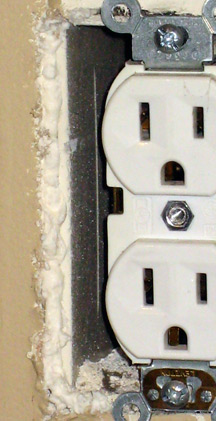
How to Insulate Electric Outlets / Receptacles
Please note: under no circumstance is latex foam to be applied in the interior of an electrical switch, outlet box or any other electrical fixture/device.
Exterior Wall
Begin by locating outlets, switches and other electric fixtures that are mounted on exterior walls. One 12 oz. can of DAPtex Plus yeilds a 1/4″ bead for 510 feet. That translates into a lot of outlets.
Prep
Turn off the appropriate breaker and double check to ensure the power is off. Remove the cover and clean away any dirt or debris (like pieces of drywall).
Application
Spray the foam along the outside of the fixture looking for gaps in insulation. Fill voids to 90% capacity and let the foam expand the additional 10%. DAPtex Plus is toolable while wet so you can mold it in place.
Clean up
Remove any excess, uncured foam with soapy water. Cured foam can be scraped away.
Curing
Foam will be fully cured in about 24 hours and have a sponge-like consistency. After it’s fully cured, replace the cover.
What do you think? Have you detected air leaks around electric outlets?










I am a much bigger fan of DAP foam products than I am of Great Stuff.
DAP is much easier to use, in my opinion. Have you guys compared the two?
Is this better than using the foam insulation inserts in electrical outlets?
@ckstevenson, I think this will make a much better seal, and thereby, better insulate than foam inserts.
Can I use the DAPtex Plus foam on the inside of electrical outlets and light switch boxes? I want to seal the the wires pass through the boxes. Thanks for your help.
@Frank, I’m not expert but I’d advise not using any sort of product like this inside the box. I don’t think it’s safe or up to code.
Ethan and Frank, you cannot use any insulation inside the electrical box as the wiring requires room for heat disipation when in use. As the outlet is being used the wiring created heat due to the electrical load, the space around helps with cooling. If you find that there is still air coming from the outlet through the holes (plug holes) I suggest the child caps while it is not in use.
I have outlets that have some kind of plate that blocks the air flow from the actual plug holes and “moves” whenever you plug something in. However, I have noticed they can be a pain because they can make it difficult to force a plug in and sometimes just won’t budge at all. Do you have any experience or advice with these?
Hi Daniel,
Those plates are not for blocking air-flow but rather as a safety precaution to prevent kids from putting things into the socket. I’ve seen them on power strip and retrofit covers. They can be frustrating to operate and that’s part of the reason I don’t use them.
Those receptacles with built-in child-proof ‘plates’ are now required by the electrical code. Yes, it makes harder to actually use the outlet, but it prevents accidental fires.
While speaking of child-proof “plates: I worked in an area of a hospital where I thought it would be wise to place those single, insertable “plugs” into each individual outlet. The maintenance guys had a fit- said the tips often broke off in there, requiring the outlet to be replaced. Guess I’d rather have them do that than someone have to do CPR on a child. The child-proof plate outlets would solve that, and would be a good idea to place in any waiting room where kids frequent.
found this old piece in relation to today’s post. I think I will look into doing this on a small scale, i.e. my exterior wall off the kitchen and dining room. It seems to be one of the coldest areas of the condo in the winter.