


Running a new electric circuit is a pretty simple task that can be accomplished with a little bit of effort, care, and the right tools.
This article is focused on running a new circuit for light fixtures or outlets. The same principals apply to all 110V circuits, and slightly modified instructions can be used for 240v circuits.
Tools & Materials Required to Run a New Circuit
- Wire strippers.
- Pliers or wire cutters.
- 14/2 or 12/2 Romex wire in the length required (see below).
- Electrical boxes.
- Receptacles.
- Wire staples.
- Hammer.
- Phillips and flat head screwdrivers.
Electric Code & Regulation Concerns for Running a Circuit from the Breaker Panel

To meet code in most areas you must obtain a permit and have your work inspected by the local electric inspector. In some jurisdictions you can only perform this work if you are a licensed electrician, even if the work is in your own home. Check your local government’s web site for details.
Almost all jurisdictions enforce either the 2005 or 2008 National Electric Code (NEC). You can read the 2005 and 2008 NEC online for free, just follow the instructions in that article for how. If you’re new to electrical work or looking for some helpful guidance, we highly recommend picking up a good instruction manual. We’re big fan’s of Stanley’s Complete Electric, a resource we regularly turn to for help that is much simpler to follow than the NEC.
Remember, only tackle jobs you are qualified to perform. And as always, if you use our instructions, you do so at your own risk.
15 or 20amp Circuit: Select the Right Wire for the Amperage
Lighting and receptacle circuits in a house are 110v, 15-amp, or 110V, 20-amp. For 15-amp circuits, 14/2 (meaning, 14 gauge, 2 conductor) Romex is appropriate. For 20-amp, 12/2 Romex is appropriate. Note that 14/2 and 12/2 wire will actually have 3 wires inside: a black, white, and ground wire. Remember, as gauges go up, the size of the wire goes down. Do not install a breaker that is too large for the wire. (E.g., do not install a 20amp breaker on 14/2 wire). This is unsafe and could lead to a fire.
For most installations, 15-amp circuits are appropriate. The code requires 20 amp circuits in kitchen appliance circuits and dedicated microwave circuits, as well as in a few other scenarios. You might choose to install a 20 amp circuit in a garage or workshop to handle additional load. Otherwise, 15 amp circuits are appropriate for lighting and outlet circuits.
Running Romex Wire for a New Circuit
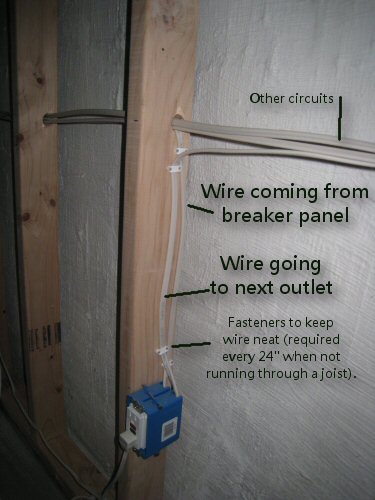
Running Romex on studs and joists is pretty simple: Start with the coil of wire at the breaker box. Run wire along side of, or through studs to the first outlet or fixture, and and then run the next strand of Romex to the next outlet or fixture, and so on. Each outlet serves two purposes: to provide power to devices plugged into that outlet, and to bridge the circuit to the next outlet in the line. Leave enough wire on the breaker panel side to run the whole length of the panel. (E.g., if the wire enters the panel at the bottom, leave enough wire to reach just above the top of the panel.)
(Note: Even though it appears that house wiring is serial, it actually is not. House wiring is always in parallel. If a house were wired in serial, current would only pass to the next outlet when a device was plugged in and running on the first. Obviously, that’s not how houses work. If this doesn’t make sense to you, don’t worry about it… it’s a question we sometimes hear.)
Here’s a picture of a typical Romex run through a single gang box. How to wire a receptacle is outside of the scope of this article, but its a pretty simple, straightforward step.
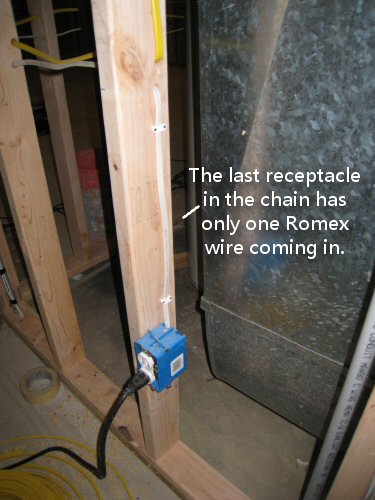
The final electric box will only have one set of Romex coming in:
How Many Outlets can be Connected to a Single Circuit?
For lighting fixtures, the limit is 80% of the amp limit of the circuit. For outlets, the limit is 8 based on the assumption of 180W per outlet; however, we recommend installing only 5-6 outlets per circuit given the higher demand of today’s appliances and electronics.
Connecting the Circuit at the Main Breaker Panel
To connect the circuit at the breaker panel, you’ll need to purchase a new compatible breaker and have at least one free space in the panel. There are several different brands of panels and corresponding breakers, so make sure you get the right one for your panel. Both Home Depot and Lowes sell the most common brands. If you don’t have any space in your electrical panel, you can replace one of the breakers with a tandem breaker that will give you an extra slot.
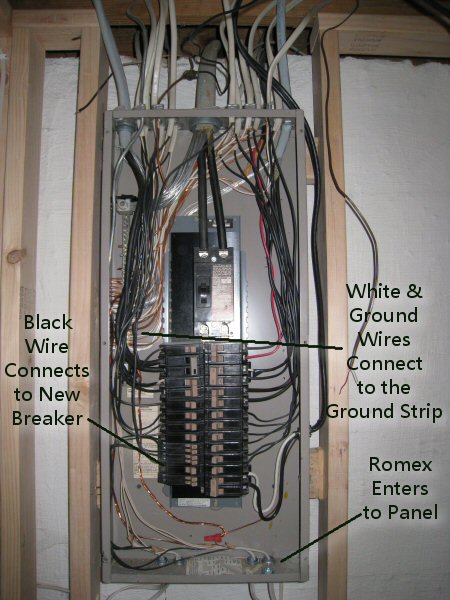
Connecting the circuit to the panel is simple. Remove the front cover of the panel. Remove one of the knock-outs and install a cable clamp in the knock-out to keep tension off the wire. White and ground wires are stripped and connected to the grounding bus, and the black wire is connected to the breaker (usually, via a screw). In most panels, the breaker simply pushes into place, making contact with the hot strip in the back of the panel. Make sure the breaker is turned off before connecting it.
Note: We recommend you turn off the main breaker to the house (the big one, at the top) while installing a new breaker. If you don’t, the two center bars in the back will be energized with enough current to kill you. Note that even when you turn off the main breaker, the screws at the top of the main breaker and the exposed wire coming in are still energized.
Testing a New Circuit
After you snap in the breaker, ensure your work is clean and double check your wiring. When you’re confident everything is set, turn on the breaker and test your new circuit using a circuit analyzer or professional multimeter (review).
What do you think? Have you ever run a new circuit? Let us know about your experience.










Thanks! We’ll be doing a lot of this soon at the Stone House.
You’re most welcome! I hope lots of folks find it useful.
Can you run a 12/2 wire from the panel box to the outlets or switches and the run 14/2 wire off of the outlets or switches to other outlets or lights on a 15 amp breaker?
Why? You shouldn’t mix wire sizes in a circuit. There’s nothing to be gained, since the whole circuit is limited by the 15A breaker, and as someone else said, in the future someone might see the 12/2 in the box and assume it’s a 20A circuit, and then you have a dangerous situation, with 14 ga. wire on a 20A breaker.
Edward, I don’t know that there’s any regulation that would prohibit this (using lower gauge wire for part of a run)… One concern, of course, is that a future electrician decides to replace the breaker with a 20amp thinking the entire circuit is running 12/2. I would be more comfortable if the 12/2 wasn’t the wire that started in the panel…
Check out the 2008 NEC for a better answer. (There’s a link up towards the top of the article).
I just watched a show on HGTV with a guy named Mike. As a part of a remodel, he found a panel with most of the romex feeders coming into the side of the panel, but about four were coming in the top. He and two electricians said those wires at the top needed to be moved to the side.
What code was he talking about. I’ve never heard anything like that. Am I missing something?
How far can you safely run a new line? I need to move my welder to my garage, probably 100′ from my current 240 recepticle, in the utility room. I am thinking that I will need another smaller breaker box on the other end to be safe, but what guage wire, and is this too far? I am asking about the distance, because I have always been told that too long of an extension cord would cause a loss of voltage.
Mike, that question’s going to need to be fielded by a qualified electrician. Unfortunately, it’s beyond us here. You could try http://www.ezdiyelectricity.com/ for an answer maybe.
Can I run stranded wire #10 gauge from control panel with 20 amp breaker since the wires already there maybe left by the electrician under the house 4ft high. Then I have to put the junction box at the end because I plan to extend with solid wire #12-2 gauge that run into my Japanese tea house from the backyard with 3 outlet and one light. The out let maybe will have to use mostly laptops, electronics gadget and electric heather (oil). Thank you!
Nothing in the code would prevent you from using a thicker wire than is required for part of a run…. You get into trouble when you do the opposite – running a thinner wire than is required. The load you describe seems well within the rules for a 20amp breaker and 12/2. Note that I am not an electrician-you should follow the code for your area for all your work.
Having an electrical background ( simple!), I found your instructions to be very helpful for the average homeowner. Thanks for your emphasis on safety.
When running 12-2 wire from my house to a garage for just 3 lights and 3 outlets using 110 volts, can I use a Square D QO service panel for the 110 volts circuit breakers? Thank you.
I recently had to rerun a wire for my dryer in order to get a grounded wire to my outlet and my dad gave me one great piece of advice. When you put the circuit breaker into the box, keep one hand in your pocket. The thought is that you won’t accidentally grab two poles and connect the circuit with your body. I took it one step further and wore insulated gloves. The last piece of advice I have is take your time. Trying to go quickly is a recipe for disaster.
How low can I run a wire thruough a wall. Reason I am asking is I drilled a hole through a new stud wall to go under the outlets (6″ off subfloor) and run up to each one. Want to make sure I am not doing anything that I will fail for. Thanks in advance for your response.
Brian, you should be able to find code limits for cable length, but I’ve never seen this as a problem in most regular-sized homes on a reasonable circuit. I would think the limit is greater than 250 ft., but I am not sure.
Even though I have the main switch off in the panel box can I hook the white wire up to neutral to the bar that isn’t hot is it
I was wondering how many 12-3 conductors can be used in one staple. It is my understanding that it depends on the size of staple and manufactures recommendations. the only thing on this subject I could find in the NEC was on 334.30
One thing to note, if wiring the circuit to a sub panel, ground and neutral must be on their respective bus bars. Only in the main panel can they be mingled.
Jeff – good add. I have this in the article linked on “main breaker panel” but not here. If you are working in a subpanel you have to keep neutral and ground on separate buses.
I just had the power company run new service to my shop. I had an electrician wire my breaker box but I am installing the circuits. Are you saying that in the main breaker panel, I can run both the white (neutral) and ground wires to either or the same bus bar? I thought the white had to go to the common bar and the ground wires to the other.
Nice tutorial. keep up the good work.
Muchas Gracias!
Thanks. I always like how clear you make these. On a somewhat related but different note, an awesome (read: useful to me) article would involve an explanation of how to add a second switch to an already existing bank of lights. I use my bulkhead often, but when I exit through it I have to either leave the basement lights on, or fumble around in the dark for a little to open it. Any easy fixes here (other than to call an electrician?)
You have a few options. On the “easiest” front, simply replace the switch with one that uses a remote in addition to the switch, then just velcro the remote somewhere more convenient (or sit it in a place more convenient). These switches usually run around $30 or so at the big boxes. (Obviously, you could do home automation solutions too – but these are going to get very pricey).
On the more elaborate side, you can convert the switch to a three way switch. We haven’t done an article on that, but it’s not too hard. There are two ways to wire a standard switch, and each of these two ways has a way to modify it into a 3-way switch, but that involves running romex through the wall to another switch location – not always the easiest solution if the drywall is already up.
Jeff Williams might have some additional thoughts on this too – he always seem good for ideas on this type of thing. We’ll add this to the list of projects we might do an article on.
There’s a great Family Handyman article that explains it (with diagrams) way better than I ever could. Basically you have to run three wire from the existing switch location to the new switch location. http://www.familyhandyman.com/DIY-Projects/Electrical/Switch/how-to-wire-a-threeway-switch/Step-By-Step
You guys always have very helpfull info. How far back can I go to find articles I might need in the future.
You can look through our stable of “How To” categories linked at the top of every page.
Hmm I wish these would come through my reader so I would see them. I think the rrposts don’t (at least not in Google Reader anyway).
But this is a seriously helpful article. I’m just about to close on a house and I see a few places where I’ll need to do some work like this. Hopefully with a great article like this (and an engineering friend) I can do it myself!
Glad to find this post! I’ve found that 2013 must be the year of needing more power…The garage/workshop is first on the list and I will definitely be revisiting to make sure I’m not skipping over any steps! Thanks Fred!
Why does my main breaker keep flipping…it runs an outside outlet and the bathroom. Which I do not have anything plugged in.
Brenda, most likely you have a short circuit somewhere in the line. This means a hot wire is touching the neutral or ground wire, or it’s touching something connected to ground (for example, a metal box). You should definitely get an electrician out to examine this, and in the meantime, you should leave the breaker off. Whatever you do, you definitely should not try to “tape” or otherwise hold the breaker in the on position … that is a recipe for a fire.
I need a GFI outlet on the exterior wall of my house directly below the main breaker box to our single-family home, for the exclusive purpose of plugging in a string of low-voltage lights in one portion of my front yard planting area (5 lights tops, including 1 spot for our flag) and nte 25′ in length from the panel. ??? – Is it legal and possible to make a connection directly into the main breaker box, tapping into one of the home’s existing lighting circuits to give me an outlet on the exterior wall of my home? I’m not an electrician, so I may be saying this incorrectly, but I’m trying to find a way to accomplish this small project. I won’t be doing the work, and will be hiring a local contractor to do it for me.
Hi Don,
While it can work to do what you suggest, it is definitely not to code… You need to add another breaker to the box and run the wire from there. Might be best to hire an electrician who can do this for you.
I want to run a 220 line outside. Do I have to run through a knockout,and down through the floor,or can it be run through the back of the panel and wall?
I plan on using Carlon NM sch.40 conduit,, “LB” conduit body,and straps.
I need to know if itwould meet code.
I’m running a 12/2 wire in my garage for my outlets. When going from the panel /main in my house which is about 75′ can I use 12/2 or do I go to 10/2? I’m also putting in a subpanel in the garage
Hello. I have two mobile homes attached to one another- not a married double wide but two separate now forming one large one. ISSUE: I need to have the junction boxes from the rear home (1970 model year with all 14/2 wiring) hooked directly into my new 200amp/40slot breaker box in the front newer home. The older home has 5 hot jct boxes and will be taking up five 15-amp breakers in the new box. The old 60-amp breaker box/lead wires from the underbelly have got to go due to age and the unknown. QUESTION: should I connect the jct boxes directly to the new 200amp box using 14/2 or 12/2 romex to the new 15 amp breakers? The longest run should be no longer than 70 feet, at best. NOTE, only lights and receptacles will be used in the older home and nothing besides a fan or lights will be used on the existing wall 14/2 wires. However, I will be having 3 dedicated 12/2 20-amp dedicated receptacles placed for uses such as portable a/c, heating, etc. Thanks so much. Sorry so long…
I’m sorry. Never used a forum before. Is this the wrong place to have asked this?
i have a short in a lighting circuit
I have a switch that powers on an outlet when you walk into the room, but I want that same switch to power a ceiling light. …Can I Just connect to the switch via piggy tails or do I have to rewire the outlet? ….Our just run a new circuit?
Regards
Alex
I have a barn with a separate breaker box. All breaker switches (5) are 20 amp. I need to run another breaker & wire from the barn to my horse troughs (2) outside. Each trough will have a 1500 watt water heater within it. 1500 watts draws 12.5 amps, SO, can i place a 30 amp breaker switch within the same box with all the rest of the 20 amp breakers??? My electric is 240 running from the house (i believe) to the barn breaker box. Also, should i use a GFCI Breaker??? Also, what size wire should I use.
Thanks,
I am trying to replace an older model and no longer made light/heater/exhaust fan in my bathroom with a newer version. The wiring to the switch control older model fixture is 12/2 Romex (one black wire, one white wire, and one ground wire) that continues to the older model fixture to be replaced. The newer model requires 12/3 Romex and a new switch control. I understand how to connect the 12/3 Romex wire (one white wire, one black wire, one red wire, and one ground wire) to the new fixture and the new switch control. My question is how do I connect the 12/2 Romex wire to this switch control, or can I do it?
Connect black from 2 wire to heat, and white to neutral for heat, 3 wire – black to vent, red to light, white grabs the rest of the neutrals, all grounds tie together, if all on the same circuit the neutrals all tie in the switch box. Some electricians run the heat on a seperate circuit, i like to if my panel will hold it
It’s been a while since went to school and learned basic electricity but unless the terminology has changed, I believe the terms for electrical circuits – you mentioned when explaining how they are in houses – is in SERIES or in parallel. Not in serial. Please let me know if that has changed and you know I’m not correct.
I am adding a bedroom in my finish basement. Do I need GF circuits for that bedroom because it is in the basement?
Also do I have to pay attention to the way I connect to the black and white wires to outlets?
Thanks
I am installing a new electric water heater in my camper. I already have a 12/2 wire running to the breaker box inside, but need it to be just a little bit longer. Do I need to replace the whole wire or can I safely connect to the existing one?
I had all my 12 volt lights working and so I had to put on sheet rock. I disconnected the breaker wire and put them back the exact same way. Now none of my lights work. I checked the closest light to make sure all the wires were still connecting and that I didn’t pull to hard an disconnect any wire. There all still conected but I’m not getting power to my lights can you tell me why.
Hi,I have recently moved into our new spot in ca and I’m using my motor home in a spot at my friends house the pole where I’m getting my electricity is doubtful at best I can’t seem to get more than ten amps from the outlet which is a 70 amp line run from the main panel, now first off is my question,does a line that’s already run through a panel grounder have to be grounded again? And #2, does it need to go through another breaker or can it just be run right from the panel breaker? Answers to these questions would really help me alot
I have a 35’x15′ addition to my manufactured home that has 12-2 Romex running from the outside service panel box to the audition and all switches and Outlets that I’m now having a problem with. I’m now having problems with circuit overload which shuts off power two switches and Outlet to the edition only I would like to know can I run 14-2 Romex from the power box outside to the audition and from there tie into 12-2 Romex and run to the switches and Outlets and will that solve my problem?
I am putting a breaker box in my shop and was planning on tapping into my breaker box in my house but it doesn’t have a place on the bottom to tie into. Is there a way I can get 220 from my house panel to my shop.
I want to put in a new fuse box and rewire the whole house. A local electrician told me to run 10-2 wire to a junction box to each room and connect the light and outlets to that. can I do this?
I am adding a new circuit to run new outlets to my garage, using 12g , the breaker box is on the opposite side of the house, I plan on running the wire out of the box in conduit to a junction box attached to the soffit where it will tie into the Romex in the attic, is this to code? I can’t find much info on getting the wire from circuit box to attic