


Editors Note: This article is from 2009 when Fred & Kim were getting ready to insulate their basement, and it’s a great review of the options they considered. If you’re thinking about insulating your basement, it’s important to make an informed decision about installing a vapor barrier, and there’s a lot of misinformation out there. After you finish reading this article about insulation options, be sure to check out the Related Content section to learn more about vapor barriers.
We’re just about ready to insulate an unfinished basement game room and this post reviews a number of options for achieving maximum efficiency in basement insulation installations. The article begins with an overview of the basement area and then provides a summary of insulation options.
Basement Wall Construction & 2×4 Wall Studs
The basement walls are constructed of stacked cinder block. The front half of the house is completely underground, while the back of the house is mostly at ground level, with a small area about 2-3 feet underground. The house has decent grading that keeps water away from the foundation, but moisture was still a problem in a few sections.
We used a combination of Super Thoroseal and SunnyDry foundation waterproofers to seal out the remaining moisture, and regraded the gardens in the front of the house. Together, the results have yielded good results, we haven’t had any moisture problems since.
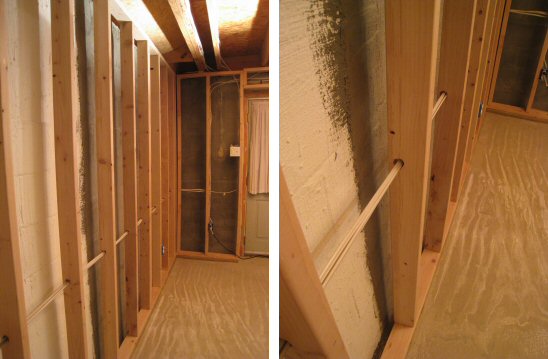
While we’ve taken precaution to ensure the wall seal is tight and that no water is leaking, we still want an insulation product that is mold resistant, since I have a lingering fear that moisture could seep back in at some point in the future (say, due to settling of the foundation and a break in the seal).
We framed the basement walls using traditional 2×4 stud walls fastened to a pressure treated 2×4 bottom board. We briefly considered metal stud framing, but still like the solidity and rigidity of wood, so we stuck with what we knew. The walls are not fastened to the cinder block (as that would penetrate the water tight seal). Instead, the walls are fastened to the joists above, and we used powder charge nailer to fasten the bottom board in place.
We left about a 1 inch gap between the cinder block and the stud wall to provide extra space for wall insulation, figuring we’d need that to get maximum efficiency.
R-13 Fiberglass Basement Wall Insulation
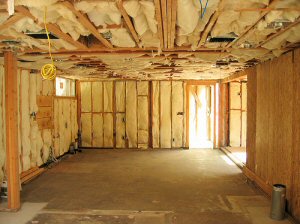 The first option up for consideration is fiberglass batting: the traditional R13 pink fiberglass available at the big box store.
Fiberglass Pros: Fiberglass is good because it’s relatively cheap; it doesn’t require any special installation tools; it can be brought to the house using a standard pickup truck; and, it can be installed by hand in a single day.
Fiberglass Cons: The drawback of fiberglass is that it doesn’t provide great R-value (about R3 / inch), and it can be susceptible to mold with unfavorable moisture conditions. Fiberglass is considered a mold resistant product; however we’ve seen several instances of molding fiberglass batting, including the fiberglass we removed from this basement when we started working it. Fiberglass also doesn’t fill every nook and cranny of the walls, leaving gaps for air to circulate, which ultimately contributes to energy loss. These air gaps are not considered in the reported R value of the insulation, making the effective R value much lower.
We ultimately decided against fiberglass because we’ve had a pretty significant draft in the basement and even with fiberglass installed, this draft will still be leaching energy from the room.
Wet Cellulose Wall Insulation
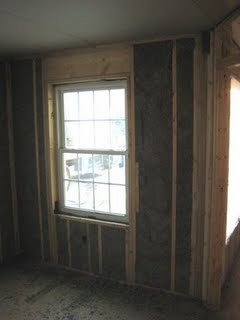 The second option up for consideration is wet cellulose insulation. We looked at products like NuWool Wall Seal Insulation, a sprayed-in wet cellulose insulation.
Wet Cellulose Pros: Wet cellulose is a sticky cellulose product sprayed into the stud walls. The R-value is slightly higher than fiberglass at about R4 / inch. The main advantage of wet cellulose over fiberglass is it’s ability to fill the cracks and voids that fiberglass batting leaves open, providing a much tighter building envelope. It has a number of other advantages including being highly fire resistant and eco-friendly. It Provides a slightly more cost-effective solution than spray foam products, but does not offer as tight a seal.
Wet Cellulose Cons: Higher cost than fiberglass (but worth it considering the added insulation value and energy savings); requires special installation tools and entails a somewhat “messy” installation. Would be best performed by a contractor, although DIY kits are available and we considered these. Cellulose is mold resistant but still susceptible to mold in the least ideal environments.
We decided against wet cellulose insulation because spray foam offered a better alternative. If you’re looking for cellulose installation instructions, Todd provides them at that link.
Spray Foam Insulation: Open Cell Insulation
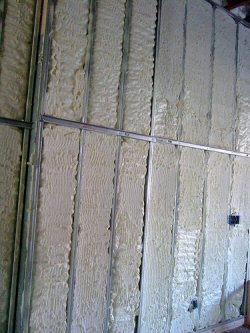 The third and fourth options up for consideration are spray foam insulation products. I’m starting with open cell insulation because it’s less expensive and not the option we ultimately chose. That said, open cell insulation is a good product that can be very cost efficient for many installations.
Open cell spray foam insulation is a chemical product that is sprayed onto the wall and then expands to fill the space. The term Open Cell refers to the cell structure of the resulting foam, which cures to a sponge-like material with millions of tiny open bubbles. The consistency is similar to angel food cake. The chemicals are mixed on site using a special compressor and gun system. The compressor may heat the foam to a required temperature. When sprayed on the walls, the foam sticks and expands in place.
Open Cell Foam Pros: Open cell foam is sprayed in place and expands to fill the space. It creates a better seal that spray cellulose and provides a comparable R-value in most installations (about R4, slightly higher than fiberglass). Spray foam is nice because it can be sprayed blindly into a cavity and will fill the space of that cavity.
Open cell foam expands to 100 times its spray-on size, making it extremely good for filling voids and relatively cost efficient. It is also nice because it stays somewhat flexible, which is good for ensuring flat drywall installation.
Open Cell Foam Cons: Open cell foam does not provide as tight a seal as closed sell foam because the bubbles are broken and it is easier for air to flow between the cells. Unlike closed cell foam products, open-cell foam products are generally filled with air. Closed cell products can be filled with a chemical that is much less efficient at transferring heat that air, leading to greater energy efficiency. Also, closed cell products can nearly double the insulation performance of open cell products.
Closed Cell Spray Foam Insulation (Selected Option)
Closed cell spray foam is very similar to its open cell counterpart, with the exception that the bubbles in closed cell foam are ‘closed’ and so do not permit any air flow. You can think of closed cell foam as a very tight honeycomb of closed cells that are waterproof and air tight.
Closed cell foam can come in a range of different cured hardnesses, all the way up to foam that can support human weight. Closed cell spray foams can also be designed so that they cure with bubbles filled with non-air chemicals that improve energy efficiency.
Closed Cell Foam Pros: Closed cell foams offer very high R-values (R7.5 per inch!). Closed cell foam completes the building envelope and tightly seals gaps to prevent air flow. Closed cell foam is highly mold resistant and also provides a vapor barrier for the installation.
Closed Cell Foam Cons: Best performed by a professional installer, although DIY kits do exist. Significantly higher price than fiberglass, but offers a superior seal.
Recommended Method
While closed cell spray foam is slightly more expensive than other methods, it offers high R-value with the best mold resistance. Given that we’ve invested thousands of dollars in radiant floor heating, we believe that the higher cost is justified and would recommend this method.
We’re currently working with a contractor to price the job, and to share all the details with you!
Alternative Insulation Methods
There are more insulation options than what we’ve listed here, including hybrid installations (e.g., closed cell foam topped with fiberglass), and installations of rigid foam board, etc. We’ve covered all the common options here; and hope you find it a good reference.
What do you think? Got a question? Leave it in the comments… or tell us what insulation you choose for your house…
(photo credits: fiberglass insulation by ann-dabney; wet cellulose by todd; spray foam insulation by el diablo robotico)










I went through a similar process as well, looking at fiberglass, a combination of rigid foam and fiberglass, and spray foam, and ultimately went with the closed-cell spray foam. Blog details here: http://gregmaclellan.com/blog/basement-insulation/
Rigid foam and fiberglass was my next choice though. The biggest problem (for me, anyways) was that the walls have to be flat, and you need to glue the rigid insulation to the walls to ensure there are no air gaps which could allow moisture to form. Generally you put the rigid foam on the walls, 1 to 2″ thick, then frame 2×4 studs (or 2×6, if you want more insulation), and put fiberglass batts in the stud cavities. This helps to insulate the studs themselves, as if you have the studs against the concrete directly, they may transfer heat, partially bypassing your insulation.
Good choice going with the closed cell spray foam. While your walls are smooth and sealed, as you mentioned, if your foundation gets a crack, you’ll have moisture coming in. That is the case in our 80 year old home. Someone had sealed up the walls at one point, but cracks in the foundation opened up and moisture started to seep in. Spray foam is about the only solution that can handle a bit of expansion and contraction without cracking. Any other solution would work fine now, but not likely 20+ years from now.
I have seen many people chose to use closed cell option. But I’m wondering what do you do with the wall w/plumbing?? Any specific instruction for that?
For example, we have a laundry room to finish. This laundry room has utility sink, washer & dryer, and mini kitchen. Since it’s located to the corner of our house, we need to insulate 2 walls covered with plumbing and electrical wires.
We are thinking Rigit form for this location. What do you think based on what you research?
c – for plumbing and around access points, we’ll stop the foam and use traditional fiberglass insulation to fill these spots. You never want to insulate pipes away from the room (such that they hug the exterior wall), as they will freeze during the winter. Instead, we’ll use loose fiberglass batting between the pipes and the exterior walls.
Greg – excellent point about rigid foam requiring smooth walls. We couldn’t think of a great way to securely fasten the foam in a manner we were sure would hold… so the closed cell option is great for us. All in all, I think closed cell foam is the wave of the future… it’s the most mold resistance, high-R value option that completely seals the space – you can’t ask for much more than that.
Great job Fred! Basements are by far the hardest place in a house to insulate due to the moisture that’s trapped in concrete and block walls. I’m very eager to see your finished product and hear all about the foam installation. Spray foam is certainly the top option for basements!
I had one exterior wall that had plumbing in it, and to deal with it, I framed that section of wall about 1″ farther out from the concrete than everywhere else. The spray foam guys simply sprayed behind it, and the plumbing is still all accessible. It was really no problem at all. The pipes have a tiny bit of “splash” from the foam on them, but you could still work on them if needed.
I actually did all my plumbing and wiring before the foam, and except for getting foam on some of the receptacle boxes, I could have fairly easily done it afterwords. In fact I did run a couple extra network and cable lines after the foam went in. Especially near the bottom, it doesn’t come all the way to the front of the studs (in fact, probably only about 1/3 to 2/3 of the way, bottom to top, in my case).
You of course will want to check with your installer first, if you plan on doing that, as if they use a higher-expanding foam or are putting in in thicker it could be an issue.
Greg – took a look at your pictures… how thick do you have them put the foam on? You’re right – its only about 1/3-2/3 of the way out to the joists. Are you planning to fill the rest of the gap with fiberglass?
I’m currently debating how much foam we want to put in. Our installer is recommending no more than 2.5 inches for underground areas, and up to 3.5 inches for above ground areas. The R value of the foam we’ll likely use is ~6.5, vice the 7.5 I cited in the article.
Fred: For the foam we installed, we went the economical route of having them put on 1 inch of foam spray to seal up the concrete (plus add around R-7 of insulation), and then put up the fiberglass as you mentioned. We simply couldn’t afford putting in 3+ inches of the stuff. Plus, R-25 for foam vs R-18 for foam + fiberglass just isn’t that big of a different in the basement where the majority of the ground never gets colder than 50* anyways. On a second floor exterior wall, any sane person would welcome that extra R-7 however 🙂
Fred: Nope, I just left it as-is, and put drywall up. It’s approx R-20 at the top, and less as it goes down to the bottom. It’s been -15 C outside here, and the basement is actually warmer than the upstairs now – anecdotal, yes, but it is definitely ‘enough’.
Probably one other thing to note as well – when you use closed (and I think open?) cell insulation, the building codes (here in Ontario anyways) state it has to be covered with a ‘thermal barrier’ (which can be drywall). Basically, you can’t have it exposed because it can release hazardous smoke if it’s burned. Apparently the newer stuff they use now doesn’t do this, or at least as much (I didn’t get a totally straight answer from the couple people I asked), but the building codes of course have not totally kept up with the technology.
Thanks for the feedback – glad to know your basement is cozy. I think we’ll stay on the conservative side for cost purposes, rather than ‘overdoing it’ Also good to know about the toxic potential during a fire… Our wall will indeed be covered with drywall so we should be in good shape.
Hmmm. In investigating my basement project I’m finding that it is suggested to keep studs away from the foundation so there is ample air circulation once your walls are up. Therefore I don’t plan on using insulation as I fear this will block the ability of air circulation. This being important in basements where dampness is usually nature of the beast. I also understand if using an insulation with a vapor barrier (kraft paper), it is suggested to slit the barrior with a utility blade. I did my old home with a vapor barrier, and there were signs of a bit of a moisture issue which eventually developed. I was going to seal everything with a waterproofing sealant, but may not since my new basement appears pretty dry for a basement.
I also noticed with my prev basement. The duct runs were keeping a nice temp year round since there is some percentage loss of hot air/heat, cool air/ac throughout the duct work. Plus the furnace was somewhat exposed as well.
David: you have it VERY wrong. What you want to avoid is (warm) inside air touching cold surfaces (eg, concrete): that is when condensation forms, and then you get moisture problems in behind your walls. You either need to use a vapour barrier to keep the inside air separate from the air in the insulation (eg, in the case of fiberglass batt insulation), or use a solid insulation like rigid or closed-cell spray foam.
Check out http://www.buildingscience.com/documents/information-sheets/5-thermal-control/basement-insulation/ :
> Basement walls should be insulated with non-water sensitive insulation that prevents interior air from contacting cold basement surfaces—the concrete structural elements and the rim joist framing. Allowing interior air (that is usually full of moisture, especially in the humid summer months) to touch cold surfaces will cause condensation and wetting, rather than the desired drying.
Another problem altogether is when there is water entering your basement, through cracks or other means – that needs to be taken care of first, before you start worrying about insulation and vapour barriers.
Greg – took the words right out of my mouth… Excellent addition to this post and thanks for the good reference.
Well, I understand what you all are stating. I would quickly agree if not for a concrete basement/foundation wall in the equation. What about allowing the foundation walls to breath? What I was told by several is a need to allow the moisture which is inherent to most any concrete basement wall a way of escaping. And that putting up a vapor barrier will ‘trap’ this moisture behind the wall. Does this not make any bit of sense? It does to me. They say you need to allow air circulation by keeping studs at least 1″ away from the foundation wall, and no vapor barrier/lock. This is to allow the inherent moisture a means to escape. Anyone out there with maybe ten or so years of having done their basement, and their experience? I would really Iike to hear of their experience(s).
OK. I read through the info in the link. It makes some sense now as they do state the insulation must be semi- permiable, or semi-impermiable to allow inward drying. Knowing this, it makes more sense. It isn’t a true vapor barrier which was the point that I had trouble with. Thus the slicing of any kraft paper barrier. This is great info to read before doing a basement.
Thanks for breaking down your insulation choices but did you ever consider other natural fibers such as cotton or recycled denim insulation?
In regards to the spray foam did you go with Icynene? It’s water-blown and produces no off-gases.
Hey Timothy,
Truth be told, we didn’t consider cotton or recycled jeans (although Ethan wrote an article about the jean insulation on this blog some time ago)…
We actually went with closed cell spray foam because of the superior R value and the ability to better block air flow. As for the Lcynene, that’s a great question I will ask our installer. He mentioned that all of the products they use are “green.”
We’re planning to keep the family out of the house for the installation, but Ethan and I will be sticking around with gas masks and jump suits to film the installation… Video should be awesome.
Hi there, I am trying to figure out if the walls in my room actually have insulation. Does a tool exsist that can check the wall for insulation? Or is there a way for me to check without actually looking inside the wall? I’m thinking of something like a stud finder, but for insulation.
I swear my room lacking it somewhere because it is so increadibly hot when the rest of the house is fine.
I’d appreciate any help, or direction if you could steer me there. Thanks!
Spray from will not combat moisture infiltration through a wall crack nomatter how minor. We specified exactly this on a commercial basement renovation and ended up with a mould related lawsuit. The hydrostatic waterpressure from even the most minor infiltration creates a cavity between the concrete and the foam. Due to the closed cell nature of the foam the concrete can’t breathe or dry out resulting in mould, it just takes longer for the symptoms to present themselves.
Wow. Better leave that cavity for air to circulate. I am looking to use rock-wool, sometimes referred as mineral wool. For it’s density & moisture resistance. Sound isolation is a priority as well.
There is no good way to leave a cavity between the raw concrete surface and an interior insulation. Air will get in that space and thus condensation. The best bet is to seal foam up against the foundation as tight as possible and seal all edges. If using closed-cell, there is no consensus–even on buildingscience.com–about how thick to go with that foam. A minimum of 1″ XPS (extruded) is recommended pretty much everywhere. As you get thicker you lose drying ability, but many sources cite 2″ is fine. Expanded foam dries much more aggressively but has less R value and moisture, if excessive, can lower its R further.
A good compromise I believe is 1.5″ of XPS foam tight against the foundation, sealed top and bottom and then a stud wall built inside of this with at least 1/2″ gap between the stud wall and the foam surface. This way air (hopefully dehumidified) can move in behind the wall between the foam and the studs and assist in drying. In this manner you really ought to have no mold problems in the studs and drywall. If you are not draining properly at the foundation the foundation can wet and not dry properly but I’ve not come upon a good approach to keeping the foundation itself dry other than not going too excessive on closed-cell insulation.
As always, look at site drainage first. Even without any insulation if you have water hitting your walls frequently they will soak and there’s no way around that.
In the example Jay just posted on the 13th I cannot see how a cavity of any kind would have assisted. If water is coming in a basement it’s coming in, so at that point the best defense would have been an interior drain system. And if using an interior drain, buildingscience does specifically state to use 2″ XPS. Then water hitting the back of the foam will drain into the floor.
I have an open interior drain that is damp most of the year since it will feed moisture to the sump pump as designed. Sump pump works well for 20 years in dealing with water in heavy rains. Never had any serious water threat in basement.
I envision a stud wall along the 2-inch perimeter drain similar to what is shown in the first pictures above. I’ve been advised to attach 2-inch foam board to block wall and use use 6-mil vapor barrier on lower 2 feet of wall and over drain and under base plate. Stud wall would be up against the 2-inch foam board. How should I fill stud cavities ? Batts sound like bad idea.
Hi jgodfrey–
Batting could work just fine – our buddy todd over at Home Construction Improvement provides details on how to insulate basement walls using a foam board/batting combination. Check out this link: foam insulation for basements
You could also skip the polystyrene foam and have a pro install closed cell foam like we did. Much better results.
jgodfrey – correction, I did not read your post thoroughly – closed cell with be a problem with the interior drain. polyethylene at the base + polystyrene up against the wall + batting is probably your best option.
” closed cell with be a problem with the interior drain.”
Perhaps I don’t understand properly, why is this? I should note that I have an interior drain in my basement with 1/2″ gap around all walls where they would otherwise meet the slab. Under this is gravel that feeds a sump. One of building science’s articles specifically says that in case of an interior drain that 2″ XPS is a good idea because it knows that once moisture hits serious levels it will simply drip down into the drain and underneath anyway.
Or are you quite literally talking about an interior drain in the middle of the room or something?
Jenkins; Fred:
To clarify: Not sure what closed cell means. The interior drain in my basement has 2″ gap around all walls where they would otherwise meet the slab. This is damp most the year; one drain hole in a block at the far end and one other will feed water (from heavy rains) into the 2-inch perimeter drain that goes to the sump; however because there’s no serious external drainage problem, water from two holes just sinks into the gravel below without causing perimeter space (drain) to fill with any serious water. The sump pump seems to handle the water table increase fine. Thanks.
Jenkins-I’ll be the first to admit I have little experience in this situation; however, I would be loath to install closed cell over an interior drain like this. Closed cell hardens like a rock and is difficult to remove. If you end up with a problem with the drain you have a terrible mess and no access points. Plus, I am a bit wary of trapping moisture between the closed cell and the wall. Exterior moisture-infiltration problems should be fixed prior to installing insulation.
I suppose if you are willing to permanently limit access to the drain, then closed cell is an option.
Example I remember seeing (not sure on what show it was) compared several cups (Coffee mug, paper cup, glass cup, and thin closed cell cup) with each holding hot liquid – the foam cup had the coldest surface temperature. Same cups were later used to hold ice water. Foam cup was only one without condensation on the outside.
When it comes to dealing with moisture/condensation issues in a basement I am pretty confident that using closed cell will yield significantly better results.
It pains me as I am a cost effective DIYer who would much rather install fiberglass bats – but I would rather finish my basement once and believe it will cost less to do it right once rather than dealing with mold, moldy materials, ill health, etc etc if I cut corners this time around.
My basement has not leaked in 3 years but I cannot predict the future. I am sold on closed cell and believe the end results and long term performance will offset any added costs. While not being able to DIY it will be a blows to the pride – it would be a bigger hit having to redo it in a few years!!)
I have a question regarding basement walls. I have a finished basement with a poured concrete foundation, batt insulation and drywall. The batt insulation is wet against the poured concrete. Is this from condensation? I bought the house three years ago and pulled out soaking wet batt insulation from the basement walls – am I heading in that direction again?
Thanks!
Jamie-
Yes, I think that would be your best option. After you remove the drywall and insulation, check for any mold issues. If you can remove the metal or wood studs easily, this would make installing the liner easier and give it a better seal. Once you remove the studs, place the liner along the top of the walls length wise. The liner comes in only 4′ or 6′ wide so a second row will be needed. Tape all seams and seal the top edge. Replace the studs, new insulation (if you want it) and drywall. The liner will prevent the insulation from getting wet. Any water that seeps in or condensation that forms will run down the wall to the floor and then to the sump pit. You may want to seal the floor with the liner as well, forcing any water that seeps in to stay trapped under the liner until it finds its way to the sump pit. This would help prevent wall and floor damage.
If you have any more questions just let me know.
It seems to me likely that Jamie’s issue is in fact water from the foundation, not condensation. A batt tight against the wall is going to substantially limit air movement, so if he’s still getting moisture there’s a good chance water is coming in. I do know that at least one local town as recommendations similar to Eugene’s about some water-impervious membrane against the foundation wall.
The issue is that although this will stop water (e.g. that coming from foundation), the membrane will be at the same temp as outside (due to its thinness)–at least typically–and thus any warm, moist air from inside that sneaks up to it will, on the warm side of the membrane, condense. This issue is resolved by the “magic” of foam. Not only is the foam going to be undamaged from moisture and not lose its R value as it soaks (unlike, say batt insulation–and expanded foam to a small degree ), but its hot surface on one side and cold on another is separated by a couple of inches of distance and condensation is not an issue due to the very slow nature of the heat transfer.
I’m surprised eugene’s liner has an R5, but that’s fairly high. If it does indeed have R5 it would assist with this condensing problem I mention. If you put too much insulation in front of it, though, it becomes mostly cold at the same temp, thereby introducing it again.
Regarding another post, I see no reason to insulate at all in front of 2″ of foam. R10 is good–you can check with local code but the benefits of more insulation are just not worth the money, even in a pretty cold climate.
I always wonder, for most people, how much this superior insulation approach is necessary. There are a LOT of moldy basements but there are a LOT of unmoldly ones, too–even just using batts and poly film. Site drainage is absolutely a key issue here, but running a dehumidifier to keep humidity low helps hugely as well.
I couldn’t agree more with Greg, Rigid foam and fiberglass is a good choice but a more work and a flat surface is needed.
Fiberglass is brutal in a basement, it will retain that water for a long time if wet. Not to mention, it does nothing for vermin or insects. It’s also not fireproof and loses r-value the colder/wetter it gets.
In my opinion, never use fiberglass, use rockwool. Its far superior in every way, as well as being completely fireproof. Thats what they use in commercial/industrial insulating. Fiberglass is a bad joke. Its only still used because its ‘cheap’.
I used DryLoc on my basement block walls before gluing 1″ polystyrene boards and taping all the seams. I then framed my walls with a small air gap between the studs and polystyrene and used fiberglass insulation between all the studs. My basement is very comfortable during all seasons. I finished my entire basement myself, so ease of installation and costs were both priorities for me.
This method is indeed a good one, Haus. Todd over at HCI has decent instructions for this one that we really like.
I also really like Todd’s instructions at HCI – that was one of my main guides when I was insulating my basement.
Insulation?
I have studs agaist my basement walls. How do I insulate that?
I am sorry, should explain a little more . Want to finish basement . It has studs and electric ran to. The basement doesn’t get wet.
In that case of studs against wall I think you have three options:
1) Have somebody come in and spray foam. This is ideal
2) Fiberglass batt insulation between studs (like is done still to this day in most basements) with plastic sheet in front of batts
3) Fiberglass batt insulation with plastic behind
There’s some debate over options 2 and 3 which is best. You may want to check with your local town inspector to see his preference, for his may force it one way or another if you’re using a permit.
I’ve never heard of the wet cellulose stuff, before. Seems like a close call between wet cellulose and the open cell foam.
Is closed cell foam applied in the same manner as open cell (sprayed in before drywall)? I hadn’t run across this article before, thanks for the reboot!
Yeah, both installed the same way. It’s sprayed in lifts. Each lift has to cool before the next can be applied (if doing multiple).
Another thanks for the repost. It’s not really an important aspect to consider but I’m curious about how easy it is to remove the spray foams. Do they chip away? I can’t really get a grasp on what it would feel like.
That’s a good read. It’s good to read about all the options out there. Especially since just thinking about putting up fiberglass insulation again makes me itch. I can’t stand the way that stuff makes you feel.
We are considering closed cell spray foam, should this be applied directly to foundation walls prior to framing or should it be applied after framing and electrical/plumbing rough out? I’m thinking before we anything we spray it?
Dom, I would frame your wall but set it 2 inches out from the wall. Then spray. This way the foam would get behind the wall and not have any thermal bridging but you wouldn’t have to worry about shaving it off to get a uniform thickness. At a quick glance the installer would know exactly how thick he’s spraying.
For a cheaper option you could spray just the rim joist and then used 2 inch rigid insulation with taped seams on the walls. Set your framed wall up against that. You’ll have the same R-value but for a much more DIY friendly price.
Thanks Jeff, we thought of using XPS but the contractor said the cost isn’t much less once you add in material and labor. One very large insulating contractor here said to spray first forming a continuous barrier then frame, any downfall with that method that you can think of?
Thanks Jeff, we thought of using XPS but the contractor said the cost isn’t much less once you add in material and labor. One very large insulating contractor here said to spray first forming a continuous barrier then frame, any downfall with that method that you can think of?
The only downfall is if the contractor wasn’t very good at getting a uniform thickness then they might have to shave it a little if it’s really uneven after installation before plumbing up the wall. If you have a large contractor that’s done this hundreds of times then they should have no issue getting an even spray. I’m sure you’ll be fine.
The XPS option only saves money if you’re doing the install yourself.
Good luck!
[…] materials are stables of construction for finishing rooms above ground. When used in a basement, they usually do not work well. Since basements are naturally humid, all these materials absorb moisture, and when it combines […]